Curtis A. Ward | Military strike IS in Nigeria – expanding US war on terrorism in West Africa
Loading article...
-
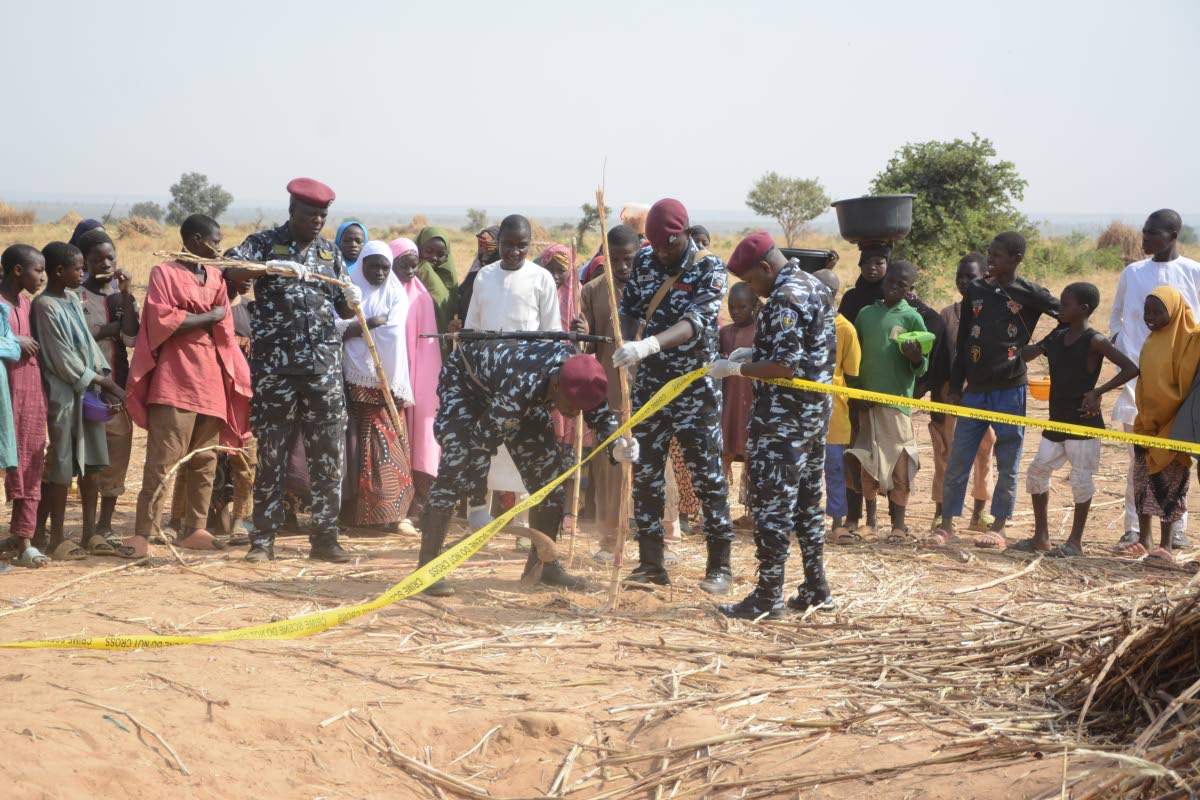 Nigeria police, Anti-Bomb squad, secure the scene of a US airstrike in Northwest, Jabo, Nigeria, Friday, December 26, 2025.
-
 Ambassador Curtis Ward
The military strike on an Islamic State (IS or ISIS) affiliate in northern Nigeria is consistent with past US actions against IS and combatting international terrorism. The timing is not relevant. And it should not be conflated with attacks on narco-traffickers in the Caribbean. There is no similarity or parallel. One important distinction is that IS is designated by the United Nations as an international terrorist organisation. The UN Security Council (UNSC) has acted, and authorised counterterrorism (CT) measures, including military actions against the terrorist organisation and its affiliates. The entire international community is obligated under UNSC resolutions to take CT action against IS. No such obligation or authority exists against narco-traffickers in the Caribbean Sea.
What this counterterrorism military operation against IS in Nigeria represents is expansion of US military response to West Africa security threats. It is taking the fight to terrorist groups in an area in which they seemed to have been acting without severe consequences. But as it has been with the exercise of the military option in combating terrorism, the use of force is not a long-term solution.
Military force has no impact on the spread of terrorist ideology. Military force reinforces it. Only targeted soft-power programmes have the potential to neutralise violent extremist ideology and reduce radicalisation and recruitment to violent extremism. There is enough evidence to support this observation and conclusion. Military operations tend to show immediate but short-term results while soft-power programmes – PVE – are far more effective in the long term.
But most importantly, the attack on IS on Nigeria’s sovereign territory was executed in cooperation with the Nigerian government and not as a unilateral military attack on Nigerian soil by the US military. This military CT operation conforms to international law and UNSC mandates. According to Nigeria government officials, the military operation was weeks in planning with a mix of Nigerian and US intelligence. The US military operation had the imprimatur of the Nigerian government.
REGIONAL THREAT
Recently, the US carried out several military strikes against IS in Syria just a few days before the Nigeria strike. Notably, the military strikes on IS in northwestern Nigeria, on Christmas day, targeted two camps of the lesser of IS presence in that country. The larger and more dangerous IS affiliate, Boko Haram, is based in the northeastern region of the country.
Nigeria has struggled for over two decades to deal with Boko Haram, its homegrown terrorist group. Considered to be among the most dangerous terrorist groups in the world, Boko Haram has been affiliated with IS since 2015.
On August 26, 2011, Boko Haram, also a UNSC designated international terrorist organisation, carried out a bomb attack on the UN headquarters in Abuja, Nigeria, killing s21 individuals and wounding several others. The terrorist organisation has killed hundreds of Nigerians as well as others in neighbouring countries in the northeast – Cameroon, Chad, and Niger.
Boko Haram’s leader, Abubakar Mohammed Shekau, pledged solidarity with Al Qaida affiliates in Afghanistan, Iraq, North Africa, Somalia, and Yemen in 2012, before switching allegiance to IS. Boko Haram and IS shared a common ideology: establishing a caliphate in all countries with a large Muslim population.
Boko Haram poses a regional threat and a threat to Western interests in the region. Many Nigerian government military and law-enforcement personnel have been killed by Boko Haram. Yet years of military operations against this terrorist group have had very little effect on its capabilities to do significant harm.
This US attack on IS in Nigeria is the first direct US military operation in Nigeria. In the past, the US government has provided intelligence, training, and other services, including sale of military equipment to the Nigerian military, but there has never been direct military engagement by US forces. It won’t be the last.
POLITICO-RELIGIOUS BALANCE
President Trump’s claim that this attack on IS is aimed at protecting Christians who are being killed disproportionately by IS in Nigeria was quickly denied by the Nigerian government. A Nigeria government spokesperson refuted the claim, denying any relationship between the military operation and religion. African countries with large Muslim populations could face significant political backlash if there is truth to President Trump’s claim. A religious-based military operation targeting the Muslim population in the region also threatens Western interests – stirring rejection of US economic, geopolitical, and security engagement in Nigeria and elsewhere in Africa.
The Nigerian government must treat this with caution for fear of upsetting the politico-religious balance in the country, which is based on sharing power between the two major religions – the population is almost evenly split between Christian and Islam. The presidency of the country has for decades rotated between members of the two religions – Islam in northern Nigeria and Christian in the south. The current president of Nigeria, Bola Ahmed Tinubu, is a Muslim. Maintaining this balance between the Christian and Islamic religions in Nigeria is a major political and security preoccupation for the country.
Whether the US strike against the IS-affiliate terrorist organisation in northwestern Nigeria is a one-off CT operation or is a precursor for extending the “war on terrorism” to other areas of West Africa where IS has a strong presence is to be determined. Given that the IS group known as Islamic State Sahel Province (ISSP) operates in Sokoto State (Nigeria) as well as in Mali, Burkina Faso, and Niger, the Christmas Day strike could be a precursor of future CT strikes in West Africa.
The US has carried out multiple military strikes against al Shabaab, an Al Qaida affiliate in Somalia in Eastern Africa. Successive US governments have actively supported CT operations against Al Shabaab but not in West Africa, where terrorist groups, including IS affiliates, pose significant threats to stability in the region.
Any of these countries – Syria, Somalia, Venezuela, Nigeria – could be in line for the next US military operation in 2026. So is Iran.
Ambassador (Ret) Curtis A. Ward is former ambassador/DPR of Jamaica to the United Nations – Security Council Affairs, attorney-at-law & international consultant, and a geopolitical & international security analyst. Send feedback to columns@gleanerjm..