Allan Alberga | Hurricane Melissa and Jamaica’s moment of reckoning
Loading article...
-
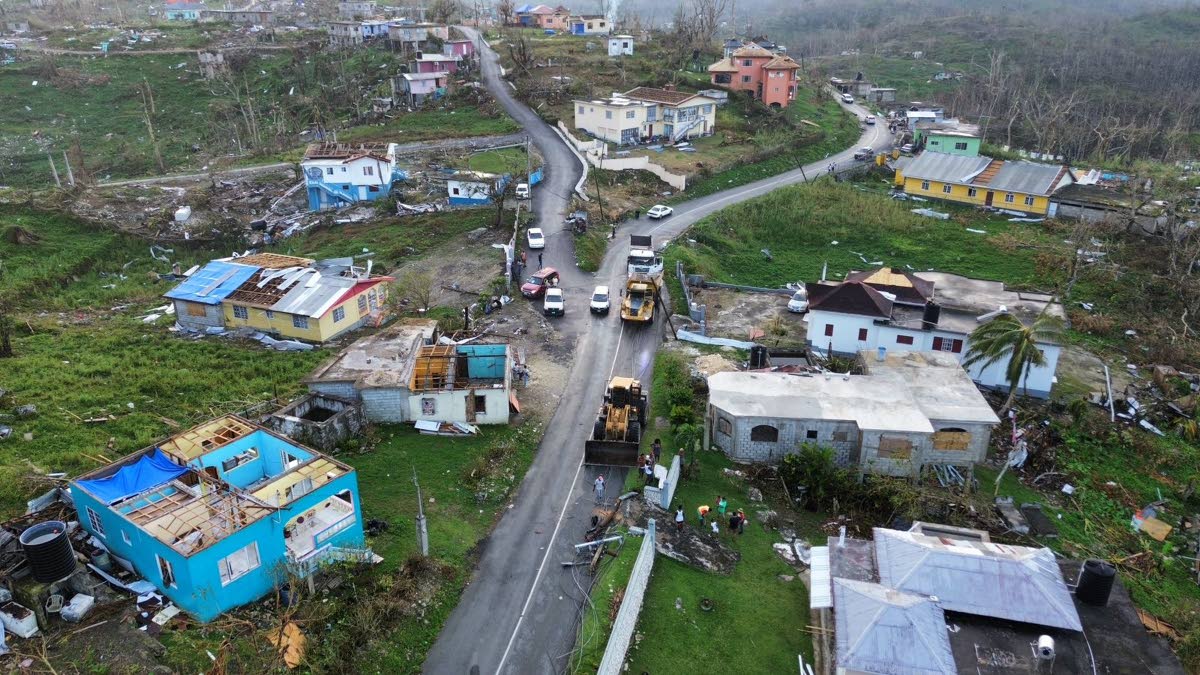 A road is being cleared of debris after the passage of Hurricane Melissa
-
 Allan Alberga
Now that the winds from Hurricane Melissa have subsided, Jamaica finds itself at a moment that demands reflection rather than routine recovery. Across the island, lives were disrupted, livelihoods damaged, and communities tested. Such experiences are not unfamiliar in the Caribbean, where hurricanes have long shaped geography, memory, and social organisation. What distinguishes this moment, however, is not simply the passage of a storm, but the context in which it occurred.
Globally, extreme weather events are increasing in both frequency and intensity. Cyclones, floods, wildfires, earthquakes, and heatwaves are no longer isolated disruptions, but recurring tests of governance capacity. Climate change has transformed natural hazards into persistent structural risks. For small island states like Jamaica, hurricanes can no longer be treated as episodic emergencies managed after the fact; they must be incorporated into long-term development planning, fiscal policy, land use decisions, and governance reform.
Recent studies indicate that Caribbean hurricanes have grown more intense over the past two decades, with stronger winds and heavier rainfall causing disproportionate damage to small island economies. Similar patterns are observed across the region, from Puerto Rico to Barbados, underscoring that Jamaica’s challenges are not isolated, but part of a broader, systemic climate and governance imperative.
Hurricane Melissa stood out not only for its strength but also for its unusual trajectory toward the island. Meteorological patterns that once guided planning assumptions appear increasingly unreliable. This reality raises a critical question with far-reaching implications: should Melissa be treated as an exception, or as an early signal of the conditions Jamaica must now plan for as a matter of course?
TREAT AS WARNING
Treating Melissa as a one-off event would allow a return to familiar routines – clean-up, reconstruction, reassurance, and eventual forgetting. Treating it as a warning would require a more uncomfortable assessment of whether existing systems of governance, planning, and participation are adequate for an era of environmental volatility. The distinction between these choices is not academic; it will shape future outcomes.
Responsibility for this task does not rest solely with elected officials, though they carry constitutional authority. Effective disaster preparedness and sustainable development require broad participation, including civil society organisations, the private sector, local communities, and the Jamaican diaspora. Resilience cannot be delivered exclusively through centralised directives. It must be built through systems that encourage shared ownership, local initiative, and public trust.
Historically, hurricane preparedness and recovery in Jamaica have struggled to command widespread confidence. Decision-making has often been highly centralised, with limited community engagement and uneven transparency. While centralisation can offer coordination, it has also revealed weaknesses in responsiveness, adaptability, and accountability. Until recently, storms lacked the intensity necessary to force a sustained reconsideration of these arrangements. Hurricane Melissa has altered that calculus.
One encouraging feature of the post-Melissa period has been the scale and speed of assistance offered from within Jamaica and across the diaspora. Donations, supplies, and logistical support flowed swiftly, reflecting a deep sense of national and transnational responsibility. This generosity, however, carries an obligation. Recovery efforts must be transparent, efficiently coordinated, and equitably managed, lest relief distribution become a source of frustration, division, or political tension rather than national renewal.
As public discussion has begun to shift from immediate recovery to future preparedness, renewed attention has been given to governance reform. In an article in The Gleaner, Professor Roselea Hamilton proposed decentraliastion as a means of strengthening Jamaica’s ability to manage development and respond more effectively to crises. Her intervention has reopened an important conversation that has surfaced periodically but has rarely been sustained beyond moments of crisis.
COMPARATIVE GOVERNANCE MODEL
More than three decades earlier, a similar governance framework was articulated in an article titled ‘An Alternative Path to Development’, published in 1992 and offered by this writer. That proposal, informed by comparative governance models elsewhere, advocated a departure from excessive centralisation toward a system that encouraged broader participation and regional empowerment. At the time, the model attracted little public debate and was largely ignored. The circumstances that prompted it, however, have not diminished; they have intensified.
The development framework inherited from colonial administration was designed for control and uniformity rather than participation and adaptability. It did not encourage mass engagement, except through partisan mobilisation, nor was it structured to respond quickly to localised crises. In an era defined by climate uncertainty, such limitations impose growing economic, social, and political costs.
Decentralisation, properly designed and responsibly implemented, is not a rejection of the state. It is a strengthening of it. By empowering regional and local authorities within a coherent national framework, decision-making can become more responsive, accountability more immediate, and communities more invested in outcomes. Local institutions are often best positioned to assess risk, mobilise residents, and act decisively when disasters strike, while national institutions retain oversight, coordination, and resource allocation.
There is a temptation, particularly in moments of crisis, to romanticise past approaches or retreat into familiar administrative habits. That temptation must be resisted. Many of the so-called “good old days” were neither inclusive nor efficient, and they are increasingly ill-suited to the environmental realities Jamaica now confronts.
Hurricane Melissa has delivered a message that extends beyond wind and rain. Whether Jamaica responds with incremental adjustment or structural reform will shape its resilience in the years ahead. The storm has passed. The choices it presents remain.
Allan Alberga is an attorney-at -law based in Atlanta and an engaged member of the Jamaican diaspora. Send feedback to allanalberga@aol.com.