Samuel Braithwaite | Venezuela, Guyana, and US global dominance
Loading article...
-
Samuel Braithwaite, lecturer, Department of Economics, UWI Mona.
-
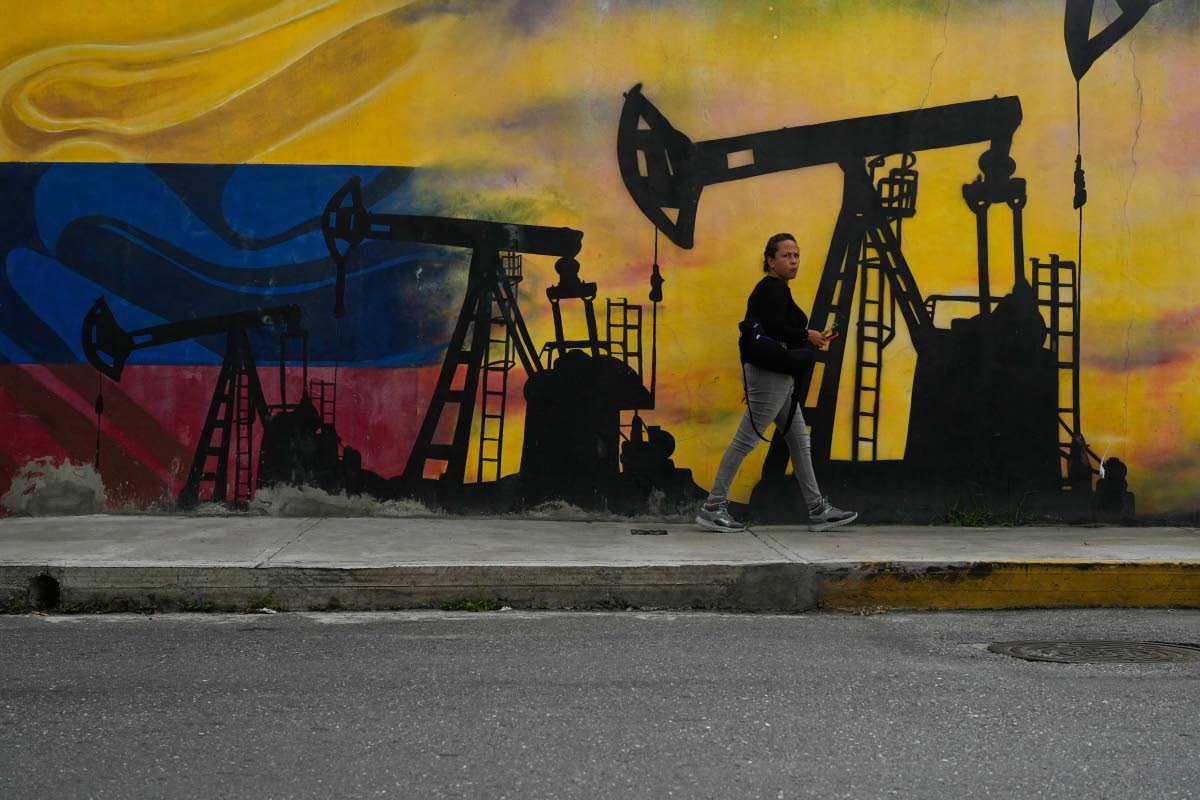 A local walks past a mural featuring oil pumps and wells in Caracas, Venezuela on January 6, 2026.
On Saturday, January 3, 2026, the eyes of the world turned to Venezuela. The response of CARICOM was pilloried. I have no issue with CARICOM’s terse diplomatic statement which touched the right notes and aligns well with the view that we are “friends of all, satellites of none”. This article is not about personalities. It is not meant to paint any actor in a negative or a positive light. It is not meant to paint grey those areas which are clearly black or white, areas such as the universal sanctity of international law. It does not support “isms and schisms”. This article seeks to provide some context to the situation which currently obtains in Venezuela and the Caribbean.
Venezuela, a tale of two realities
Venezuela was once a prosperous nation. At the peak of its oil production, Venezuela produced 3.5 million barrels of crude oil per day in the 1970s. The economy boomed. The construction sector told the story of prosperity; new roads, new bridges and new buildings, buildings seemingly competing for titles such as best designed or tallest. However, the prosperity was not universal. On the periphery of the core there was growing discontent. The hillsides were dotted with buildings jammed together in disorderly fashion, a far cry from the stacks of gleaming glass which dotted the core. Hugo Chavez studied and internalised how similar discontent was dealt with in places such as Cuba. Luckily for him, his failed coup attempt in 1990 did not leave him dead. He was instead sent to prison like Fidel Castro, who also attempted a and was imprisoned. Unlike Castro, however, Chavez would ultimately achieve power through the ballot box. Like Castro, his leadership was branded a revolution – the ‘Bolivarian Revolution’ or Chavismo. It was time for prosperity to reach the periphery.
Revolutions require money. Large amounts of money. The business class was certainly not going to forego vast amounts of revenues to fund the revolution. It is no surprise, therefore, that nationalisation was the chosen path. In 2007, Exxon Mobil demanded of the Venezuelan government between 10 and 12 billion US dollars as compensation for their nationalised assets. The Venezuelan government countered with an offer of 1 billion US dollars. The matter was settled at the International Chamber of Commerce (ICC) in Paris. Venezuela was ordered to pay Exxon Mobil 908 million US dollars; an amount just shy of what Venezuela had offered in the first place. After accounting for money frozen abroad and outstanding debts, the Venezuelan Oil Company, Petroleos de Venezuela (PDVSA), paid 255 million US dollars to Exxon Mobil. In 2019, however, a World Bank Tribunal ruled that Venezuela must compensate ConocoPhillips 8 billion US dollars for nationalisation of its assets in 2007. It is unclear whether ConocoPhillips will be compensated, given that the US is now in control of the sale of Venezuelan oil.
Chavismo went ahead and prosperity was not only shared with those on the periphery of Venezuelan society, it was also shared with the small island developing states of the Caribbean. While Chavismo was well intentioned, there are stories of mismanagement, corruption and drug dealing. Whether one is sufficiently convinced to lay these allegations directly at the feet of Chavez and his successor, Nicolas Maduro, these allegations provided context for US sanctions against Venezuelan exports and government officials.
It is the right of any sovereign nation to act in the best interests of its citizens, within the realm of international law. Therefore, while US sanctions have certainly hurt the Venezuelan economy, the Obama and other US administrations were within their rights to decide which countries to engage with and how to engage with them. We can lament the true motives of various US administrations but we cannot argue against their right to make decisions to protect their citizens; bullyism, illegal acts, and big stick diplomacy aside, of course. Or are sanctions only justified against countries like apartheid South Africa?
THE GUYANA PLAY
The year 1999 marked Chavez’s rise to presidential power, it was also the year the Government of Guyana signed a Production Sharing Agreement with Exxon Mobil. In 2008, one year after its Orinoco Oil assets were nationalised, Exxon Mobil initiated oil and gas exploration activities in Guyana. Oil was eventually discovered offshore Guyana in 2015. The pivot to Guyana was not coincidental. The article ‘Supermajordämmerung’ from The Economist (August 3, 2013) provides some context, and I quote:
“[t]hese days more and more NOCs [national oil companies] are able to do without the supermajors’ help. This means the supermajors are increasingly reliant on oil which is hard to get at: either because of geology (oil buried deep underwater and far from any shore); or because of chemistry (oil mixed up in tar sands and the like); or because of politics (oil in countries politically difficult to deal with). Their size, know-how and experience serve the companies well in such plays.”
Exxon Mobil’s successful exploration (Liza Discovery) in Guyana was done at severe depths, 18,000 feet in total (water depth and below the sea floor). This is a similar depth to the Macondo Well in the Gulf of Mexico, site of the Deepwater Horizon Disaster. In short, Exxon Mobil, and other super majors, long knew that Guyana had commercial quantities of oil, and had a very good idea of where it was. Chavismo and the global growth of national oil companies provided the perfect timing to bring Guyana online.
US GLOBAL DOMINANCE
The current US administration has unabashedly made clear its agenda to increase its global dominance. A primary plank of US global dominance is the US dollar. The US dollar is a global store of value. Drug dealers, for example, have long been in love with “the Benjamins”. It is the global unit of account, the global “monetary language” used to quickly state the value of everything from barrels of oil to other currencies, including bitcoins. And, finally, it is the main global medium of exchange for international transactions. It should be noted that there are unconfirmed reports that Venezuela has amassed a significant reserve of bitcoins, bypassing the use of the world’s primary reserve currency, the US dollar.
Crude oil is the topmost traded international commodity and so the connection between its trade and the US dollar is easy to appreciate. The US is a major oil producer and, in recent years, has been a net exporter of energy resources (oil and gas). So, why go after more oil? Aside from stockpiling oil in the US national strategic oil reserve, controlling the production and sale of crude through American companies helps to maintain the global demand for the US dollar. However, increasing production in Venezuela from its current level of one million barrels per day (about one per cent of global output) will take years. Further, there is a global oversupply of crude oil and Venezuela’s crude is “heavy and sour” and therefore costlier to refine, relative to Guyana’s light, sweet crude. Interestingly, most US refineries were built to refine heavy, sour crude oil.
The current US military posture in the southern Caribbean does not signal an impending full-scale military action. Indeed, full-scale military action requires at least two aircraft carrier groups, there is only one such group currently in the region – the USS Gerald R. Ford. The unfolding story is about gunboat diplomacy situated within a larger geopolitical posture impatient to increase US global supremacy. It is deeper than oil.
Samuel Braithwaite, is a lecturer in the Department of Economics at The University of the West Indies (Mona). Send feedback to columns@gleanerjm.com.