Christopher Burgess | Learning-led economic growth
Loading article...
-
 Christopher Burgess
-
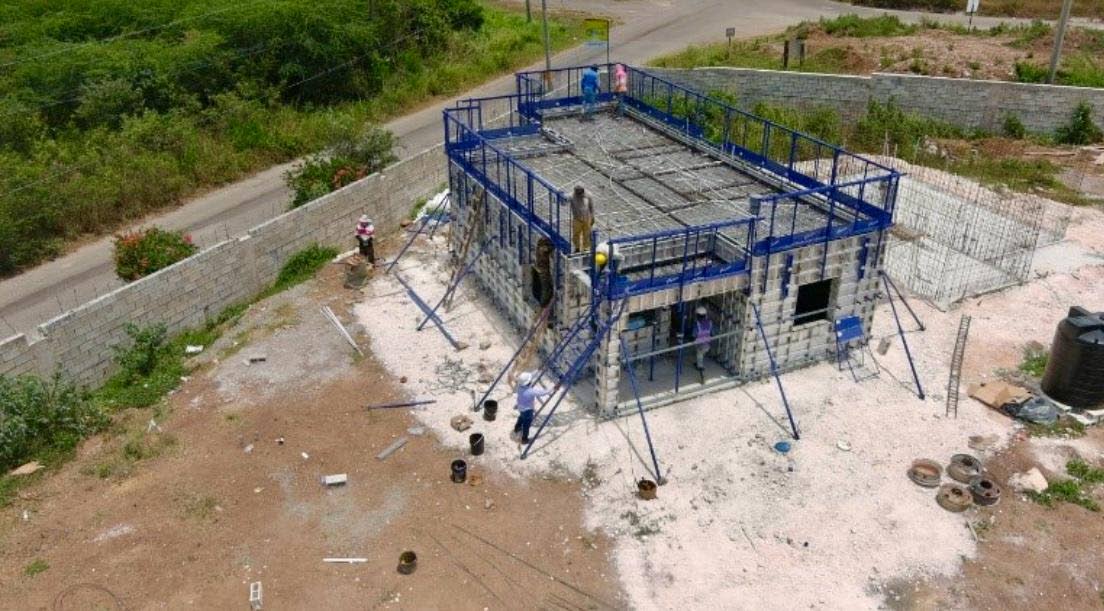 This aerial photo shows a housing unit under construction
Economic growth today is no longer driven by capital, cheap labour, and openness alone – it is driven by how well economies build capabilities, absorb technology, and compete in global markets. Countries that embed learning in production move into higher-value industries, increase productivity, and capture more value. Those that do not will remain stable – but stagnant, participating in the global economy without upgrading, as Jamaica has.
After two decades of macroeconomic stabilisation, Jamaica’s growth and productivity remain weak, averaging about 1 per cent annually. The country followed the Washington Consensus prescriptions of the 1990s – liberalisation, fiscal discipline, and open markets – which stabilised the economy and reduced poverty. Inflation has declined from 25–30 per cent in the 1990s to below 6 per cent today, while poverty has fallen from over 25 per cent to less than 5 per cent. But this stability has not translated into higher-value production and a more skilled workforce. Markets alone do not deliver development.
The next phase requires a shift from openness alone to institutions centred on learning, productivity, and strong global linkages in sectors where Jamaica can compete.
WASHINGTON CONSENSUS LIMITATIONS
When Jamaica adopted the Washington Consensus model, it assumed that open markets would allocate resources efficiently and drive growth. In practice, weak competition and institutions limited this outcome, concentrating market power in key sectors such as banking, food, and manufacturing.
The economy shifted toward services tourism, logistics, remittances, and basic BPO – while manufacturing declined and agriculture underperformed. GDP growth fell from about 2 per cent between the 1960s and 1990s to roughly 1 per cent since. Jamaica is stable – but stagnant, according to World Bank data.
As Nobel Laureate Joseph Stiglitz argues, markets fail to diffuse knowledge and technology. Without strategic intervention, particularly in education, technology and skills, economies become locked into low-value activities. This is evident in Jamaica: tourism generates foreign exchange but, with leakages exceeding 60 per cent (STATIN) and weak domestic linkages, has limited impact on local value creation. BPO creates jobs, but largely in low-value functions. The ‘Local First’ initiative risks remaining aspirational unless it enforces local sourcing and scales domestic production.
THE LEARNING ECONOMY
Modern economic growth theory emphasises institutional strength and learning – where wealth is generated from within the economy rather than relying on external conditions alone. Growth is driven not only by capital and labour, but also by firms adopting new technologies and building competitiveness.
Since the 1960s, countries like Singapore, Ireland, and Vietnam have applied this model by aligning STEM education and institutions with markets – raising GDP per capita more than 20-fold.
For Jamaica, this will require learning embedded in factories, farms, logistics hubs, and service firms through coordinated action among government, industry, and institutions to build capabilities over time.
Jamaica’s challenge is fundamentally a knowledge gap. This begins well before HEART/NSTA Trust (HEART) at the secondary level. Outcomes in secondary education – particularly in mathematics and science – remain weak, constraining the ability of firms to adopt technology. Institutions like HEART exist, but training remains misaligned with production.
The knowledge gap is evident across several sectors. Services dominate (65–70 per cent of GDP) but remain focused on low-productivity activities with limited technological spillovers. Locally owned hotels remain small, with limited regional expansion. In contrast, international hotel chains operating on Jamaica’s north coast have tens of thousands of rooms across the region. Agriculture (6–8 per cent) is volatile, constrained by high unskilled labour input, low mechanisation, and weak export linkages. Logistics remains focused on movement rather than value-added production.
Limited learning capacity is constraining growth.
TRANSPORTATION VS TRANSFORMATION
Jamaica must participate where it can win and avoid unfocused or unrealistic industrial ambitions.
Asia-Pacific and Europe dominate global logistics, accounting for about 70 per cent of global activity, because it is tightly integrated with manufacturing. Logistics is expanding but remains regionally uneven. According to the UN Trade Report, Asia grew about 10 per cent recently because of integration with manufacturing.
For Jamaica, the implication is that we must move beyond transshipment, pass-through logistics and import dependence, like warehouses. These only capture a small portion of the value chain. Jamaica must move into light-manufacturing and global production networks.
I recently visited a logistics warehouse in Toronto integrated into a North American network of over 300 partners that performs light manufacturing. Jamaica must connect to similar networks and develop light manufacturing capacity, rather than remaining a passive logistics outpost in the Caribbean.
Logistics linked to production creates growth.
ROLE OF HEART
Policy and institutional strengthening must address the central production constraint: human capital. More than 60 per cent of Jamaicans lack certification or formal skills.
HEART should drive Jamaica’s learning economy. Yet, while funding has risen to over J$25 billion and enrollment has increased modestly, certification remains flat. There is a gap between training inputs and productive skills. For example, HEART’s work-based training was less than 10 per cent of the total enrollment, according to the 2024 Annual Report. In 2020, the Auditor General found that, despite rising spending and enrollment, HEART is failing to convert training into certification and productivity, reflecting weak alignment with labour market needs.
The problem is that HEART operates primarily as a classroom-based training provider, not an industry-embedded learning system. We must also be honest: weak outcomes at the secondary school level mean HEART is working with students that lack the mathematics and scientific skills needed for productivity upgrading.
New SEZ agro-parks, call centre campuses and logistics hubs should have HEART training offices built into the infrastructure.
Finally, economic stability alone cannot deliver growth. The next phase requires a shift to a learning-driven growth model, where policy and knowledge institutions are aligned with production.
At the centre of this transformation is learning by doing — building global value-added linkages while avoiding the misallocation of scarce land to low-value, import-focused warehouse developments.
Dr Christopher Burgess is a registered civil engineer, VP of engineering for the Jamaica Institution of Engineers, a climate scientist, land developer, and managing director of CEAC Solutions. Send feedback to columns@gleanerjm.com