Michael Abrahams | Outdoor learning, empathy, context and contrition
Loading article...
-
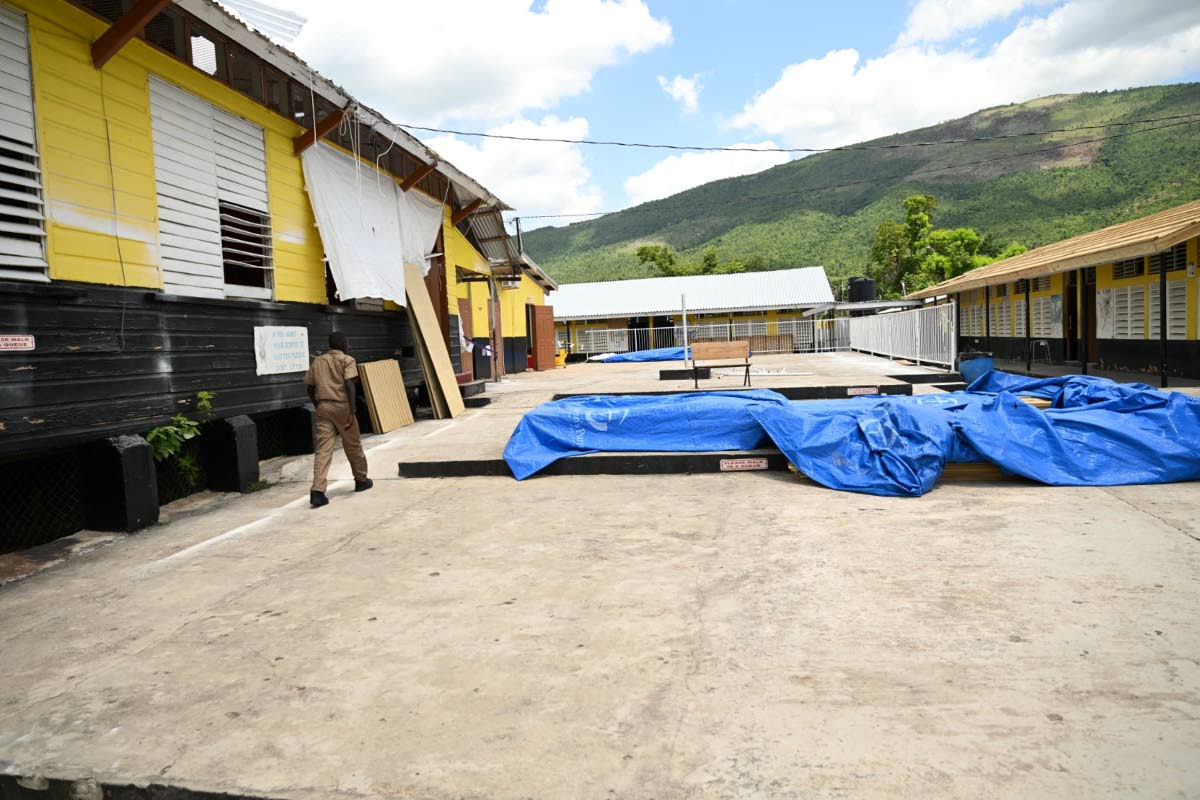 Burnt Savannah Primary School under repairs.
-
 Michael Abrahams
Hurricane Melissa damaged around 688 schools in Jamaica, with 313 severely affected. However, according to the Ministry of Education, Skills, Youth and Information, only 57 priority-one schools severely damaged by the hurricane were fully repaired and completed before the start of the 2026-2027 academic year in September, meaning hundreds of schools have not been fully restored.
One such school is Holland Primary School in St Elizabeth, where a newspaper story reported that severe heat and poor ventilation under a tent being used as a classroom forced teachers to teach the students outdoors: Grade Two students under the shelter of a bamboo structure, and Grade Three students beneath a mango tree.
Speaking at the launch of the Jamaica Reconstruction and Resilience Oversight Committee (JAMRROC) on September 8 at Jamaica House, Prime Minister Dr Andrew Holness announced “a successful reopening of the school year”, although the metrics used to define “successful” were not elucidated. He also mentioned reading newspapers that highlighted children being taught under trees, likely referring to the Holland Primary situation. He laughed and recalled that, when he went to school, being outside was his favourite time because the classrooms were so hot. While saying that he was not excusing the lack of resources in some schools, he noted that “classrooms are unbearably hot” and that “we should not look down on having children learn closer to nature in cooler environs and in a setting that is more supportive of learning”.
His comments sparked widespread backlash. Many viewed them as tone-deaf, ill-timed and insensitive to children being inconvenienced and compelled to learn outdoors because their indoor learning spaces remain unsuitable. Others defended him, recalling their own experiences of outdoor classes and the enjoyment they derived from them.
Three days later, at another event, Holness doubled down. He said hundreds of peer-reviewed studies demonstrate the benefits of being taught in conducive environments, including outdoors, and stressed that this was not an argument for replacing classrooms, while dismissing what he called “nonsense” from his critics. He also pledged to rebuild schools in more modern and resilient ways.
Indeed, multiple peer-reviewed studies have shown the positive effects of learning outdoors. The problem is not outdoor learning itself. It is the absence of empathy, context and contrition in how he framed it.
Outdoor learning is most effective when deliberately incorporated into the curriculum. It is quite different when students are compelled to learn outdoors because their classrooms remain unavailable or inhospitable. Those who nostalgically recall outdoor lessons from their youth had it as an adjunct rather than a primary feature. For example, if the weather became intolerable, they could retreat to a classroom that offered comfortable shelter and allowed lessons to continue. Also, it is significantly hotter nowadays than it was decades ago.
The children the prime minister speaks of today have been thrust into the situation and have restricted options. To make matters worse, many of them have been traumatised by Hurricane Melissa and will return to home environments that are also suboptimal, as their dwellings may also have been badly damaged by the storm. Some may have even lost their homes.
Context matters. A 2022 systematic review published in Frontiers in Public Health concluded that outdoor learning should be incorporated into children’s curricula “with reference to their local context”. The main countries that have embraced outdoor learning include Denmark, Sweden, Finland, the United Kingdom, Germany, Japan, South Korea and Canada. However, they all have substantially cooler climates than Jamaica. In hotter countries such as Australia and Singapore, outdoor activities are often scheduled for mornings or late afternoons, while activities during the hottest periods take place indoors, in cooler environments. The crucial distinction is that these children have options and structure.
The tents at Holland Primary may be uncomfortably hot, but staying outdoors nowadays in Jamaica during the day can be risky. This summer was the hottest since global record-keeping began and, earlier this month, the World Meteorological Organization (WMO) warned that 2027 has a very high potential to be even hotter. In fact, in a press release published on August 25, our own Ministry of Health and Wellness warned that “excessive heat stress is harmful to health and is potentially fatal”. It urged us to limit “as much as possible, outdoor activities to mornings and evenings”. However, much of the school day falls in the late morning and afternoon, when temperatures are higher.
It would be unreasonable and unrealistic to expect all damaged schools to be repaired in less than a year. However, earlier this month, while speaking at an event marking his administration’s third term governing our country, Holness expressed dissatisfaction with the slow pace of recovery from the hurricane and complained about the “inefficiency” and “lack of productivity” within his administration. But he is the country’s leader, so this is happening under his watch. In fact, he reassigned the Office of Disaster Preparedness and Emergency Management (ODPEM) to the Office of the Prime Minister (OPM) in November 2025. As our leader, he bears ultimate responsibility for his administration’s performance. Good leadership does not require accepting blame for every failure, but it does require acknowledging responsibility when things go awry.
The prime minister’s initial remarks were devoid of empathy for children enduring the consequences of schools that remain unfit for normal use. Outdoor learning has genuine advantages, but those benefits cannot be divorced from context. There is a profound difference between structured outdoor learning and being forced to do so because the State has failed to restore your classroom. While clarifying his remarks, Holness also had the opportunity to acknowledge the concerns of affected families and express regret over the slow recovery. Instead, he doubled down. That response was disappointing. Outdoor learning can enrich education when used as a deliberate strategy. It should not be used to rationalise deprivation.
Michael Abrahams is an obstetrician and gynaecologist, social commentator, and human-rights advocate. Send feedback to columns@gleanerjm.com and michabe_1999@hotmail.com, or follow him on X @mikeyabrahams.