Mariame McIntosh Robinson | Is Jamaica facing a human capital crisis or opportunity?
Loading article...
-
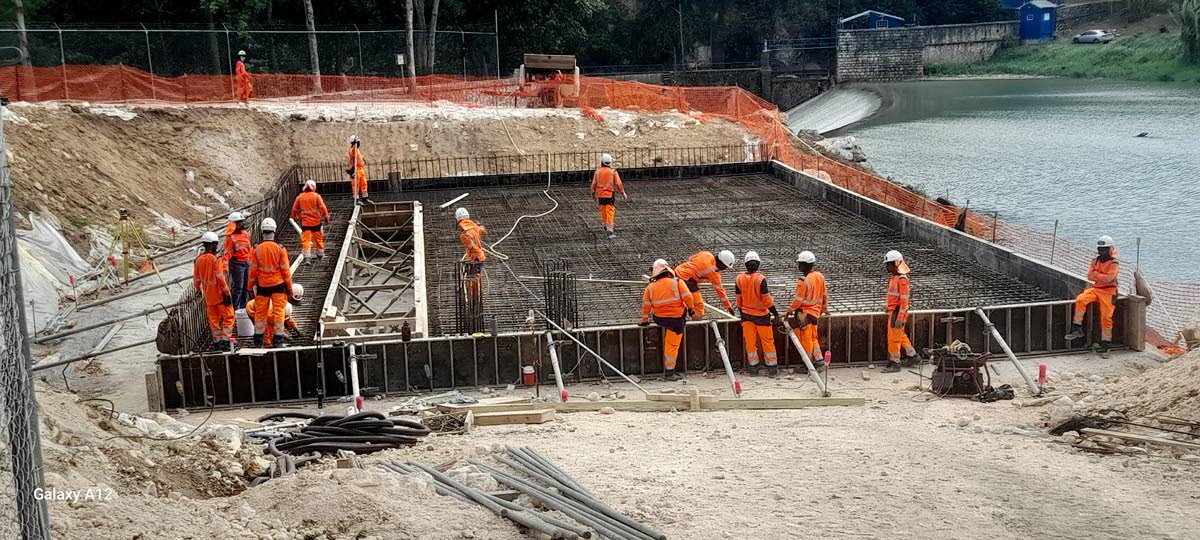 Workers at the Rio Cobre Water Treatment Plant during a site tour on Wednesday.
-
 Mariame McIntosh Robinson
A challenge often cited by businesses is access to capital, and Jamaica has made significant advances in deepening its sources of equity capital, while banks continue to be a staple of the financial sector. Yet, increasingly, another constraint is being heard: access to human capital.
Employers in a range of sectors say they cannot easily find the talent they need across a variety of roles. At the same time, we also hear from young people, including university graduates, that they cannot find suitable job opportunities.
What explains this disconnect? Do we have too few people, too few people with the right skills, or qualified people and available jobs failing to find each other? Has migration hollowed out particular occupations? Are employers asking for skills our education and training system is not producing quickly enough? Or are firms themselves underinvesting in the people they already have?
The uncomfortable answer is that we do not know enough.
Jamaica has labour-market data and a national Labour Market Information System, but we are still not as data-rich as we need to be about vacancies, emerging skills, wage signals, skills mismatches, and the capabilities employers are struggling to find. Anecdote should not be mistaken for evidence. But neither should the absence of sufficiently granular, timely evidence become a reason to ignore what employers and workers repeatedly tell us. It should be a reason to measure it better and anticipate shortages before they become crises.
This matters to Jamaica’s long struggle to achieve sustained higher growth. Human capital is a productivity issue. Labour productivity, broadly, how much value we create from each hour of work, is ultimately what allows an economy to sustain higher wages, stronger companies, and better living standards.
The World Bank’s new Human Capital Index Plus places Jamaica above the Latin America and Caribbean average overall and identifies it as a strong performer relative to countries at similar income levels, highlighting progress in on-the-job learning and tertiary completion.
A country can improve its human-capital indicators and still have difficulty converting talent into productivity. We can have educated people in the wrong jobs, vacancies without suitable candidates, employees with adequate technical knowledge but insufficient communication or problem-solving skills, and firms that underinvest in developing their people.
Is Jamaica approaching a human capital crisis or human capital opportunity that we have not yet fully learned how to measure, match, and mobilise?
UPSKILL FOR ADAPTABILITY
Jamaica needs to move deliberately up the skills ladder, but we should resist defining “future-ready” too narrowly.
Digital fluency matters, so do technical and vocational skills. Technology and business models are changing faster than traditional curricula can be redesigned. The most resilient workforce will therefore not simply be the one trained for today’s jobs. It will be the one most capable of learning tomorrow’s skills.
That requires greater emphasis on transversal skills: communication, critical thinking, problem-solving, teamwork, negotiation, conflict resolution, project management, reliability, and the ability to learn continuously.
These are sometimes called “soft skills”, but there’s nothing soft about them. They are what allow technical knowledge to travel across industries, technologies, and job descriptions.
We also need to change the culture around skills. Mariéme Jamme, founder of iamtheCODE Foundation, puts it simply: skills equal dignity. A skilled electrician, coder, technician, nurse, plumber, machinist, or beauty professional creates real economic value. The question should not be whether a pathway is academic or vocational, but whether it builds capability that people can use productively.
Training must also connect more tightly to work: employers should help design programmes, offer apprenticeships and work-based learning, and create clearer pathways from training to employment. If firms cannot find every skill in the market, the answer is not always to keep searching; sometimes it is to hire for aptitude and values, then train.
In addition, since Jamaicans will continue to pursue opportunities abroad, workforce planning must continually replenish critical domestic skills while finding better ways to benefit from the knowledge, networks, and experience our global mobility creates.
TECHNOLOGY TO SCALE LEARNING
Digital delivery gives Jamaica an extraordinary opportunity to put high-quality learning within reach of far more people, but access to content is not the same as learning: enrolment is usually strong, completion rarely is.
From my own experience, three practical lessons stand out.
First, build community through peer accountability and live interaction. Second, solve the device problem. A phone is a poor substitute for a laptop on many technical tasks. Third, have a human facilitator assigned to subgroups to provide encouragement and accountability.
Technology can scale instruction; people can turn instruction into capability.
Imagine making high-quality, modular learning in digital tools, AI literacy, financial capability, communication, and management available to Jamaicans throughout their working lives, with employers, professional associations, and communities helping people complete it.
MAKE PRODUCTIVITY PERSONAL
Perhaps the most important shift is cultural.
We should stop talking about human capital as though it is something government does to or for us. Government has indispensable responsibilities, but productivity is also personal. Human capital is accumulated one person, one team, and one organisation at a time.
If you run a company, invest more deliberately in the capabilities of your people. If you manage a team, teach and give feedback rather than simply evaluating. If you are an experienced professional, mentor and open a door. If you are early in your career, do not wait for an employer to make you employable. Build the digital, communication, and problem-solving skills that remain transferable and relevant. If you are a parent, make learning, curiosity, and adaptability part of what success means at home.
This does not absolve government, which must still deliver effective education policy, modern vocational training, reliable digital infrastructure, better labour-market data, and sensible incentives for workforce development. However, government cannot upskill the country alone.
The most powerful human-capital strategy that could be adopted may be both top-down and bottom-up: institutions creating the conditions for people to develop, and citizens, companies, and communities exercising the agency they already have.
The World Bank estimates that, over the long term, a 10-point improvement in Jamaica’s Human Capital Index Plus would be associated with roughly 10 per cent higher future income, and that closing current human-capital gaps relative to high-performing countries at similar income levels could raise future income by about 16 per cent.
Jamaica does not lack talent. Our opportunity is to turn more of that talent into productive capability, and to keep renewing that capability as the world changes.
That requires the better labour-market data, evolving national policy, employers who train, managers who develop people, institutions that respond faster to changing demand, and individuals who take ownership of remaining relevant.
Businesses have long cited access to capital as a constraint to growth. As Jamaica looks towards its next phase of development, let us ensure that human capital does not become one as well.
Mariame McIntosh Robinson is the MD of Global Triangle Advisors; she is the PSOJ vice-president and chair of the Human Capital Development Committee. Send feedback to columns@gleanerjm.com.