Dennis Minott | When a nation names its big mistakes
Loading article...
-
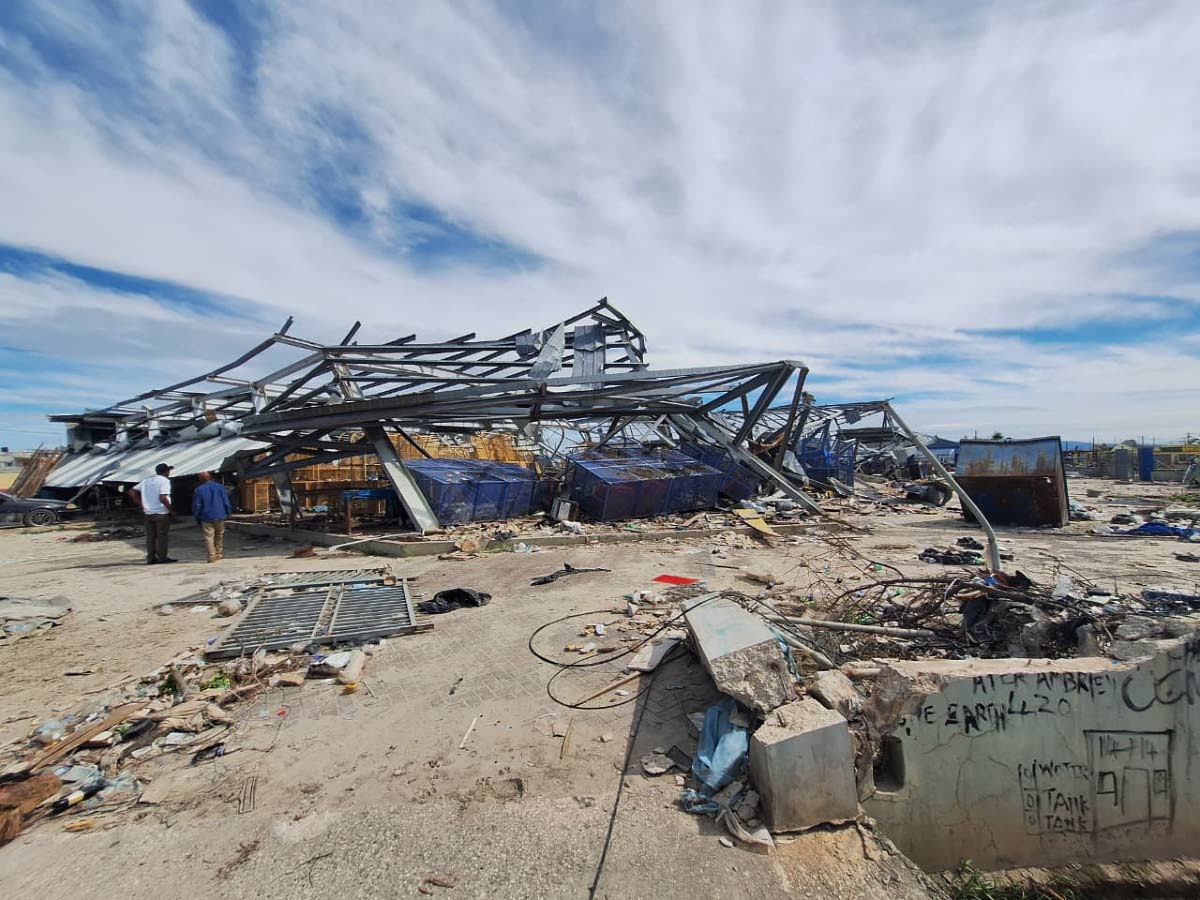 The mangled remains of the Black River Market in St Elizabeth following the passage of Hurricane Melissa on October 28, last year.
-
 Dennis Minott
In the English-speaking world, place-names often do the quiet work of history. They remember what speeches forget. They archive errors that reports smooth over. One such name, recurring with unsettling frequency across the Anglophone map, is “Folly”.
According to the GeoNames global gazetteer, at least 36,147 places across English-speaking lands carry the word Folly in whole or in part. The word is not a slur on sanity. In the British naming tradition from which Jamaica inherited so much of its cartography, a folly marks a failed, abandoned, or ill-judged enterprise, a costly mistake made confident by power, optimism, or hubris, and later exposed by reality.
Jamaica itself officially bears three such names.
Old Folly in St Ann recalls an early agricultural or estate venture that proved uneconomic or poorly sited, perhaps a great house, a mill, or a planned settlement that collapsed under environmental or market realities. The scheme failed; the verdict endured.
Folly Point in Portland stands on the coast as a sterner warning. Coastal “follies” across the British world typically mark misjudged maritime works: a wharf where currents were unforgiving, a beacon placed without respect for wind or reef, a trading post imagined from the map rather than the sea. The name survived as a caution to those who came after.
And Folly in Clarendon speaks quietly of plantation-era ambition, over-confident crops, mills, or irrigation schemes that could not survive drought, soil limits, or shifting markets. Here again, the name judged the plan, not the people.
SINGLE THREAD
Across these three places runs a single thread: nature and economics were consulted too late, if at all. The land was expected to comply with intention. It did not. The map remembered.
This history matters now, urgently, because Jamaica stands again at a moment when names are being prepared for future maps, whether we intend them or not.
In the ragged aftermath of Hurricane Melissa, western Jamaica has been laid bare. Rivers have reminded us of their memory. Floodplains have reclaimed their rights. Coastal systems have rehearsed their indifference to press conferences. And yet, in what should be the most evidence-disciplined moment of national rebuilding in a generation, I observe a disturbing drift toward improvisation dressed up as confidence.
Under the stewardship of the Andrew Holness administration, post-Melissa recovery is increasingly framed as a theatre of urgency rather than a discipline of wisdom. Cabinet ministers “ham it” before cameras. Well-heeled voices rush to microphones to proclaim that only “deep-pocketed investors” can rescue Savanna-la-Mar, Darliston, Black River, Whitehouse and their neighbours.
What is conspicuously absent from centrestage are the very people whose knowledge exists precisely for such moments.
• Urban planners have been sidelined.
• Hydrologists are scarcely heard.
• Civil engineers are reduced to afterthoughts.
• Community elders – those who know where water used to run – are indulged as colour, not counsel.
What is evident is the gravitational pull of Kingston-centred decision-making, the over-representation of wealthy land developers, and the quiet marginalisation of local intelligence. This is not recovery; it is re-enactment – the replay of the same cognitive error that christened Old Folly, Folly Point and Folly itself.
METAPHORS
If we persist, Jamaica will not need to invent metaphors. The map will do it for us.
I can already see the outlines of new names emerging, not in malice, but in consequence.
One township may yet earn the bitterly apt title “Andrew’s Folly”.
Another remembered as “Two-Michaels’ Folly”. And should this present tsunami of ministerial improvisation continue unchecked, an entire county risks being rechristened, by popular memory if not by statute, as “Tufton-McKenzie” in place of Cornwall.
Maps are patient. They wait decades to deliver their verdicts. But they are ruthless in their accuracy.
Let us be clear: hurricanes do not create follies. Responses do. Disasters merely strip away illusion. They test whether a society respects expertise or confuses wealth with wisdom, urgency with insight, spectacle with substance.
Post-Hurricane Melissa reconstruction should be Jamaica’s most deliberate national exercise since Independence: a chance to rebuild towns according to hydrology, not haste; to site housing with respect for flood recurrence, not investor convenience; to restore livelihoods without repeating extractive habits that left communities fragile in the first place.
Instead, I fear we are mistaking motion for progress.
• Wisdom would insist on slower speech and faster listening.
• Wisdom would seat hydrologists before seating developers.
• Wisdom would invite elders before inviting investors.
• Wisdom would understand that resilience is engineered long before it is announced.
The tragedy of a folly is not that it was attempted, but that it was warned against and attempted anyway. Every Jamaican “Folly” had its Cassandra. Someone knew. Someone said so. Someone was ignored.
Hurricane Melissa has given us a rare gift: the chance to choose differently while memory is still wet, while lessons are still visible in silt lines and broken culverts and altered shorelines. If we squander that gift, the land will not argue with us. It will simply remember.
And one day – quietly, without ceremony – children will ask why a place bears an odd name. And the answer will come, as it always does with follies: because once, power spoke louder than wisdom, and the land had the final word.
Jamaica deserves better than another footnote on the map. It deserves the humility to learn, before the name is written.
Dennis A. Minott, PhD, is a physicist, green energy consultant, and long-time college counsellor. He is the CEO of A-QuEST. Send feedback to columns@gleanerjm.com.