The perfect storm
Loading article...
-
 TAYLOR
-
HURRICANE MELISSA, packing sustained winds of 295 km/h or 185 mp/h, barrelled across Jamaica on Tuesday, with winds that howled loudly and sustained showers that, together, have hurled climate change as a clear and present danger back into public view.
Professor Michael Taylor, one of Jamaica and the Caribbean’s most celebrated climate scientists, has said that the lessons from Melissa should be quickly absorbed and applied, to ensure Jamaica and the Caribbean’s resilience in the face of what is projected to be a growing number of extreme weather events associated with a changing climate.
Climate change, fuelled by the emission of greenhouse gases related to the human consumption of fossil fuels, such as oil and gas, presents a range of risks and threats. They include extreme hurricanes but also warmer temperatures, sea-level rise, and coastal erosion, together with compromised water and food security and public health threats.
Among the immediate takeaways from Hurricane Melissa, Taylor said, is the “psychological marathon” that preparedness has been – a new feature of Jamaica’s experience with extreme hurricanes among which Melissa is counted – as a Category 5 system that made landfall in Jamaica at noon on Tuesday.
“We had the first official bulletin from the Met Service last Tuesday. Every bulletin since then gave us a new landfall date or a new landfall location. The slow speed of this storm adds a whole new dimension to how we think through climate change, climate change adaptation and its other dimensions,” Taylor, a physicist, said.
“Up to now, the country has been going through mental wariness and fatigue,” he added, speaking with The Gleaner from his home on Tuesday afternoon as Melissa wreaked havoc in the southern and western parts of the island.
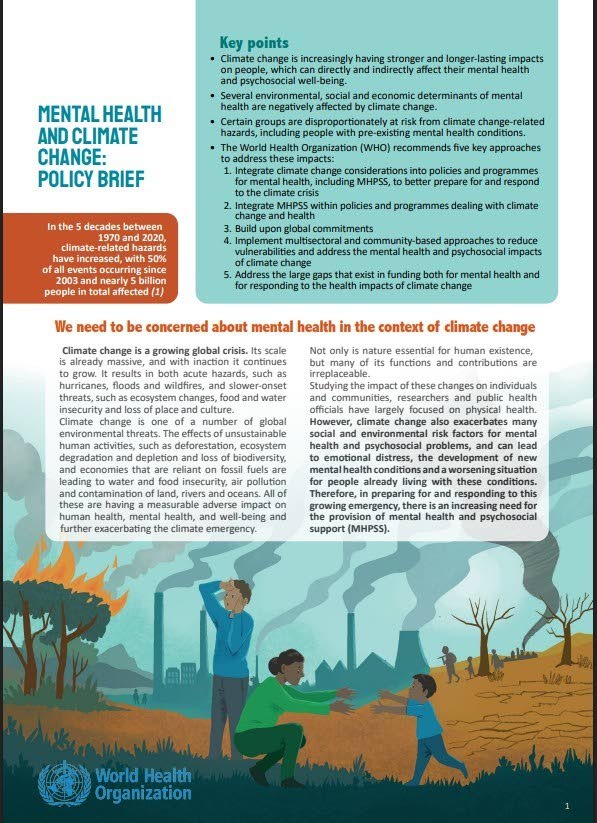
In a 2022 Mental Health and Climate Change policy brief, the World Health Organization (WHO) notes that researchers and public health officials have largely focused on physical health in their look at climate impacts.
“However, climate change also exacerbates many social and environmental risk factors for mental health and psychosocial problems, and can lead to emotional distress, the development of new mental health conditions, and a worsening situation for people already living with these conditions,” the policy brief said.
“Therefore, in preparing for and responding to this growing emergency, there is an increasing need for the provision of mental health and psychosocial support,” it added.
PRIORITISE MENTAL HEALTH
Jamaica’s Ministry of Health and Wellness, in the lead-up to and during the hurricane, had among its key messages the encouragement to ‘prioritise mental health’, urging Jamaicans to make use of available mental health services, including helplines such as 888 NEW LIFE and the U-Matter Chatline for persons 16 to 24 years old and which can be accessed by messaging the word SUPPORT to 876-838-4897 or @ureportjamaica.
Meanwhile, Taylor, co-lead for the Climate Studies Group Mona and dean of the Faculty of Science and Technology at The University of the West Indies, Mona, agreed with the sentiments of the WHO policy brief.
According to Taylor, it will be necessary, as Jamaica looks to enhance its resilience, to give consideration to how mental health and psychosocial support can be comprehensively and sustainably built into the preparedness and recovery planning for extreme hurricane and other events.
“This is something we are going to have to think about seriously. Climate change and health has grown on the global scene this year. But we typically think of climate change in terms of vector-borne disease and heat stress and so on,” he said.
“However, disaster plans are going to have to evolve completely. They are going to have to take into consideration the long lead-up times (and all the implications that flow from that, including mental health impacts) of these events. We will also need to think about how we communicate that and who does the communicating,” he noted.
pwr.gleaner@gmail.com