Universities urged to prepare students for AI‑driven economy
Loading article...
-
 From left: Ashli Rose-Davis, coordinator of the Vincent HoSang Entrepreneurship Programme at the Mona School of Business and Management (MSBM); David Marchick, dean of the Kogod School of Business at American University; Leighton McKnight, executive in residence, MSBM; Dr David McBean, executive director, MSBM; George Willie, managing partner of Bert Smith & Company and patron of the George Willie Lecture Series, and Janice Henlin, director of marketing, MSBM. Contributed
-
From left: Ashli Rose-Davis, coordinator of the Vincent HoSang Entrepreneurship Programme at the Mona School of Business and Management (MSBM); David Marchick, dean of the Kogod School of Business at American University; Leighton McKnight, executive in residence, MSBM; Dr David McBean, executive director, MSBM; George Willie, managing partner of Bert Smith & Company and patron of the George Willie Lecture Series, and Janice Henlin, director of marketing, MSBM. Contributed
-
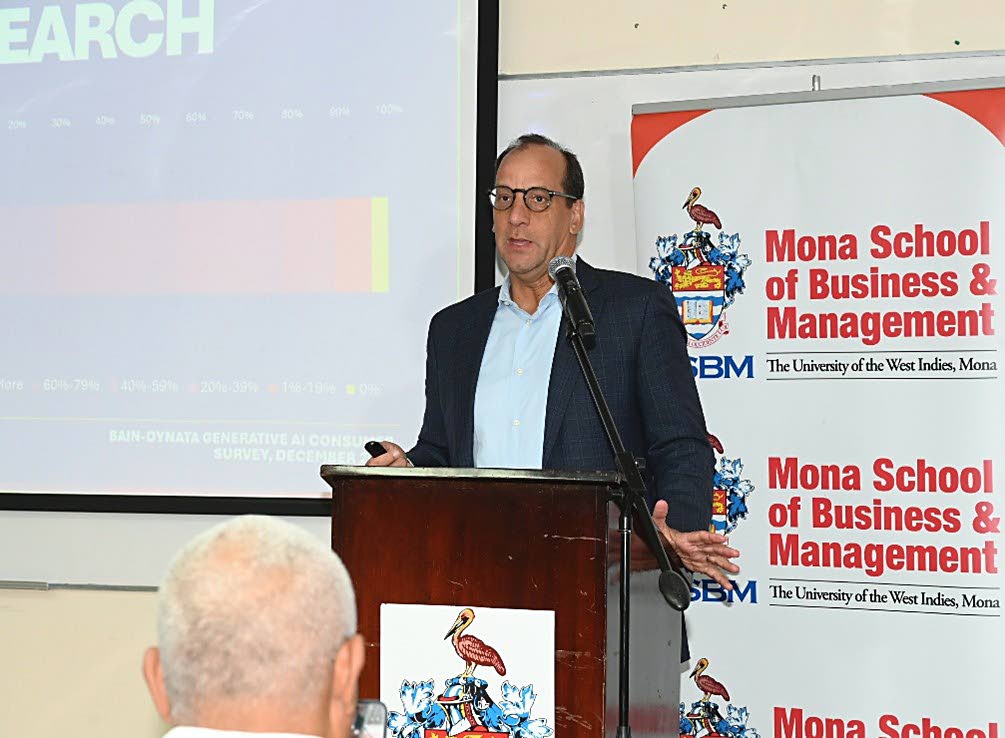 David Marchick, dean of the Kogod School of Business at American University, delivers the keynote address at the recent George Willie Lecture Series, hosted by the Mona School of Business and Management, UWI, Mona. Contributed
A pointed warning about the future of work and education took centre stage as the Mona School of Business and Management (MSBM), UWI, Mona brought together leaders from academia and industry to confront a pressing question: is the Caribbean truly ready for the age of artificial intelligence?
At the recent George Willie Lecture Series, David Marchick, Dean of the Kogod School of Business at American University, delivered a forceful address urging universities to rethink how they prepare students for a rapidly evolving, AI-driven global economy.
Speaking on “AI in Higher Education: Strategies for Producing AI-Ready Graduates”, Marchick argued that the implications of artificial intelligence extend far beyond technology programmes. “AI is going to change everything – how we work, how we learn, how we interact. It won’t replace human talent, but those who understand AI will have a clear advantage. Our responsibility is to ensure every graduate is AI fluent, regardless of discipline.”
Generative AI is already reshaping higher education. Studies indicate that more than 70 per cent of students now use tools such as ChatGPT and Gemini for coursework, revision and research. Under Marchick’s leadership, faculty and staff at Kogod developed and implemented what Poets & Quants – a US-based digital publication covering business schools and management education – described as “the most consequential AI transformation in business education”.
Marchick’s presentation underscored a central point: AI literacy is no longer a competitive advantage, but a basic requirement for employability and leadership. Drawing on Kogod’s experience, he argued that institutions must move beyond treating AI as an elective or add-on subject, and instead embed it across every area of study.
He outlined a structured, role-based model that reframes education around AI-augmented professional identities. Rather than isolating AI within technology courses, the model integrates it across core disciplines, preparing students to operate effectively in AI-enabled workplaces. Spanning leadership, entrepreneurship, marketing, finance and advanced technology, the framework illustrates how AI enhances each domain – supporting reflective leadership and ethical decision-making, accelerating venture creation, strengthening creative and marketing execution, powering data-driven financial analysis and advancing the development of agentic systems. Together, the model presents a holistic approach in which AI becomes an embedded capability rather than a standalone skill.
Marchick stressed that no field is exempt: finance and marketing, as much as the humanities, must evolve alongside artificial intelligence.
Dr David McBean, executive director of MSBM, underscored the importance of sustained engagement with global leaders on the implications of artificial intelligence for higher education. Such exchanges, he noted, are critical to ensuring that institutions and graduates are equipped to succeed in an AI-driven world.
“Artificial intelligence is reshaping how we teach, how we learn, and how we prepare graduates for the future workforce. It is vital that we have these discussions to ensure our students are ready to lead in this new era. We extend our gratitude to George Willie for facilitating these important conversations and for his continued support in bringing distinguished voices to MSBM.”
With artificial intelligence already transforming industries ranging from healthcare and finance to public policy and education, the George Willie Lecture Series reinforced MSBM’s role as a regional thought leader at the intersection of business, innovation and learning. By convening global expertise and stimulating critical debate, MSBM continues to position Jamaica and the wider Caribbean to compete, lead and innovate in an AI-powered world.