Colombian island joins C’bean push for reparative justice
Loading article...
-
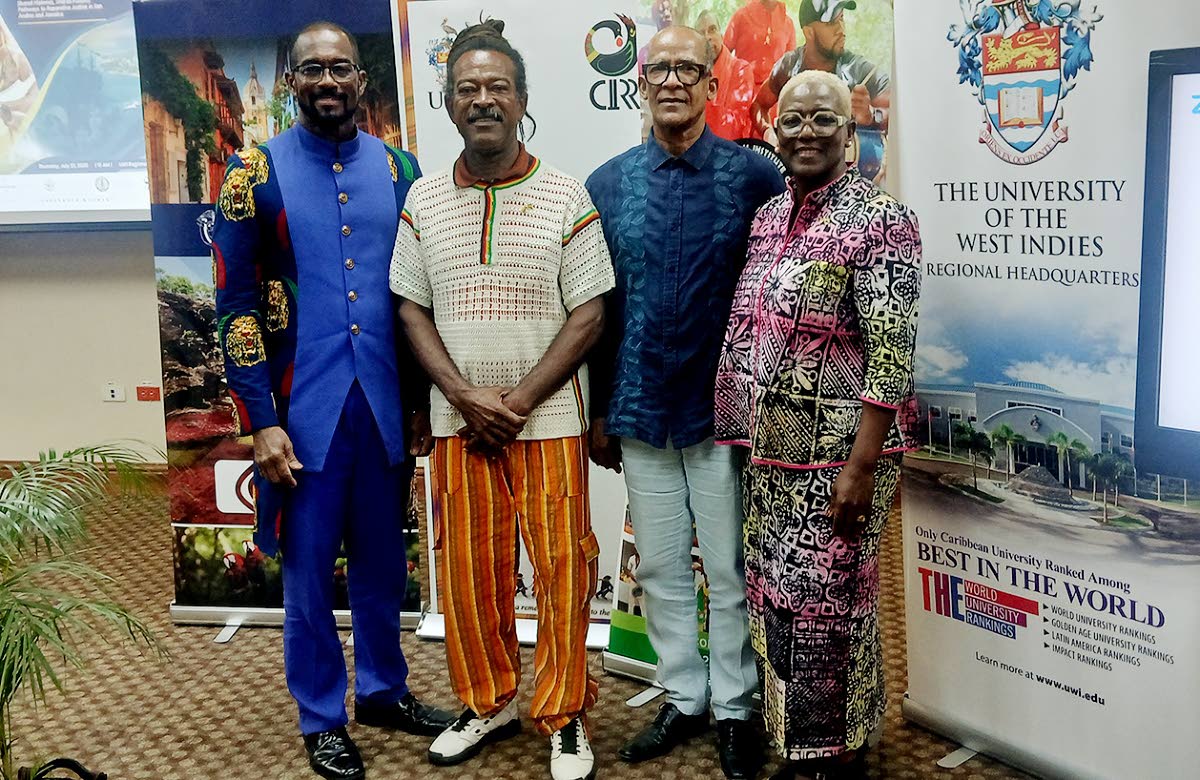 From left: Reverend Dr Alberto Gordon May, guest speaker and resident of San Andrés; musician Jimmy Archbold; fellow San Andrés resident Ishmael May; and Emiliana Bernard Stephenson, ambassador of the Republic of Colombia to Jamaica, at the Caribbean Continuity Conference at The University of the West Indies Regional Headquarters in St Andrew on July 23.
-
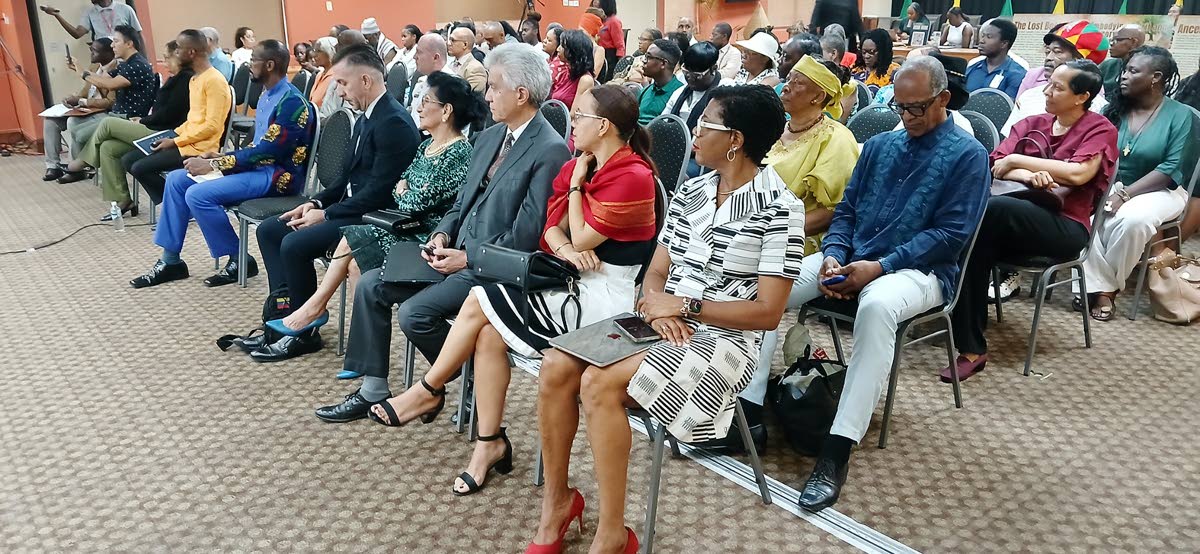 Participants listen during the Caribbean Continuity Conference at The University of the West Indies Regional Headquarters in St Andrew.
-
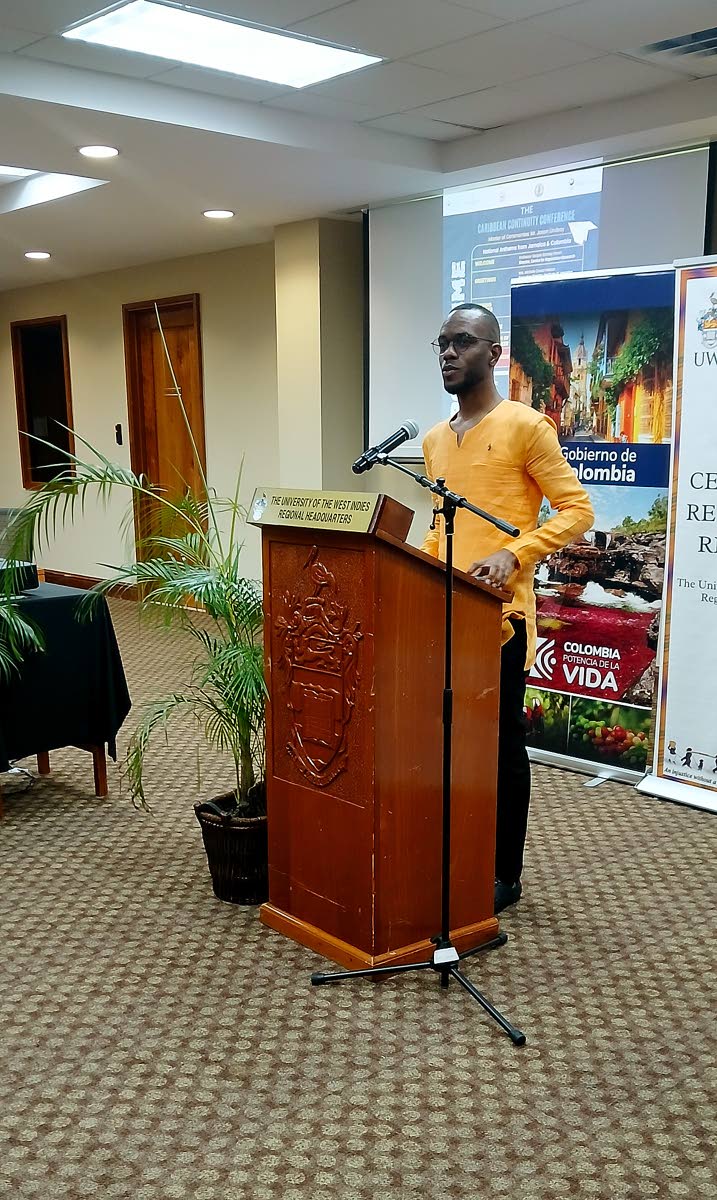 Dr Kirt Henry, director of the African-Caribbean Institute of Jamaica/Jamaica Memory Bank, addressing the Caribbean Continuity Conference
San Andrés, a Colombian overseas department located approximately 300 miles from Jamaica and about 467 miles from mainland Colombia, is joining the Caribbean campaign for reparations for the harms inflicted during colonial slavery.
Roughly comparable in size to Jamaica, the archipelago is home to Patois-speaking descendants of Jamaicans and other peoples, collectively known as the Raizal people.
In the 1600s, British traders in enslaved Africans brought enslaved people from Jamaica to the archipelago, which includes San Andrés, Providencia and Santa Catalina. This gave rise to the Raizal people, who speak Spanish, English and an English-based Creole language.
Though the territory’s history differs from Jamaica’s in many respects, it contains familiar elements of colonial brutality and injustice. Among them was the forced imposition of Spanish language and Catholicism on the Raizal people.
Those issues were at the heart of the Caribbean Continuity Conference, held at The University of the West Indies Regional Headquarters on Hermitage Road in St Andrew on July 23 under the theme ‘Shared Histories, Shared Futures: Pathways to Reparative Justice in San Andrés and Jamaica’.
The guest speaker was Reverend Dr Alberto Gordon May, who traces his lineage to William May, an enslaver at May’s Pen in Clarendon, then principally a cattle estate.
RESILIENCE
Gordon May, an internationally respected educator, theologian, community leader and president pro tempore of the Western Caribbean Peoples, began by noting that he stood on the shoulders of his ancestors and Caribbean forebears, and that he had come home. Fluent in English, Spanish and an English-based Creole, he described Creole as “the language of resilience”, adding that it was the best language in the world, despite repeated attempts to erase it.
He went on to outline a five-point reparative justice claim rooted in what he described as layers of unrepaired harm: British colonial harm, Spanish colonial harm, the harm of African enslavement, the harm of “Colombianisation”, and the harm of climate injustice. Although distinct in origin, they form one story, “one continuous history of extraction and erasure”, he said.
Among the demands are a full and formal apology from the British Crown and restitution that reconnects the people to their heritage. The claim also seeks acknowledgement of colonial dispossession and formal apologies for the cultural and religious erasure committed by Spanish colonists, as well as “support to recover what was taken from the people’s archives and memory”.
Beginning in 1633, enslaved Africans were reduced to property and forced to labour on cotton, tobacco and coconut plantations, enriching colonial powers. Gordon May argued that this crime against humanity must be recognised and repaired, alongside broader efforts to reclaim the African heritage that was suppressed.
The process of “Colombianisation” brought further hardship. English and Creole were banned; ordinary people who spoke them were verbally reprimanded and, in some cases, physically abused. Forced to adopt Spanish, many experienced lasting trauma and a profound disruption of their cultural identity.
As a result, the Raizal people are calling for the reversal of assimilation through genuine trilingual ethno-education, the fulfilment of promised rights to self-determination and cultural preservation, and development led by islanders for islanders. They are also demanding the restoration of the ecosystem and recognition of climate justice.
“I know these five claims may sound like a particular credence of a small people, but they are not. And that is precisely why I have come to Kingston to speak. Every one of our claims matches CARICOM’s 10-point claim. Full and firm apology, the restitution of cultural heritage, education and capacity-building, psychological rehabilitation, the right to sovereignty, and development, debt cancellation and compensation are running through all of it,” Gordon May said.
He added: “The Raizal claim is not a footnote to the Caribbean reparation movement; it is a chapter of it. What Jamaica asks of history, San Andres also asks, in the same language, on the same grounds ... . Reparation for the Raizal people is not a wish to return to some vanished past; we know the past cannot be restored. Reparation is the honest repair of what was broken, the apology owed, the culture returned, the autonomy respected, and the harm made right, so that, on these shared Caribbean waters, we may build together a future worthy of our ancestors.”
The event was organised in collaboration with the African Caribbean Institute of Jamaica/Jamaica Memory Bank (ACIJ/JMB), an agency of the Institute of Jamaica; the Centre for Reparation Research at The University of the West Indies; and the Embassy of the Republic of Colombia to Jamaica.
CONNECTIONS
In her opening remarks, Emiliana Bernard Stephenson, Colombia’s ambassador to Jamaica, told the gathering: “Today, we come together to reflect on the deep historical, cultural, and ancestral connections between the archipelago of San Andrés, Providencia and Santa Catalina, Jamaica, and the wider Caribbean.
“This conference is an opportunity not only to remember our past, but also to shape our future. Through dialogue, research, and cultural exchange, we strengthen the bonds that unite our Caribbean peoples and contribute to a more inclusive understanding of our shared heritage ... . Together, we demonstrate that culture, scholarship, and diplomacy can build bridges across borders and inspire meaningful regional cooperation.”
Also addressing the gathering was Dr Kirt Henry, director of the ACIJ/JMB.
“Today, conversations surrounding reparative justice are becoming increasingly prominent, not only throughout the Caribbean, but across Africa, Europe, the Americas and within international organisations. Those conversations have often focused, understandably, on economic redress and legal accountability. Those are necessary discussions.
“But reparative justice is also cultural. It is about restoring historical truth where silence and misinformation once existed. It is about affirming identities that were marginalised and wrongly stereotyped. It is about recognising the resilience of communities whose contributions have too often been overlooked. It is about ensuring that our children inherit histories that are fuller, more honest and more representative than the ones many of us received.”
editorial@gleanerjm.com