UTech catalogues Wilson Chong’s architectural legacy with help from son
Loading article...
-

Andrew Chong is working with the Caribbean School of Architecture at the University of Technology, Jamaica (UTech), to catalogue his father’s architectural drawings and related materials.
-
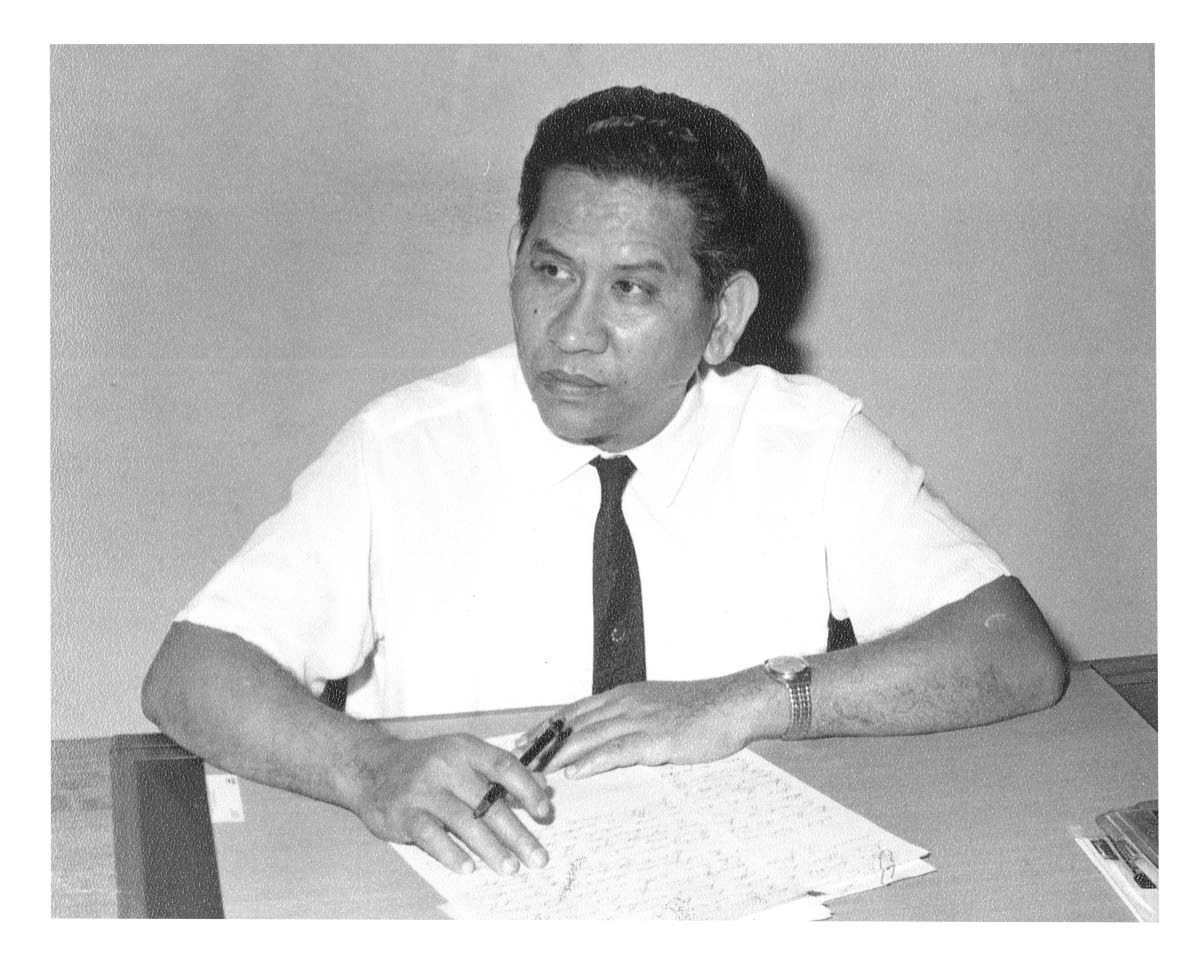 Wilson Chong
-
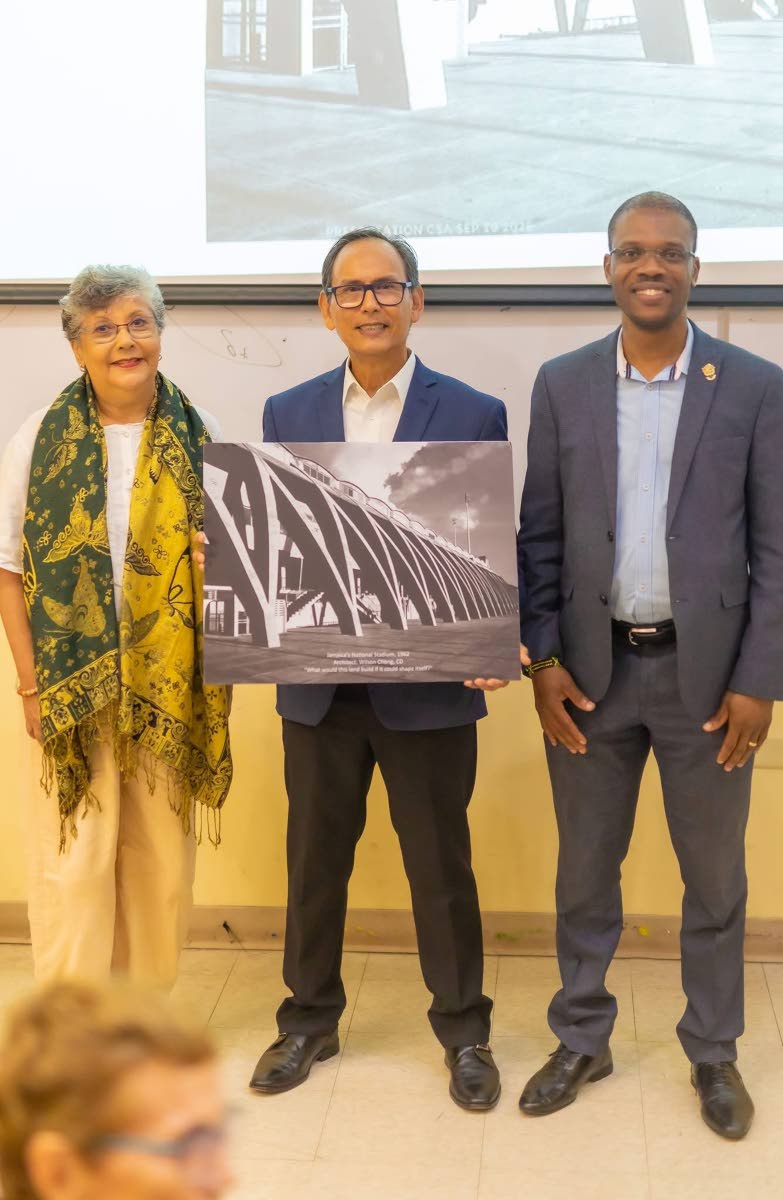 Andrew Chong (centre), son of architect Wilson Chong, shares a moment with Dr Kevin Brown (right), president of the University of Technology, Jamaica, and Associate Professor Elizabeth Pigou-Dennis, vice-dean of the Faculty of the Built Environment, following a lecture at the university in September last year.
Long before Jamaica’s modern skyline began to take shape, architect Wilson Chong was imagining what the country’s built environment could become.
Among Jamaica’s earliest licensed architects, Chong played a defining role in introducing modernist design principles, reinforced-concrete construction, and architectural innovation to a country transitioning from colonial rule to Independence.
His most celebrated work, the National Stadium, remains, perhaps, the clearest expression of that vision. As plans advance for the stadium’s redevelopment, renewed attention is being paid to the legacy of Wilson Chong, whose influence extended far beyond the buildings he designed.
His son, Andrew Chong, a Jamaican-American real estate professional, entrepreneur, business coach, and educator, is helping to preserve that legacy. For Andrew, his father’s contribution was about far more than architecture. It was about shaping spaces, building communities, and leaving behind a lasting record of Jamaica’s development.
Preservation
Andrew is working with the Caribbean School of Architecture at the University of Technology, Jamaica (UTech) to catalogue his father’s architectural drawings and related materials. The project is documenting and preserving a body of work that offers an important window into Jamaica’s architectural history.
“My father was a visionary. He understood that architecture was not just about putting up buildings. It was about creating spaces that could serve people, reflect who we are, and help shape the future of Jamaica,” Andrew said.
The renewed interest comes at a significant moment. With the National Stadium poised for redevelopment, questions of heritage, preservation, and architectural legacy have come into sharper focus. For Andrew, ensuring that his father’s contribution is properly documented is an important part of keeping that history alive.
The initiative also provides an opportunity to examine Wilson Chong’s career within the broader story of Jamaica’s architectural and cultural development, preserving not only the buildings associated with his name but also the ideas, drawings, and professional legacy behind them.
The cataloguing project is now 99 per cent complete, with approximately 160 drawings documented. A further 10 drawings were recently discovered, adding fresh momentum to the preservation effort.
The newly uncovered drawings are being scanned and labelled as part of the ongoing effort to create a comprehensive record of Chong’s work.
Born into a Jamaican Chinese family in Santiago de Cuba, Wilson Chong returned to Jamaica after studying architecture in the United States. He attended the University of Notre Dame and the University of Illinois, graduating with a degree in architecture in 1952.
His return came at a pivotal moment in the country’s development.
Kingston was emerging from decades of reconstruction following the devastating 1907 earthquake, while Jamaica was increasingly embracing modern building techniques and preparing for self-government and Independence. The destruction caused by Hurricane Charlie in 1951 further underscored the need for resilient structures and renewed attention to modern construction methods.
Chong entered a profession still dominated by overseas architects. Rather than being discouraged, he established his own practice and became part of a new generation of Jamaican professionals determined to prove that local talent could design buildings of international significance.
One of his major innovations was the use of reinforced-concrete shell structures. He applied thin-shell construction to projects including petrol stations, churches, and a medical centre, demonstrating how engineering and architectural creativity could combine to produce efficient and distinctive buildings.
The Henriques Building, now home to the Cross Roads Tax Office, featured a striking asymmetrical concrete brise-soleil façade. Meanwhile, the Ministry of Education building incorporated pilotis, columns that elevate a structure above ground level. The building became Jamaica’s first government high-rise and included air conditioning and a lift, reflecting the country’s embrace of modern technology and construction.
Pioneering
Yet it was the National Stadium that cemented Chong’s reputation as one of Jamaica’s foremost architectural pioneers.
Completed in 1962 on the eve of Independence, the stadium formed part of an ambitious programme of national development. Its significance was heightened by Jamaica’s preparations to host the Ninth Central American and Caribbean Games and to celebrate Independence that same year.
“The National Stadium was especially significant because of the timing. Jamaica was becoming an independent country, and here was this remarkable structure that represented modern Jamaica. It became part of the story of who we were becoming as a nation,” Andrew said.
The engineering behind the stadium was equally remarkable.
Its grandstand incorporated reinforced-concrete tripod structures supporting curved cantilevered beams, with a thin concrete shell spanning between them.
Twenty-two arched concrete frames, connected by combined footings and grade beams, helped brace the structure against wind and earthquakes. The frames extended into 68-foot cantilevers while shallow concrete vaults provided shade for spectators. The grandstand accommodated approximately 6,000 people, with another 24,000 seated in the bleachers.
In 1964, Chong became the first recipient of Jamaica’s Governor General’s Award for Architecture. He was also honoured with the Aztec Pin by the Mexican College of Architects. In 1976, he received both the Silver Musgrave Medal and the Centenary Medal from the Institute of Jamaica. Three years later, he was awarded the Commander of the Order of Distinction (CD) for his contribution to Jamaica.
Yet Andrew believes his father’s greatest achievement cannot be measured by awards.
“What he left behind was proof that Jamaicans could think boldly, design boldly, and compete internationally. He was not afraid to experiment, and he believed in the ability of Jamaican professionals to create things that could stand alongside the best in the world,” he said.
Chong also helped strengthen the architectural profession locally. He was a co-founder and president of the Jamaica Society of Architects, which later became the Jamaica Institute of Architects, and contributed to the development of professional standards, including authoring a draft code of practice for architects.
“His legacy is not just the buildings. It is the idea that you can take your talent, believe in it, develop it and use it to contribute something meaningful to your country,” he said.