Maud McLeod returns to single-shift schooling
Loading article...
-
 Principal Beverley Feare shares a moment with students on Monday after welcoming them on the red carpet for Maud McLeod High School’s first day of single-shift schooling since 2008.
-
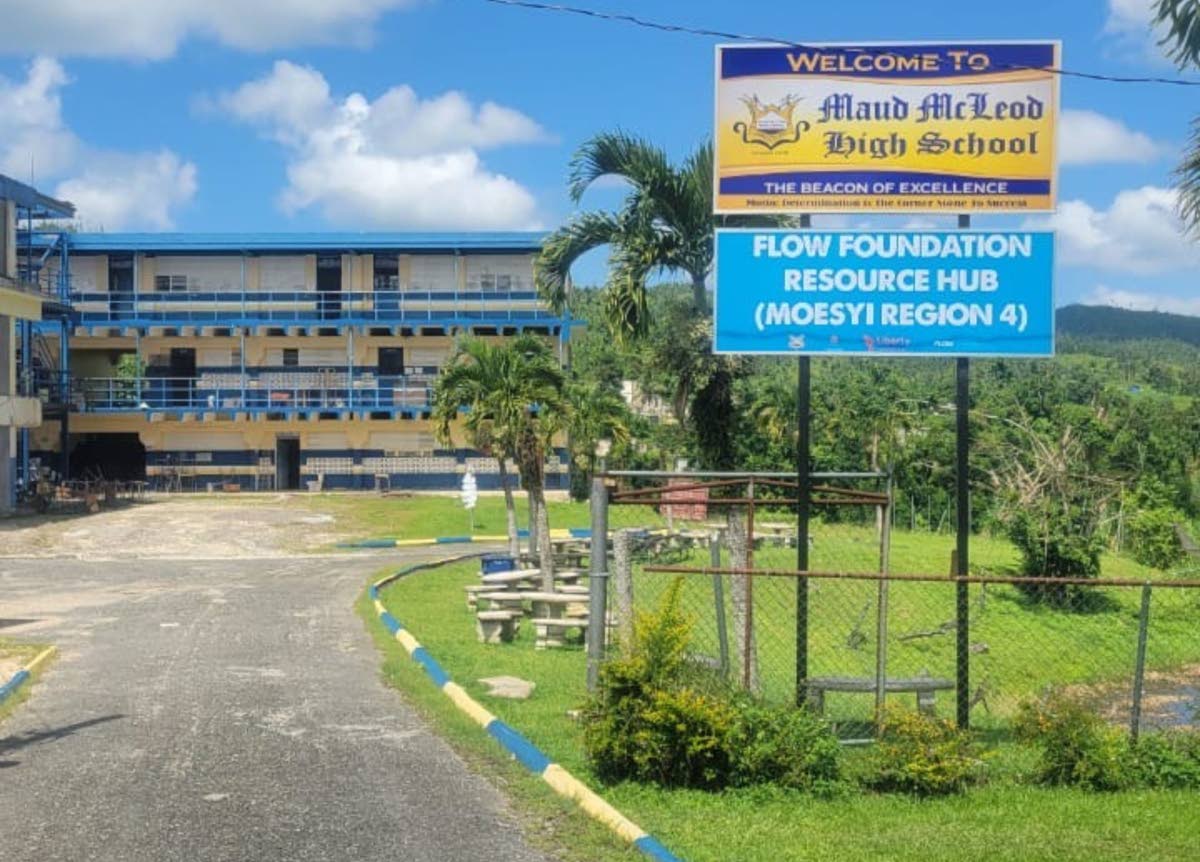 The entrance to Maud Mcleod High in Westmoreland.
While several schools across Jamaica, particularly in Region 4, are beginning the new academic year on a shift system as they continue to recover from the devastation caused by Hurricane Melissa, Maud McLeod High School is celebrating a milestone of its own: a return to single-shift schooling.
The Darliston-based institution was also severely damaged by the hurricane, with several areas left roofless and others suffering extensive water and structural damage. Yet, through a combination of community support, donations and ongoing repairs, the school welcomed students back on Monday with all grades attending during the same schoolday.
Principal Beverley Feare said the damage was extensive.
“The school was damaged, I would say severely damaged as well. The sixth-form block room; the entire agricultural science area, including classrooms, slaughterhouse, chicken coops, and greenhouse; the auto mechanic area; the tuck shop area... roofless. All the spaces I’m talking about, the pavilion on the play field... roofless,” she said.
She noted that other sections of the school were plagued by leaking roofs, while the plumbing system was also badly affected.
Rather than waiting for repairs to be completed, Feare said the school began restoration efforts as early as November.
“We started out as a school. The soldiers were here, and we would have been working with them. We got some materials, and they helped us to put on the sixth form room roof, and we were able to start back school in November,” she said.
A dream
For years, the school operated under an extended shift arrangement that had been in place since 2008, with students attending at different times. However, Feare said the administration gradually worked towards eliminating the system and had set September 2026 as its target for a return to single-shift schooling.
“This is a dream of us because when other schools were on straight shift, we had what we call an extended daytime table, where there was an overlapping time of the students,” she explained.
Last year, students in grades seven to nine attended classes from 7 a.m. to 1 p.m., while grades 10 and 11 attended from 9 a.m. to 3 p.m., allowing all students to be on the compound between 9 a.m. and 1 p.m.
Through careful timetabling, particularly for vocational and laboratory subjects, the school was able to accommodate all students without adopting the traditional morning-and afternoon-shift arrangement.
Feare believes the return to straight-day schooling could have a direct impact on academic performance.
“It will definitely benefit our students and the teachers as well, because they will have more time to teach the content,” she said.
She pointed specifically to mathematics and language, which require five hours of contact time each week under the Ministry of Education’s curriculum guidelines.
The principal is already encouraged by the school’s recent results, citing 100 per cent passes in information technology, electronic document preparation and Management, Caribbean history, physical education and visual arts. Mathematics improved to 43 per cent, while language rose to 83 per cent.
“We see an upward trend in terms of how students are performing. So, I can just imagine having five hours of math timetable, as well as five hours of language for the week. The students are definitely going to be doing well,” Feare said.
The significance of the change was reflected in the school’s opening-day devotion, where former student and teacher Rev Dr Franklyn Beckford returned to the institution he once attended as a grade-seven student.
Reflecting on his journey from student to teacher and board member, Beckford urged students to embrace the new academic year as an opportunity for transformation.
“New beginning, fresh start,” he told students, encouraging them to approach the year with a renewed attitude.
mickalia.kington@gleanerjm.com