Earth Today | ‘No surrender’
Loading article...
-
 Professor Michael Taylor.
-
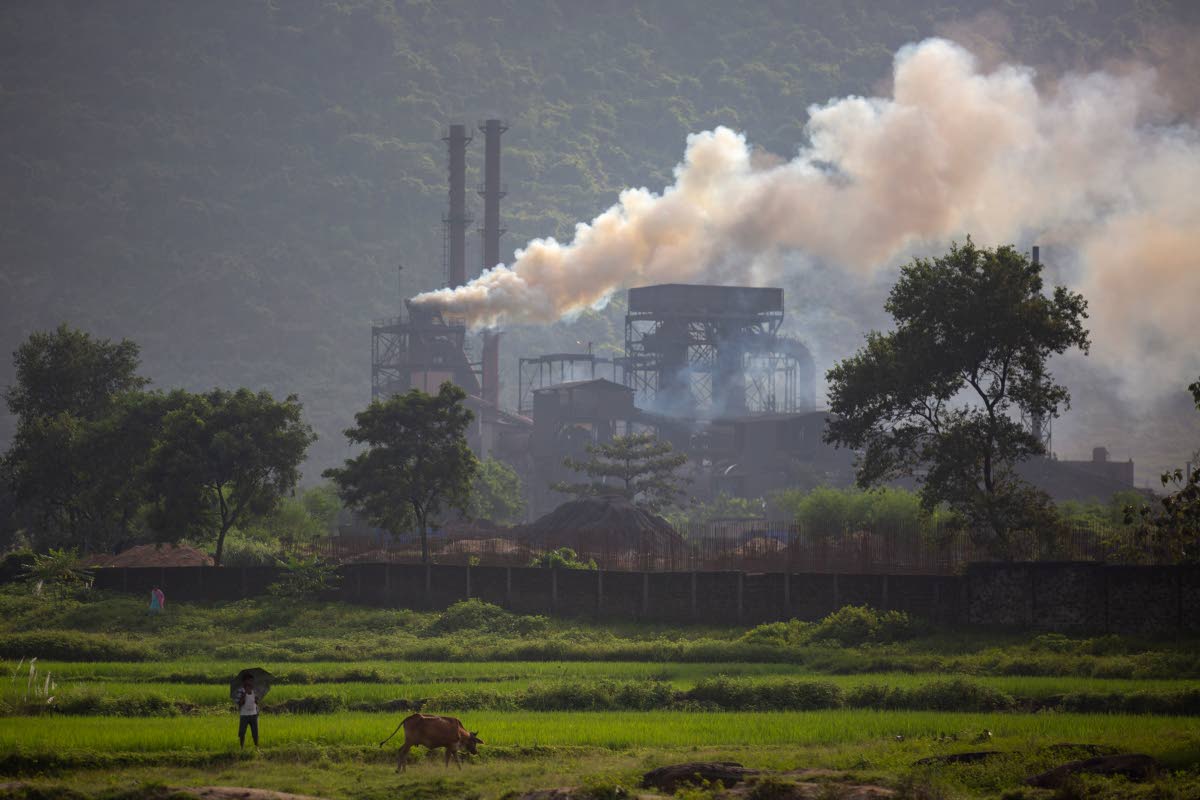 FILE – Smoke rises from a coal-powered steel plant at Hehal village near Ranchi, India, in eastern state of Jharkhand, September 26, 2021.
SMALL ISLAND states have renewed their call for scaled-up efforts to restrain global temperatures to no more than 1.5 degrees Celsius above pre-industrial levels, warning that every fraction of warming beyond that threshold increases the risk of permanent and devastating effects – many of which are already being felt.
“We know that every increment of warming above 1.5 degrees Celsius increases the risks of irreversible and potentially catastrophic impacts, from sea-level rise and the loss of habitability in low-lying islands to glacier and ice-sheet instability, forest dieback, coral reef degradation, and escalating threats to food and water security. For SIDS, these are not distant projections. They are risks unfolding before our eyes,” noted the Alliance of Small Island States (AOSIS) in a September 2 statement.
AOSIS represents the interests of 39 small island and low-lying coastal developing states in international sustainable development processes. Their statement comes in the wake of the recent publication of the concern-inducing United Nations Environment Programme (UNEP) report, Limiting Overshoot: Navigating exceedance of 1.5 degrees Celsius and pathways towards return.
The UNEP report cautioned that the world appears set, at least temporarily, to surpass global warming of more than 1.5 degrees Celsius above pre-industrial levels within the next few years. AOSIS insists that this finding must not derail efforts to reduce the emissions of greenhouse gases, such as carbon dioxide and methane, which are intensifying the warming of the planet.
“1.5 degrees Celsius is not an arbitrary goal that countries can waffle on or walk away from. It is the temperature limit that countries committed to pursue under the Paris Agreement, grounded in the imperative to protect people and the planet from the most dangerous impacts of climate change, and reinforced by the International Court of Justice’s recognition of States’ legal obligations to protect the climate system,” AOSIS said.
WAKE-UP CALL
“This report must not be interpreted as a reason to surrender the 1.5 degrees Celsius goal. It must be a wake-up call to act with far greater urgency. The trajectory is not yet fixed,” it added.
Pathways to close the emissions gap and pursue the 1.5 goal, AOSIS said, have been identified while “the best available science shows that the magnitude and duration of any potential overshoot can still be limited”.
“Governments must, therefore, focus not only on whether temperatures temporarily exceed 1.5 degrees Celsius but on doing everything possible to minimise that overshoot and return global temperatures to below 1.5 as rapidly as possible,” the group insisted.
They have also urged that the next Intergovernmental Panel on Climate Change (IPCC) assessment be available in time to inform the next Global Stocktake. IPCC is the international body responsible for the assessment of climate change research in order to inform the policy response.
SIDS have long warned of the dangers of a 1.5 overshoot.
“The severity of the climate change threat is dependent on the levels of greenhouse gas emissions concentration in the atmosphere. There is no global consensus as yet on what the future levels must be, but the Alliance of Small Island States (AOSIS) has called for targets that will limit the mean temperature increases to no more than 1.5 degrees Celsius,” noted celebrated physicist Professor Michael Taylor in a 2015 GraceKennedy Foundation lecture.
“Proposed limits are seen as ‘tipping points’ beyond which small changes in temperature will cause irreversible consequences. Achieving these limits is dependent on mitigation – actions that can be taken to reduce greenhouse gas emissions,” he added at the time.
Fast-forward to 2026 and not only does the 2015 Paris Agreement support a 1.5 goal, so does the science. The IPCC published its special report on 1.5 degrees of warming in 2018 – a report that cautioned of the dangers, including to SIDS, of exceeding that limit.
“Increasing warming amplifies the exposure of small islands, low-lying coastal areas, and deltas to the risks associated with sea-level rise for many human and ecological systems, including increased saltwater intrusion, flooding, and damage to infrastructure (high confidence),” it noted in the summary for policymakers.
pwr.gleaner@gmail.com