Selling sweets, serving children
Loading article...
-
 A student having a snack at Ascot Primary School in Portmore.
-
 Mark Jackson, principal of Ascot Primary School.
-
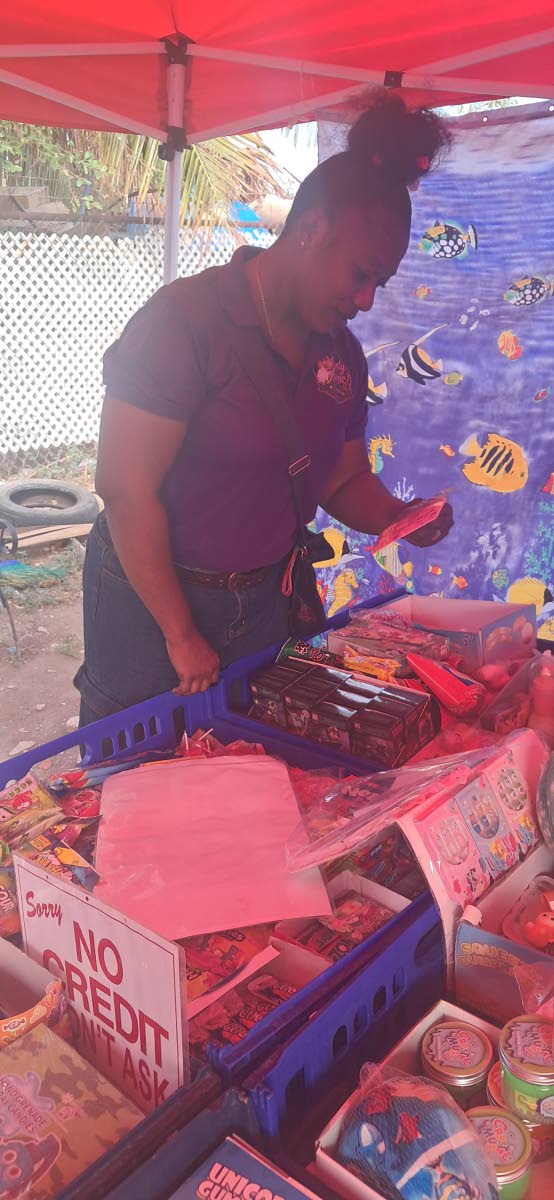 Antriesha Williams, vendor at Ascot Primary School in Portmore.
-

-
 Roogae Kirlew, principal of Spanish Town Primary School.
Antriesha Williams had no problem telling the two children “no”.
One wanted ‘vampire teeth’. The other wanted a ‘Surprise Bag’ — an assortment of toys and candy. However, with the school day about to begin, Williams turned them away from her stall outside Greater Portmore Primary School in St Catherine last Friday.
“I don’t sell my kids candy in the morning,” she said.
It is a rule she has imposed on herself for much of the 18 years she has been selling outside the school — long enough to watch generations of children grow up and to understand the complicated, bittersweet predicament facing vendors outside Jamaica’s schools.
They sell sweets, sugary drinks, toys and other temptations that principals and health officials are trying to keep away from children, especially in a school environment.
However, they also feed hungry students, lend money to parents, and watch out for children when school administrators cannot.
Sometimes, principals say, vendors are the first people to raise an alarm when a child is in danger and care for students long after school is dismissed and parents are tardy in picking them up.
Williams has a designated bench for such students.
“Because they are all mine,” she said.
“I am a people person, and so you have parents who rely on me. Sometimes they will call and say they don’t have any lunch money and ask me to give their children something to eat or lunch money for the day.”
“Once the children are happy, I am happy,” said Williams, decked out in her ‘uniform’ – a T-shirt branded ‘Auntie Annie’ and, on special days, Oxford blouses that are similarly tagged.
She sells corn flakes, pizzas, cup soups, doughnuts, fruits, burgers, tenders and fries, and is quick to speak of her food handler’s permit, though she did not have it on hand last week.
As she ushered away the two students, Williams also spoke of vendors’ internal struggles, the resentment bred by competing vendors, and the ‘bad names’ vendors outside school gates continue to receive.
Gospel music blasted from a small speaker on her stall. She said it soothes her and keeps her focused on her customers – her children.
Inside the school, the picture of vendors painted by the principal, Reverend Calvin Brown, was not so peaceful.
While reducing sugary drinks has been high on the government’s agenda, he said the vending problem is much broader than sweets.
Rules governing
school vending
“It is a sore issue,” he charged, noting that the school had held repeated meetings with vendors outside its gates, the police and parish authorities, to explain the rules governing school vending.
“Still, some of them just refuse to comply,” he continued.
According to Brown, cooked food without proper kitchen facilities and proof of a food handler’s permit is unacceptable. So, too, is the sale of toys that have little to do with students’ nutritional or educational needs.
The ‘chi-chi bum’ – a small marble-like toy that explodes when slammed onto hard surfaces – is one of his particular concerns.
“It is very loud, it frightens the children, and there are children who will cry that their ears are hurting them because of it,” Brown said.
He added that some vendors actively solicit sales from children.
“Children are on their way to school, and even in the mornings, and vendors will step out to stop them and lure them to buy,” he said, adding that some vendors also use unfriendly language and expletives.
Enforcement and regulation
“There needs to be some enforcement and regulation,” he said. “Without a framework like that, I don’t think we will be able to fix the problem.”
However, who should control the vendors remained unresolved last week.
Portmore Mayor Leon Thomas directed questions about food handlers’ permits to the Ministry of Health’s Public Health Department. He noted that while the municipal corporation can enforce regulations over vending locations, it has no control over what vendors sell.
He believes the government should go further.
“The Portmore Municipal Corporation has gone and served several vendors who have been found selling at the school, and several of them have been taken to court. But we also have letters from principals asking us to allow the vendors to sell at the school gate. To most of these requests, we have said ‘no’,” he said.
“[Principals] say the vendors are providing a service that they don’t offer inside. I am not exactly sure what that service is,” he said.
“But the Ministry of Health has to do something about the selling out there. If they are so serious about sugary drinks, I think they should ban it altogether. If they (vendors) don’t sell it in front of the school gate, they are going to sell it somewhere else.”
Last weekend, Health Minister Dr Christopher Tufton disagreed with an outright ban, instead urging schools, municipal corporations and vendors to work together.
“If the municipal authority has jurisdiction over vending and they are collaborating with the schools with a coordinated effort, there is impact that could be had outside the school gate,” he had said.
“Banning it altogether is not a ministry decision. The issue of restrictions is a government decision, and the benefits are clear.
“Personally, I wouldn’t mind only water being served in the schools, because I believe it is the best option. But, given the fact that we want to maintain some level of choice within the environment generally, and the vendors also serve the wider community, the issue must be some levels of enforcement. I think we have to try that first.”
Parents also have
a part to play
Tufton noted that parents also have a part to play in reducing demand from their children.
The latest Global School-Based Student Health Survey, involving 3,058 students, found that 41 per cent had eaten no fruit during the seven days before the survey, while only 27 per cent reported eating vegetables at least once per day.
For parents, the message is beginning to hit home.
One mother of a six-year-old daughter at Greater Portmore Primary School said she previously gave her daughter $100 every morning for pocket money.
“This was for her to just buy what she wants, her choice,” she said, noting that she became particularly concerned after seeing how badly her daughter’s teeth had deteriorated.
“Most of the baby teeth fell out, so now I don’t want any of the new teeth to start rotting again,” she said.
While she still gives her daughter the allowance, she emphasises that it should not be spent on sweets.
“They just need to put a restriction on the stuff that we should not sell,” Williams said.
“They say ‘Don’t sell water guns’ and people still do it. They say ‘Don’t sell tail combs with the iron on it’ and they still sell it. So you have to enforce the restriction on it; make a list.
“But that would mean we have to get rid of all of these things, and, if we don’t sell sweets, how are we going to survive, because it is what attracts the children,” she admitted.
At Ascot Primary School, Principal Mark Jackson has moved vendors from directly along the school’s perimeter fence to an open lot across the road.
The school does not sell sweets or sodas, but the vendors do.
It upsets Jackson, who however takes care in addressing what he described as the school’s unofficial safety network for its students.
On several occasions, vendors have been the first to alert the school when students fall ill. In one instance, a vendor intervened when a father was physically abusing his child.
Such contributions cannot be ignored, Jackson said.
“So, while they are selling some of the things that don’t contribute much to the well-being of our students ... they serve a good purpose,” he said.
At Spanish Town Primary School, Principal Roogae Kirlew has no control over vendors outside but runs a strict programme within the school walls.
His school observes a fruit-and-water day every Wednesday, and bans sodas while encouraging vendors to sell low-sugar drinks.
“It is a challenge to supervise things outside of school jurisdiction,” he said of the vendors, whom he regards as part of the school community.
“They are indeed an extension of the school. They are among the first to support fundraising and other activities and, at the end of the day, selling is survival for them.”
corey.robinson@gleanerjm.com