Clarendon councillors push permanent water fixes
Loading article...
-
 Barnswell
-
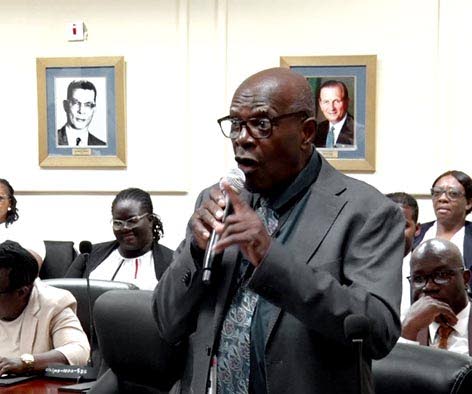 Mitchell
-
 O’Connor
-
 Thompson
-
 Williams
The $91.6-million Bunkers Hill water supply project is expected to benefit more than 1,000 residents in northern Clarendon, but councillors say much more must be done as the parish continues to grapple with a prolonged drought that has strained households, schools, farms and public health.
Commissioned last month, the Rural Water Supply Limited-implemented project serves the communities of Bunkers Hill, Mears, Broadleaf and Nairne Castle, and is expected to provide a more reliable daily supply of potable water to residents.
Mayor of May Pen, Councillor Joel Williams, welcomed the development, describing it as a timely boost for communities facing growing concerns about water security.
“While we continue to struggle with water availability, it is important to acknowledge that efforts are also being made at the national level to provide meaningful support to affected communities,” Williams said of the recently commissioned project. “This is welcome, particularly at this time when water security has become such a critical concern for our people.”
However, councillors used this month’s sitting of the Clarendon Municipal Corporation (CMC) to highlight the broader challenges posed by the drought and call for long-term investment in water infrastructure throughout the parish.
Williams said the corporation remained in discussions with the Ministry of Local Government to secure additional water trucks for affected communities.
Addressing the meeting, Williams said the ministry had received the relevant documentation and was processing the request. An update was also expected on previously announced funding for water trucking.
Invest in infrastructure
The CMC has separately committed $3 million to assist communities hardest hit by water shortages.
However, Thompson Town Councillor Collin Henry warned that water trucking should not become the parish’s default response to recurring drought.
“The northern side of the parish is suffering from people not having water in their house, their pipes or anything,” Henry said.
He argued that greater attention should be paid to springs and gullies in the hills, which he believes could be developed into more reliable sources of supply.
Henry said schools in Thompson Town were still dependent on water trucked from May Pen despite the existence of potential sources closer to those communities.
“It pains my heart,” he said.
While welcoming the funding, Henry argued that Clarendon must invest in infrastructure capable of reducing its vulnerability to future droughts.
“While we welcome the funding, we can’t be doing this every year. This trucking of water is really not sustainable,” he said.
Crofts Hill Councillor Anthony O’Connor said the situation required a broader rethink, with drought being treated as a disaster requiring targeted intervention.
“All disasters must be treated as disaster, with emphasis on origin,” O’Connor said.
A farmer who represents a northern division, O’Connor said the drought had persisted for about five months and had caused some municipal water sources to dry up.
He pointed to the Bull Head Mountain area, where water is available but existing infrastructure is not adequately capturing it.
“There is an abundance of water in the Bull Head Mountain,” O’Connor said, citing problems with pumping infrastructure, including a failed solar pump and continued reliance on a gas-powered unit.
O’Connor also warned of wider health implications, saying doctors serving Kellits and Crofts Hill had reported treating more patients for hypertension and high blood pressure.
“This drought caused more health effect to the citizens,” he said.
He called for public education on the health risks associated with prolonged water scarcity, including the importance of hydration, sanitation and heat management.
Agriculture, he added, was also under increasing pressure.
“We have over 10,000 registered farmers. RADA (Rural Agricultural Development Authority) is absent, and it is going to affect our food security,” O’Connor said, calling for closer engagement between the municipality and the Ministry of Agriculture.
‘Water for Life’
Rock River Councillor Uriah Mitchell argued that drought should be treated with the same level of preparedness as hurricanes.
“It is a disaster. I say all the time, we make preparations for hurricane, but we don’t make preparations for drought. Drought is a disaster,” Mitchell said.
He pointed to the continued absence of a reliable water supply in Rock River, noting that councillors had repeatedly raised the issue while awaiting promised infrastructure upgrades.
Mitchell said the National Water Commission had previously indicated that a project would reach Rio Bueno, but questioned the status of the intervention.
Invoking the agency’s motto, “Water for Life”, he renewed his appeal for water for Rock River residents.
“The division of Rock River died. Them dead! So, we are asking on behalf of the people of Rock River, for water. Water, sir,” he said.
Hayes Councillor Scean Barnswell described drought as a “perennial problem”, citing inadequate water supplies in sections of Hayes and Rocky Point.
Barnswell questioned whether the municipality would receive sufficient funding to sustain water trucking and noted that correspondence before the council did not appear to include the expected allocation from the Ministry of Water, Environment and Climate Change.
Meanwhile, acting disaster preparedness co-ordinator Stacey-Ann Hennigham said the CMC was incorporating drought into its disaster-preparedness programme through partnerships with RADA, the Jamaica Fire Brigade, the Ministry of Health, the Parish Development Committee and the Social Development Commission.
“The sessions are focused on increasing public awareness of the impacts of drought, promoting practical measures to reduce vulnerability, conserve water, and protect livelihood,” Hennigham said.
She said RADA had provided farmers with drip-irrigation kits and pond liners to improve water efficiency, harvesting and storage, while the Clarendon Health Department was educating communities on safe water storage, sanitation, hygiene and water-related diseases.
olivia.brown@gleanerjm.com