Remembering the days of Common Entrance
Loading article...

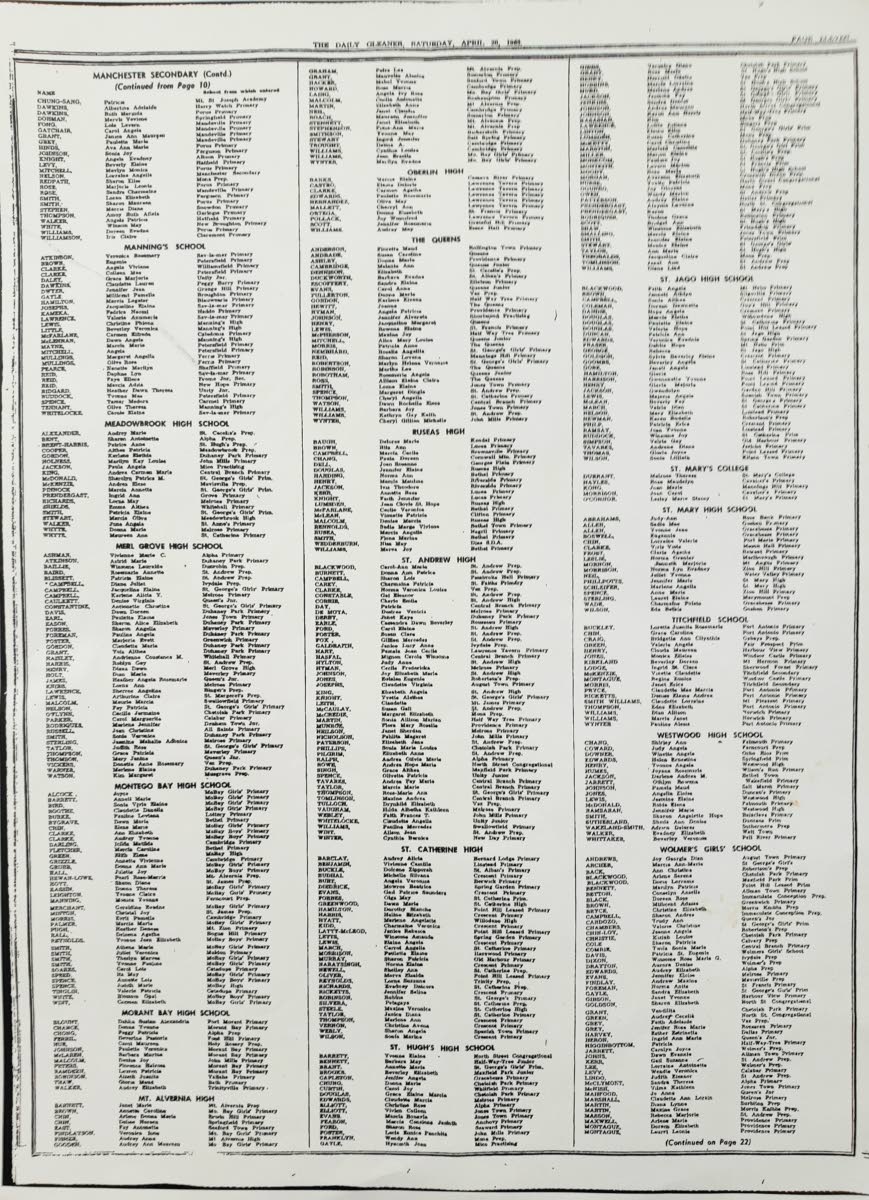
When I sat the Common Entrance Examination (now PEP) in 1968, there were no horns, bells, or mini carnivals for those who passed. Maybe a tub of your favourite Buckingham ice cream if you were on good behaviour. And yes, a few congratulatory telegrams from out-of-town family members who would have either heard or seen the results in The Gleaner. The telegrams were delivered by the town’s postman, ringing his bicycle bell at the gate. The Gleaner sold out early on exam-results day. Scores of hopeful children lined up at Dunbar’s River awaiting the arrival of the Gleaner van to see whether they had been successful.
My exams were on a Friday morning in January at a school next to my house. On Thursday evening, a friend and neighbour of mine, Clive Stewart, and I walked over to the school to ascertain where our desks were located for the exam. We found them upstairs and excitedly awaited Friday morning to sit the examinations.
Compared to what we were being taught in grade 6 at Savanna-la-Mar Primary School by Dorothy Jordan, along with the extra lessons from Mr Hubert Wanliss (nominative and accusative cases, Latin roots of words, LCM/HCF, Brighter Grammar, A Student’s Companion, and First Aid in English A to E), the examinations were not stressful at all. English, mathematics, and a general intelligence test, all sat in one day.
What was stressful was the delivery of the results. They were published in The Gleaner on Saturday, April 30, over many pages, along with a few special scholarship winners and free-place recipients. I have absolutely no recollection of the modern-day luxury of being asked which high school you’d like to attend. The teacher and my mother were friends, so I don’t know whether there was some discussion of which I was unaware. In any case, Savanna-la-Mar had only one high school then, Manning’s, so you were placed either there or transferred to Cornwall or Munro for boys, or Hampton for girls. St Hugh’s was also a very popular choice for girls, probably because it was a great school and the then principal, Inez Carnegie, was a Westmoreland native.
Nuff alarm bells rang when students were placed in schools that were not on their radar and they couldn’t find their names. Bright spark Jane Doe from Negril, for example, combed the Manning’s list five times searching for her name, to no avail. After shedding more tears than all the waters at Roaring River, she learned the following day, through a teacher, that she had been placed at Rusea’s in Lucea. It was not unusual for students to be placed in schools near their home addresses. There were many instances of this, especially in Kingston and St Andrew, because of the wide choice of schools.
Vinette K. Pryce, the Jamaican-born New York City journalist who attended Perkins Prep on Brentford Road in Kingston in the early 1960s, says she remembers vividly the stress of the night before the results came out. “I looked up to the stars above and prayed sincerely that I would pass.” She did. But she remembers that in those days there were many who passed, but could not take up the offer because they were too poor to buy shoes, books, uniforms, bus fare, and lunch.
Students who did not attain a free place, but whose performance in the examination was satisfactory would receive what was called a “half scholarship”, which secured for them a place at high school with a small tuition fee. The agony was that this list was published perhaps two weeks later, so students and their parents had to sit tight on pins and needles. Those who did not make those lists had either to pay full fees at a traditional high school, which was not cheap, at about £30 to £40 per term, or register at a junior secondary school that focused on skills development at no cost.
All requests for transfers in the late 1960s had to come via a written request to the permanent secretary in the Ministry of Education. Nowadays, parents appear to be on their own in navigating the daunting hurdle of obtaining a transfer.
It is worth noting that before the Common Entrance Examination began in 1957, premium high-school places at institutions, such as St Hilda’s Diocesan, Servite Convent of the Assumption, Knox College, and Jamaica College were largely limited to wealthy ‘brownings’ or expatriates. There were previously island scholarships to schools like JC, but these amounted to only two students per parish. Black children were mostly shut out from good schools, and we must thank the churches and a few pioneers for kicking down the school gates for the majority of Jamaicans. Of distinguished note are Bishop Percival Gibson, Wesley A. Powell, Rev George and Nellie Olson, Ivy Mae Grant, and others.
Let us join the PEP awardees in celebrating loudly with joy and glee. Students will always grow where they are planted, but lest we forget, many years ago such access was only a dream.