NIDS ID gaining traction... but privacy concerns and public trust issues persist
Loading article...
-
 President of the Jamaica Umbrella Group of Churches, Bishop Dr Roy Notice.
-
President of the Jamaica Umbrella Group of Churches, Bishop Dr Roy Notice.
-
 Jamaica Bankers Association CEO Barbara Hume.
-
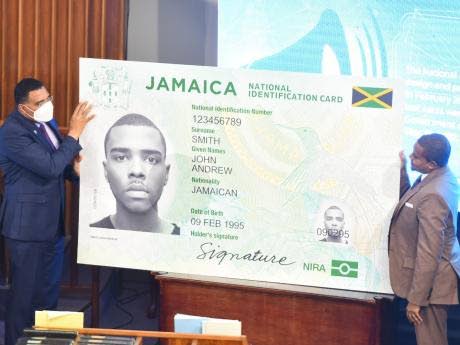 Prime Minister Andrew Holness (left) and then Minister without Portfolio in the Office of the Prime Minister Floyd Green holding a display of the proposed National Identification System card in the House of Representatives on May 24, 2022.
For Jamaicans who have already signed up for the new national identification (ID) card, one question has loomed larger than most: Can I actually use it?
At least where the country’s banks are concerned, within the last month, the answer is increasingly becoming yes.
The Jamaica Bankers Association (JBA) says all of its member institutions have now added the National Identification System (NIDS) card to the list of government-issued photo identification cards accepted when conducting business.
That places the national ID alongside the voter’s identification card, driver’s licence and Jamaican passport as recognised forms of identification across the banking sector.
But, while the card has secured acceptance, it is not a one-size-fits-all solution.
Asked whether the national ID by itself would be sufficient in all circumstances to do business with the banks, JBA Chief Executive Officer Barbara Hume said it depends on whether the transaction was “low-risk” or “high-risk”.
“All other things being equal, if you are opening what is regarded as a relatively low-risk account, meaning an account where fairly modest sums will pass through for the purpose of, for example, receiving your salary or other usual and ordinary payments, then, under the Bank of Jamaica Regulations, simplified due diligence would apply and the customer is required to supply only one government-issued photo ID, along with their TRN (taxpayer’s registration number) in order to open an account,” Hume said.
However, customers engaged in significantly larger or more complex financial transactions should not expect the national ID card to replace all other documentation.
Someone moving millions of dollars through a bank account, particularly from multiple sources, would still be subject to enhanced due diligence, Hume explained.
That means banks may request additional forms of identification, documentation proving the source of funds, and other supporting information as part of anti-money laundering and risk-management requirements.
“It is about the level of risk,” Hume said.
Although all 10 JBA member institutions now recognise the card, Hume noted that integrating it into day-to-day operations is not as simple as flicking a switch.
Each financial institution operates different technology platforms and internal systems.
“Each member institution is doing what it needs to do in order to integrate the national identification card into its automated processes for identification purposes,” she said.
Behind those efforts is a wider digital transformation taking place across both the public and private sectors.
Executive director of the National Identification and Registration Authority (NIRA), Dr Warren Vernon, said the process received an important boost after the Bank of Jamaica issued new guidance on June 17, outlining how financial institutions should use the national ID card under the new legislation.
Another key piece of the puzzle is the Jamaica Data Exchange Platform (JDXP), the secure digital infrastructure that allows authorised organisations to verify identities and exchange information with the consent of the individual involved.
Vernon compared the platform to Estonia’s internationally recognised X-Road digital system.
Several financial institutions, he said, have already begun implementing the platform, while others are expected to come on stream in phases rather than simultaneously.
“I am aware that several institutions are already taking steps to implement JDXP,” Vernon said.
The Information and Communications Technology Authority has already made the portal available for financial institutions to subscribe.
GOV’T AGENCIES
While banks appear to be well advanced in adopting the new identification system, the picture across the wider public sector is less clear.
Vernon was unable to say exactly how many government entities have fully integrated the card into their operations.
He stressed, however, that all ministries, departments and agencies are required under the law to begin accepting it.
“The government’s objective is to make the national identification card the trusted means of proving identity across the public sector,” he said.
According to Vernon, Cabinet has already issued directives requiring public bodies to accept the card.
Some agencies have moved quickly.
The Urban Development Corporation now accepts the card at all of its attractions, allowing Jamaicans, including members of the diaspora, to access local admission rates.
The National Housing Trust has also updated its procedures to recognise the card.
The document has found additional practical uses as well.
Several justices of the peace (JPs) are now using it as their official JP identification because of special features embedded on the card, while persons with disabilities have begun relying on it because it incorporates the internationally recognised access symbol.
REPORT REFUSALS
Despite those gains, Vernon acknowledged that not every organisation has embraced the new identification system.
He urged cardholders to notify NIRA whenever the card is rejected.
Four such reports have already been investigated.
In each case, Vernon said, NIRA contacted the leadership of the organisation involved and the issue was quickly resolved.
He warned that refusing to accept the card where required may amount to a breach of the National Identification and Registration Act and its regulations.
After moving beyond its pilot phase, NIRA is now shifting into full national rollout.
Approximately 2,300 Jamaicans enrolled for the national ID card in April alone, and the agency is targeting 100,000 enrolments by the end of the current financial year.
The Government has allocated $1.86 billion in the 2026-27 Budget to support implementation of the National Identification System.
To improve access, enrolment has expanded beyond Kingston, with services now available through several Registrar General’s Department offices, including Portmore, Twickenham Park, May Pen, Mandeville, St Ann’s Bay, Montego Bay and Port Antonio.
Santa Cruz is expected to be added before the end of July.
NIRA has also introduced mobile enrolment units, allowing employers to arrange on-site registration for staff.
“We have been able to refine our processes, improve customer experience, optimise our technology, and prepare for national scale,” Vernon said.
TRUST HURDLE
Even as the rollout accelerates, questions about privacy and public confidence have not disappeared.
Some religious groups and citizens have labelled the NIDS as the biblical ‘Mark of the Beast’. Critics argue that the centralised biometric database, which requires fingerprints and facial scans, mirrors the surveillance and control described in the Book of Revelation.
President of the Jamaica Umbrella Group of Churches, Bishop Dr Roy Notice, said the organisation had not taken a “formal for-or-against” position on the new NIDS.
The clergyman said the Umbrella Group of Churches had an interest in the principles of good governance, protection of privacy, constitutional rights, public trust and accountability.
“A national ID system can serve useful purposes, but the public must be properly educated about what the law now says, what has changed, and what protections exist,” Notice said.
He believes lingering scepticism is understandable after Jamaica’s original NIDS legislation had infringed people’s rights and was struck down by the Constitutional Court.
“The Government may say the new law is different, and that may be so, but public confidence will depend on what we experience, not just legislative assurance,” he said.
Notice argued that public education remains one of the Government’s biggest challenges.
“Some Jamaicans are not even aware that new legislation has been passed or how it differs from the earlier version. If citizens are being asked to trust the system, they must first understand the system.”
Even so, he noted that Jamaicans already routinely entrust sensitive personal information to banks, tax authorities, healthcare providers, telecommunications companies and countless online services.
“Much of our personal data is already held by both public and private institutions,” he observed.
edmond.campbell@gleanerjm.com