Shaquille Ramsay | Between two storms
Loading article...
-
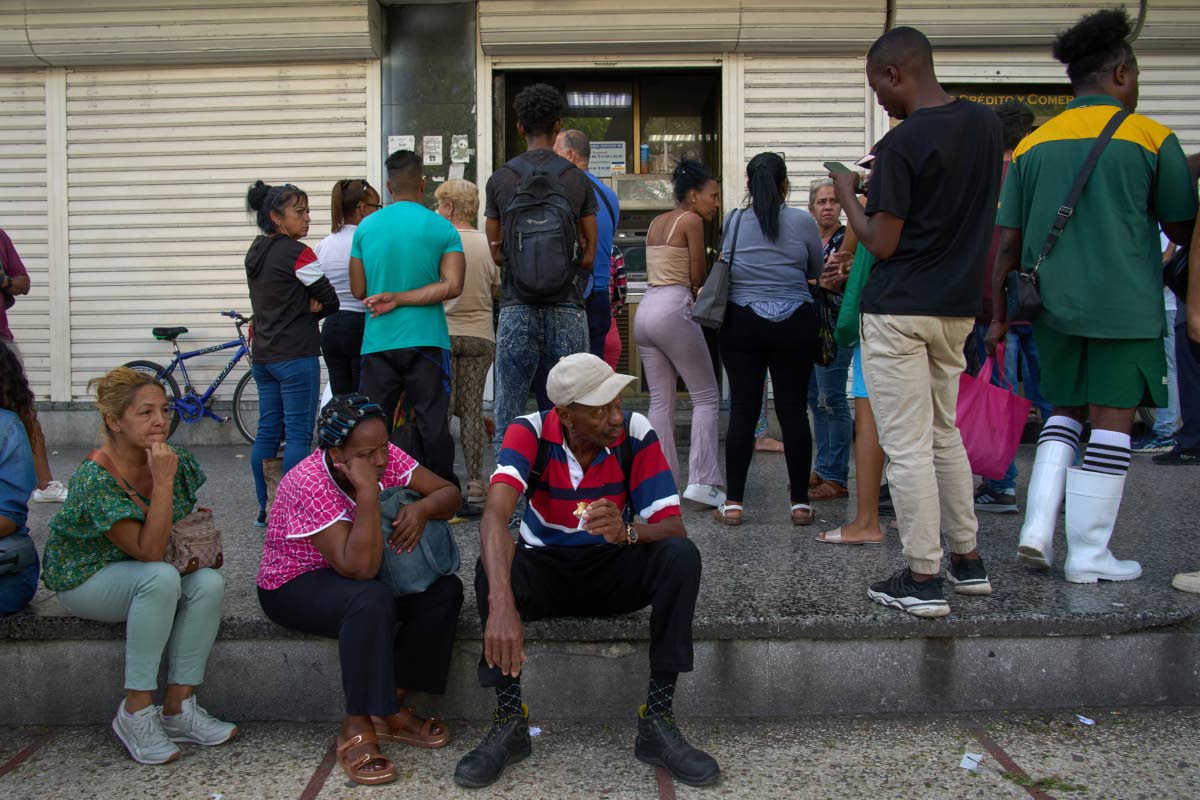 People wait their turn to enter a bank in Havana, Cuba.
-
 Shaquille Ramsay
Ninety miles separates Cuba from the coast of Florida. Less than a hundred miles separates Jamaica from Cuba. As the drumbeat of American political rhetoric grows louder toward Havana, the Government of Jamaica appears to be sleepwalking into one of the most consequential foreign policy moments this region has faced in a generation.
If Washington moves against Cuba – through incursion, naval blockade, or military action – Jamaica will not be a bystander. Geography will not allow it.
GEOGRAPHY OF CONSEQUENCE
The Caribbean is not a vast ocean that absorbs great power politics without incident. It is a narrow corridor, and Jamaica sits at the heart of it. In the event of American military action against Cuba, our airspace, territorial waters, ports, and diplomatic silence all have value to a superpower in motion. During the Cold War, Caribbean governments were routinely courted, coerced, and destabilised over the Cuba question. Prime Minister Holness must understand this is not a distant dispute. It is knocking on our door, and we must decide whether our response is shaped on our own terms or someone else’s.
WHICH CUBA ARE WE STANDING WITH?
For decades Jamaica has maintained solidarity with Cuba – rooted in the Non-Aligned Movement, in Michael Manley’s diplomacy of the 1970s, and in cooperation that has genuinely benefited ordinary Jamaicans. That history matters. But solidarity is not theology. The question our leaders have failed to ask directly: Are we standing with the people of Cuba, or with the government? Because these are not the same thing. Miguel Díaz-Canel was selected by the Communist Party’s National Assembly – no opposing party, no independent press, no credible international observers. Cuban dissidents – the Ladies in White, the San Isidro artists dispersed in 2020, the 1,000 protesters arrested after July 2021 – these are the Cuban people too. When Jamaica says it stands with Cuba, does it stand with them?
Michael Manley – whose legacy this writer holds in profound respect – was a democratic socialist. The critical word is democratic. His vision was of people who chose their own path through the ballot. We cannot claim that legacy while extending unconditional solidarity to a government that has denied its people that right for sixty-five years. And we must not allow the narrative that Cuban medical professionals serving abroad are trafficked victims to stand unchallenged – the reality is far more complex, shaped by a domestic cost structure unlike Jamaica’s and documented as largely voluntary in academic literature. We must not allow American foreign policy propaganda to become our national epistemology.
AMERICAN HYPOCRISY MUST BE NAMED
In the same breath, Washington’s conduct must be called out. The history of American foreign policy in this region is not the history of a benevolent democracy – it is coups in Guatemala and Chile, invasions in Grenada and Panama, and a sixty-year embargo punishing Cuban civilians for the sins of their government. The political establishment speaking of Cuban freedom said nothing comparable about Saudi Arabia or Egypt. This selective morality has a name. Marco Rubio – Secretary of State and dominant Trump voice on Cuba – carries a personal, generational grievance toward Havana. Personal vendettas prosecuted with American power have historically produced catastrophic consequences for small nations caught in between. If Washington violates Cuban sovereignty by force, it hands Moscow and Beijing the ultimate propaganda gift: that sovereignty belongs to the strong, not the many.
WHAT JAMAICA MUST DO
It is worth noting, with genuine commendation, that Mark Golding – Leader of the Opposition – has made the astute decision to hold his counsel on this matter. His silence is not absence; it is strategy. In refusing to be drawn prematurely into this debate, Golding has modelled the disciplined restraint that defines a statesman over a politician. It is a lesson the Holness Government would do well to study.
The Prime Minister must move beyond comfortable ambiguity. Jamaica must publicly oppose any unilateral military action against Cuba – not as a pro-Cuba position, but as a pro-sovereignty position consistent with what we say about Russia in Ukraine. We must simultaneously affirm that the Cuban people deserve free elections. We must warn Washington that destabilising an eleven-million-person island will produce a refugee crisis every Caribbean nation will bear. And we must coordinate with CARICOM on a unified regional position grounded in international law.
There is a version of Jamaican foreign policy that waits to see which way the wind blows. It has a long and inglorious history in post-colonial states, mistaking survival for wisdom and silence for strength. Then there is the version Michael Manley embodied in 1975 – when he made Jamaica’s small voice carry the weight of a large conscience. That Jamaica is still possible. The storms gathering over Havana will not stay in Havana. Let us ensure that when history records this moment, Jamaica’s voice was on the right side of both freedom and peace.
Shaquille Ramsay is a student at the University of the West Indies, Mona Campus. Send feedback to shaquilleramsay@gmail.com.