Jamaica must build resilience, collaborate in climate-sensitive world – IMF managing director
Loading article...
-
 Amitabh Sharma
-
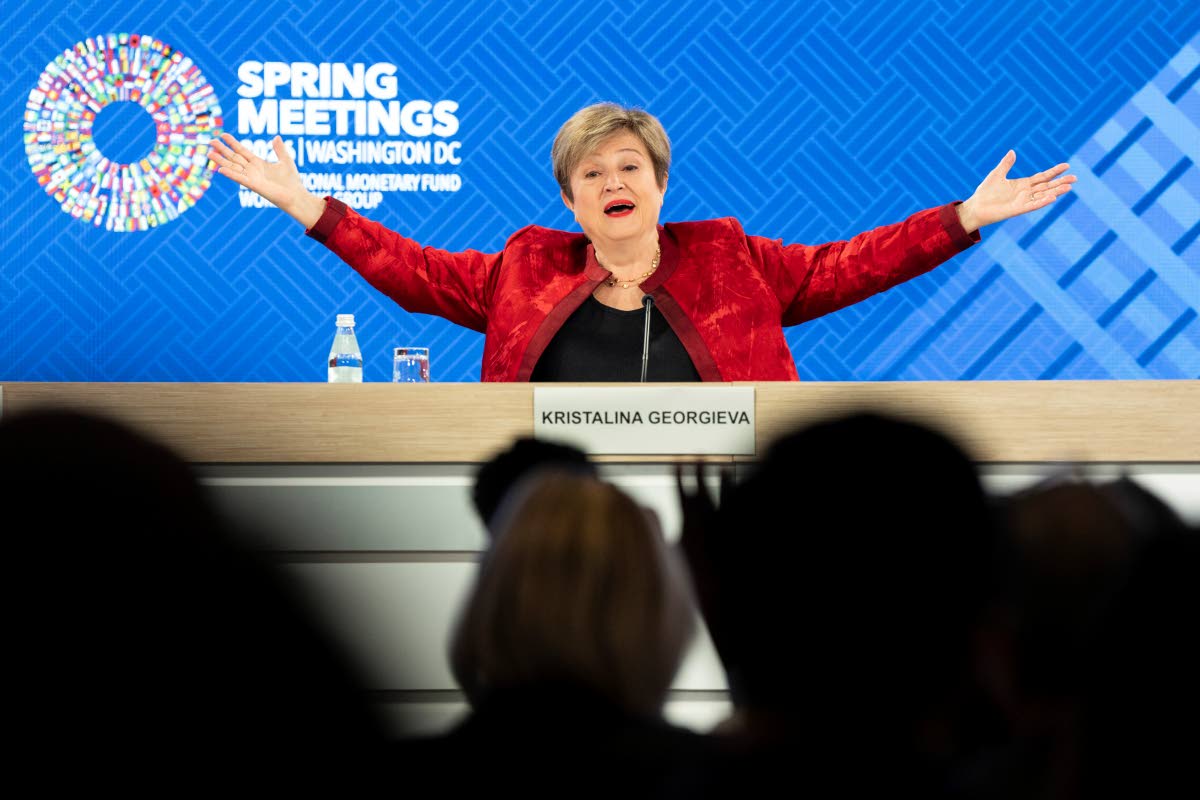 Managing Director Kristalina Georgieva briefs the press on the IMF’s Global Policy Agenda during the 2026 Spring Meetings of the International Monetary Fund and the World Bank Group in Washington, DC, April 15, 2026.
-
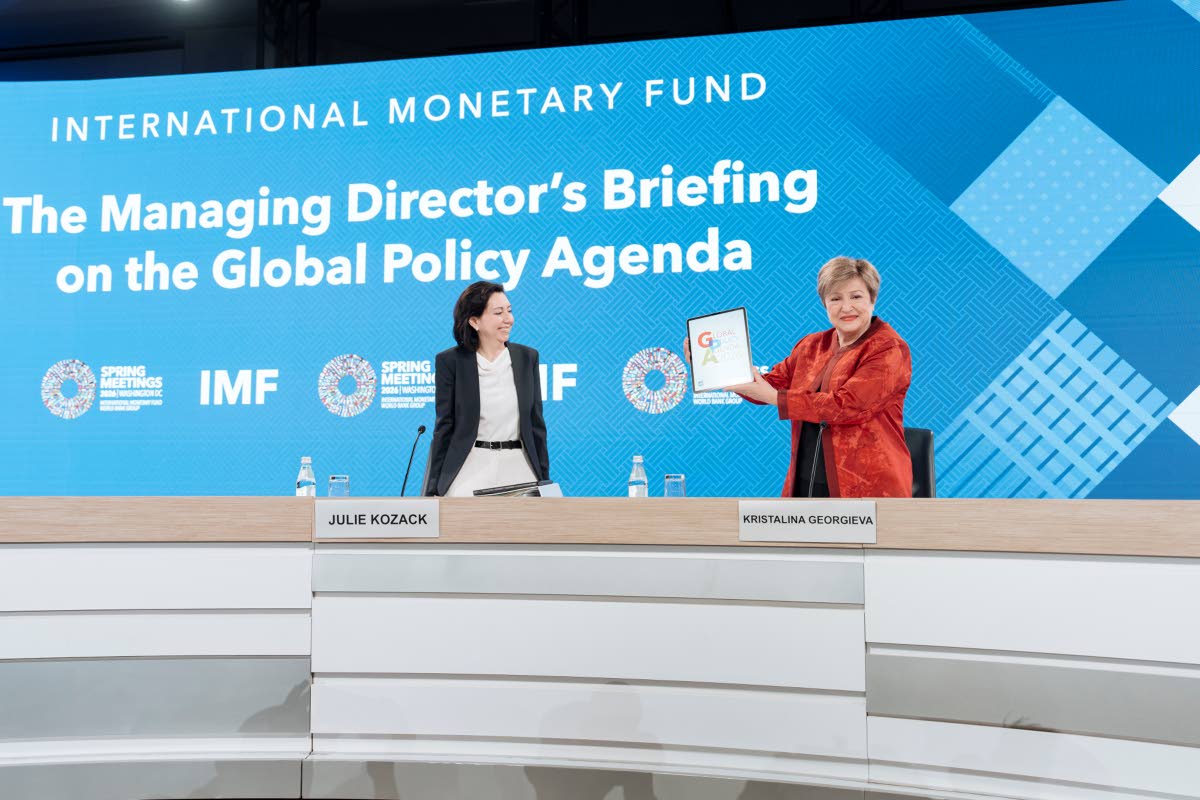 Managing Director Kristalina Georgieva holds up a digital copy of the IMF’s Global Policy Agenda report as Communications Department Director Julie Kozack looks on ahead of a press briefing during the 2026 Spring Meetings of the International Monetary Fund and the World Bank Group in Washington, DC, April 15, 2026.
Washington:
The conversations at the IMF’s Spring Meetings 2026, from April 13 to 17, primarily focused on the ongoing Middle East conflict, its debilitating impact on global economies, and how the Fund can best support low-income economies. And with that shock coming close after Hurricane Melissa last October, which left more than US$12.2 billion in damages and losses and overall cost the island 56.7 per cent of GDP.
Jamaica, literally and figuratively, was very much part of that conversation.
“The shock is global,” said Kristalina Georgieva, the managing director of the IMF. “All countries are facing higher energy prices, but the negative impact is highly asymmetric, with the biggest burdens falling on countries that import energy and have limited policy space … in many cases these are low-income and fragile economies.”
While considered a middle-income country, those observations resonate with Jamaica, still highly vulnerable to economic and climate shocks after a dozen years of tough fiscal reforms that halved the country’s debt to below 70 per cent of GDP.
The World Economic Outlook, meanwhile, has painted a grim picture. “Once again, the global economy is threatened with being thrown off course – this time by the outbreak of war in the Middle East … ,” the WEO said.
“Under the reference forecast, global growth is projected to be 3.1 per cent in 2026 and 3.2 per cent in 2027, slower than its recent pace of about 3.4 per cent in 2024–25, and to settle at about that rate in the medium term, slower than its historical (2000–19) average of 3.7 per cent. The forecast for 2026 is revised downward by 0.2 percentage point and that for 2027 is unchanged, compared with those in the January 2026 WEO Update.”
For Jamaica, GDP annual percentage change projection is negative 1.2 per cent for 2026, but is likely to rebound to 3.1 per cent in 2027.
“It is a painful story for Jamaica,” Georgieva said at the Managing Director’s Press Briefing on the Global Policy Agenda, which focused on mitigating climate shocks. “We see that happening in many climate-vulnerable countries on a repetitive basis, more frequently and across the world this climate phenomenon is becoming more of a threat to countries.”
PRAISED
She commended Jamaica’s climate-change resilience, especially after being impacted by back-to-back storms, Hurricane Beryl in 2024, which was estimated to have caused J$32 billion in damage according to the Planning Institute of Jamaica, and the category 5 Hurricane Melissa, which devastated western parishes and left US$12.2 billion in damages and losses.
“In the case of Jamaica, we did actually provide emergency financing, we were part of a coordinated group with the World Bank, and the Inter-American Development Bank, CAF (Development Bank of Latin America and the Caribbean),” Georgieva said, in response to a question posed by The Gleaner, on making small island states like Jamaica climate resilient.
She praised the Jamaican Government and Prime Minister Dr Andrew Holness, who, she said, “personally took upon himself to make sure that international support was well coordinated and as impactful as possible”.
Georgieva recommended that Jamaica, going forward, should work to move the economy to a climate-sensitive place. “It is crucial to build resilience to these shocks, both in terms of how infrastructure is constructed, but also in terms of fiscal buffers and insurance products.”
Jamaica, she said was a leader in securing disaster insurance, which helped the island tremendously. That is indeed the language being used by the Holness administration about the island’s post-hurricane reconstruction, for which it established an agency called National Reconstruction and Resilience Authority (NaRRA) to fast-track the rebuilding, beyond the western third of the island, which took the brunt of Melissa’s fury. Among the projects NaRRA will undertake, the Government has said, is the construction of a new hospital in Kingston and rehabilitation of the airstrip at Vernamfield in Clarendon to create an international aerodrome capable of accommodating large commercial aircraft.
“NaRRA is not simply a mechanism to spend money on rebuilding. It is a mechanism to use rebuilding as a means of strengthening Jamaica’s capacity, deepening domestic capability, and laying a firmer foundation for long-term growth,” Dr Holness said in a statement on NaRRA to the parliament.
WORK TOGETHER
The IMF managing director, while commending the region for putting in work to mitigate climate change, called upon the small island states to work even more closely together.
In this period of tension between the members of the Caribbean Community (CARICOM), over issues ranging from differences over US policy in the region to the choice of a secretary general for the community, Georgieva, significantly highlighted the value of integration for small countries, especially in the face of global shocks. “Regional cooperation and regional integration,” she said, is critical as “small countries cannot easily access insurance products alone. But when they pull together, they can do it … .”
Knowledge and expertise sharing, she said, is also important.
“Learning from each other, taking precautionary measures together [is critical] but also finding opportunities to strengthen growth,” Georgieva said.
Meanwhile, IMF’s Western Hemisphere Regional Economic Outlook 2026 said the conflict in Iran is creating a renewed, highly unpredictable challenge at a time when the region was working to recover from the consequences of COVID-19. “As a consequence, downside risks have increased for the Western Hemisphere region, especially given that it is difficult to have a clear picture on whether the current ceasefire will endure.”
The regional outlook has also cautioned that the tourism-dependent Caribbean economies are likely to be the hardest hit. Their debt is high and their net energy imports are large, averaging around 6 per cent of gross domestic product.
Given these exigencies facing the world, the IMF managing director reiterated the Fund’s support in strengthening the economies of vulnerable states. “We have been supporting it and will continue to support it,” Georgieva said.
The bottom line, Georgieva said, is not only for Jamaica and the region, but for the world to come together in the face of this adversity.
“It is tough when you are in a big country. Imagine what it is to be on an island. Imagine what it is if you are on an island in the Caribbean or in the Pacific and you’re on the end of a very long supply chain,” she said.
“So,” she added, “as we think of our difficulties, spare a thought for those most at risk.”
Amitabh Sharma is the opinion editor of The Gleaner and 2026 IMF Spring Meetings Journalism Fellow. Send feedback to amitabh.sharma@gleanerjm.com and business@gleanerjm.com.