Editorial | CARICOM and Caracas
Loading article...
-
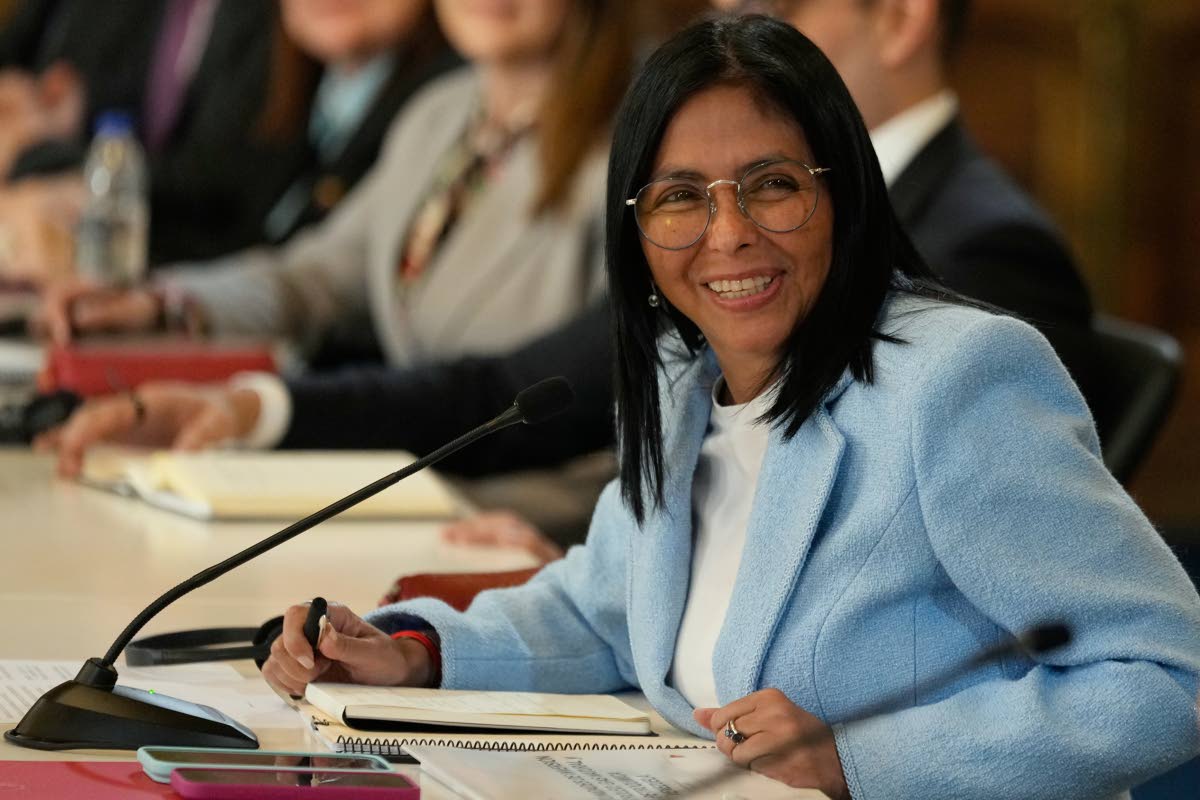 FILE - Venezuela's acting President Delcy Rodriguez smiles during a meeting with a delegation led by US Energy Secretary Chris Wright at Miraflores Palace in Caracas, Venezuela, February 11, 2026.
-
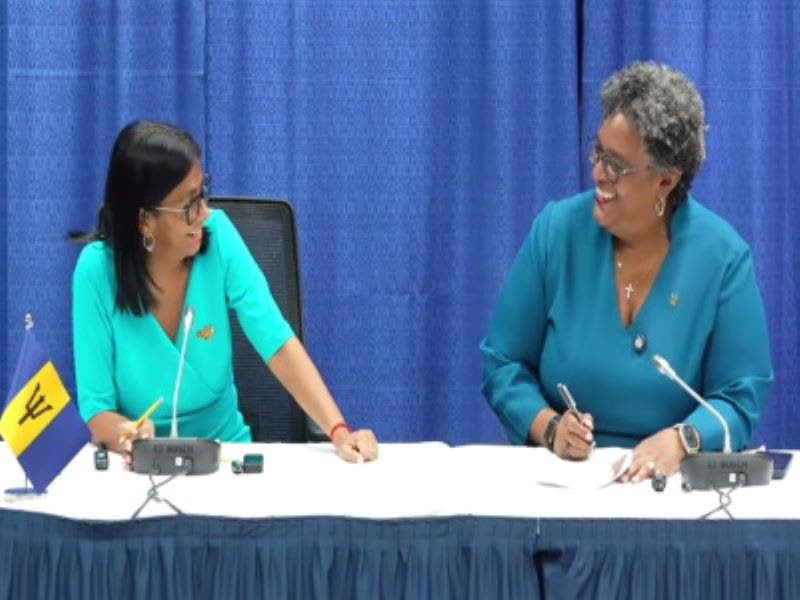 Venezuelan acting President Delcy Rodriquez (left) meeting with Barbados Prime Minister Mia Mottley on Monday.
Delcy Rodríguez’s charm offensive in the Caribbean, and her promotion of a Venezuela-Barbados partnership on renewable energy, highlight the need for the Caribbean Community (CARICOM) to fashion a coherent framework for its relations with Caracas, as well as to finalise its long-discussed regional energy policy.
Jamaica has a stake in these matters, not least because of the unresolved issue of Venezuela’s 49 per cent stake in the Petrojam oil refinery, which the Holness administration re-nationalised six years ago. Caracas rejected Kingston’s prescribed price for its shares.
If the CARICOM-related concerns are to be reasonably addressed, the community must first confront – and find solutions or credible workarounds to – a raft of developments that pose existential threats to its cohesion.
This begins with resolving the future of the community’s secretary general, Dr Carla Barnett, whose five-year term Port-of-Spain insists was improperly extended at a summit in St Kitts and Nevis in February, when Trinidad and Tobago was not represented in the room.
Port-of-Spain says it will not recognise Dr Barnett after August when her current contract expires. This places the secretary general and, by extension, the institutional work of CARICOM, in a curious and potentially untenable position.
Trinidad and Tobago, and its prime minister, Kamla Persad-Bissessar, are also at the centre of several disputes, including the state of Venezuela’s relationship with Port-of-Spain, that threaten to fracture the community.
CARICOM must also be sensitive to the concerns of Guyana, a member state two-thirds of whose territory Venezuela claims as its own – a claim provocatively reinforced when Ms Rodríguez depicted Guyana as part of Venezuela on brooches she wore during recent visits to Grenada and Barbados.
Formerly vice-president to Nicolás Maduro, Ms Rodríguez was elevated to the top position in January after weeks of intimidation by a US armada off Venezuela’s coast culminated in a US attack on the country and the rendition of Mr Maduro to stand trial, ostensibly on drug-trafficking charges. The capture of Mr Maduro, whose legitimacy Washington had long questioned, was part of president Donald Trump’s reassertion of US hegemony in the Americas.
Ms Persad-Bissessar, to the chagrin of many of her regional colleagues, has backed Mr Trump’s actions in the region, including the sinking of alleged drug-smuggling vessels and his oil blockade of Cuba. She allowed the Americans to use Trinidad and Tobago’s territory for communications and logistical support during their operation against Mr Maduro.
ATTEMPTING TO REKINDLE DEALS
The souring of relations between Caracas and Port-of -pain in the year since Ms Persad-Bissessar’s return to office derailed plans for cooperation in gas-field development and LNG processing. Trinidad and Tobago has since been attempting to rekindle these deals following Mr Maduro’s removal, as the Americans began to dictate how Caracas positions its petroleum industry.
There are, however, no signs that the US intends to grant preferential treatment to Port-of-Spain, which is eager to re-energise its lagging oil and gas industries.
These developments are unfolding against the backdrop of the US-Israeli war against Iran, which has driven oil prices up by nearly 40 per cent to above US$100 per barrel, with serious consequences for non-oil-producing CARICOM economies — Jamaica among them. This is occurring as Guyana emerges as one of the world’s fastest-growing oil producers, with output nearing 930,000 barrels per day.
Ms Rodríguez’s visits to St George’s and Bridgetown were clearly aimed at bolstering her legitimacy, both at home and in the region, by signalling that Venezuela is not without friends in the Caribbean. With the United States easing sanctions on Caracas, her outreach has fuelled hopes among some regional leaders for the return of a Petrocaribe-style arrangement, under which Venezuela supplied oil on preferential terms.
In Jamaica, whose Petrojam refinery was designed to process heavy crude of the type produced by Venezuela, Opposition Energy Spokesman Phillip Paulwell has suggested that the government engage Caracas on this front.
This, however, raises the long-standing question of the status of CARICOM’s energy policy, a draft of which was produced in 2013. The issue resurfaced in 2022 when regional leaders pledged to pursue energy security by, among other things, “utilising and harnessing hydrocarbon resources in the region towards reducing dependency on external resources”. They also committed to accelerating upstream and downstream energy investments and expanding the use of renewables. In Barbados, Ms Rodríguez and Prime Minister Mia Mottley agreed to cooperate on renewable energy initiatives.
ENERGY PRICING
Yet, in the 13 years since the outline energy policy was produced – at a time when Trinidad and Tobago was CARICOM’s only significant oil and gas producer – there has been little clarity on how energy should be treated within a Community that aspires to a single market and economy. Since then, Guyana has made its breakthrough, and Suriname stands on the cusp of its own.
In the 2000s, Jamaica argued for national treatment in the sale of oil and gas produced within the region. In practical terms, this would mean that, apart from transportation costs, Trinidad and Tobago would be unable to sell petroleum products more cheaply in its domestic market than to purchasers in Jamaica.
That issue remains unresolved, and it is among the factors driving some CARICOM members towards warmer relations with Caracas. The question of energy pricing must be addressed, if necessary, through an advisory opinion from the Caribbean Court of Justice.
At the same time, any engagement with Venezuela must not come at the expense of the regional integration movement or CARICOM’s long-standing solidarity with Guyana’s territorial integrity.