David Abrikian | Constitution considerations
Loading article...
-
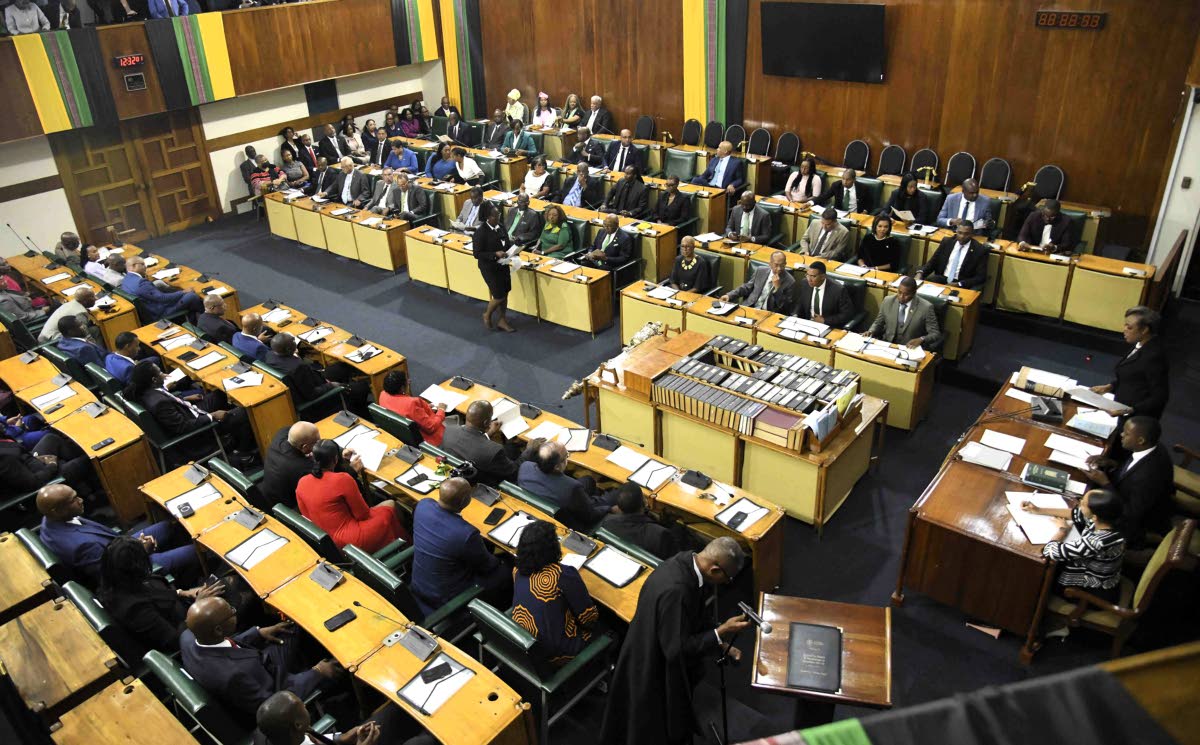 Members of Parliament at the swearing-in for members of the upper and lower houses of Parliament held on September 18, 2025 in Gordon House.
-
 David Abrikian
In a 2025 article by Marlene Malahoo Forte, ‘Do Not Mislead’, referring to an earlier article by Peter Espeut, ‘The JLP Manifesto’, she claimed that he misled the public when he said that the Constitution (Amendment) (Republic) Bill 2024 facilitates the selection of the president by the government of the day.
She asserted that the bill provides that “the Prime Minister shall consult with the Leader of the Opposition on the nomination of the person qualified under section 24(2) for appointment as President.” She also says it stipulates that “on a consultation ... all reasonable steps shall be taken by the Prime Minister and the Leader of the Opposition to agree on the nomination.”
Sub-heading 25 in Section 11 of the bill outlines a procedure for consultation between the prime minister and the leader of the opposition for appointing the president. However, it also states that, if disagreement exists between the two, the prime minister has the final say. This means that, regardless of consultation, the prime minister will ultimately decide who is president. Deacon Espeut’s claim is correct.
Regarding senators, Clause 17 of the Bill states that 27 senators will be appointed: 15 by the Government, nine by the Opposition, and three by the president. Mrs Malahoo Forte, in referring to the Senate approval process, further claimed: “The Bill preserves the constitutional safeguard that requires the support of at least one (1) member of the Opposition, where a two-thirds majority vote is required to alter any provision of the Constitution.”
Deacon Espeut, however, pointed out that a president selected by the prime minister will invariably be expected to support the prime minister’s objectives. Further, the three president-selected senators will also be expected to provide similar support. Hence, it is anticipated that any government-proposed bill will be supported by the 15 government senators and the three president-appointed senators, totalling 18 senators, which continues to be two-thirds of 27. With this arrangement, the Government can obtain a two-thirds Senate majority and pass what it wants without any support from the Opposition. Deacon Espeut is again correct.
It is worth considering that, with the multitude of different constitutions existing globally and open to scrutiny, Jamaica has the opportunity to develop the best possible one. A new constitution needs to contain a system that will promote and ensure integrity at the highest level. Jamaica has a problem with corruption and is in great need of such a constitution.
A constitution that allows a government to alter it at a whim does not bode well for promoting integrity.
A basic principle in the selection of a president is that he or she should be as far removed as possible from any political-party allegiance. One way this can be achieved is for a potential president to be approved by a committee of individuals who are themselves non-aligned to any political party. This consideration is incorporated into the constitution of Singapore, a country that, in the 1960s, was one of the poorest and most ethnically disjointed in the world, and which now has the fourth-highest GDP per capita globally. It is also a country that literally has no raw materials apart from the “raw materials” of competence and integrity.
Although absolute impartiality can never be guaranteed, in Singapore, a pre-arranged endorsement committee, called the Presidential Elections Committee (PEC), assesses all proposed presidential candidates. The PEC reviews and endorses for election only those candidates with, among other qualities, unmistakable levels of integrity, impartiality, capability, and non-allegiance or connection to any political party.
The selection of this endorsement committee is itself sensitive, as no one is without some bias or preference. However, if implemented in Jamaica, an attempt would be made to choose individuals who occupy positions where the highest levels of integrity are expected. This could possibly include the chief justice, president of the Court of Appeal, governor of the Bank of Jamaica, head of the Principals’ Association, head of the Chamber of Commerce, and others, who would be selected through as transparent a process as possible.
With such an arrangement, government activity would come under the scrutiny of non-affiliated, president-selected senators, as well as Opposition-chosen senators, thus auguring a far more objective assessment of legislative activity.
Further, the president could also be given some veto powers, possibly temporary ones, which could require a proposed bill to return to both Houses for reconsideration, after which the president would have no further say in the matter.
Although, as mentioned earlier, no governmental arrangement will ever be absolutely perfect, we need to attempt to develop one that has the nation’s best interests at heart, and the above proposals deserve further examination.
David Abrikian is a civil engineer, a former math teacher, and a member of the Religious Society of Friends (Quakers). Send feedback to columns@gleanerjm.com