Lance Neita | Takeaways from the FIFA World Cup
Loading article...
-
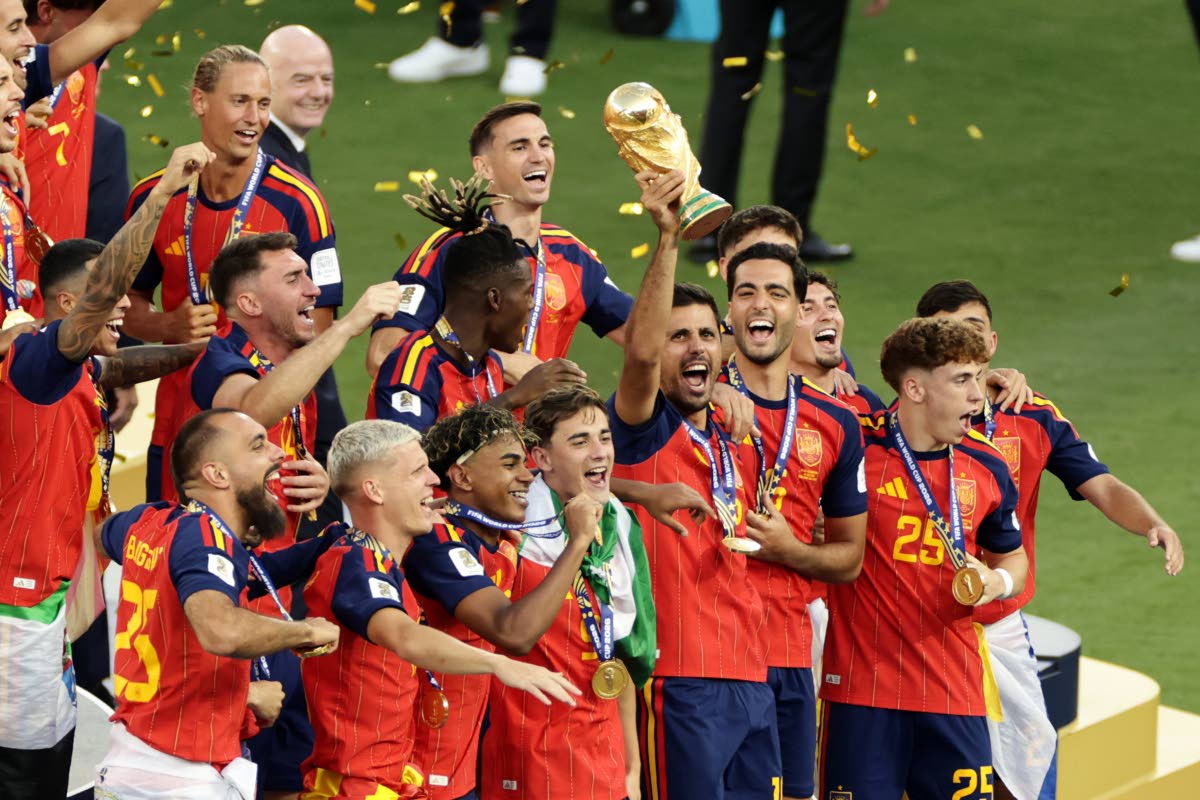 Members of the Spain national team celebrate winning the World Cup yesterday in New York.
-
 Lance Neita
The FIFA World Cup has been put to bed for another four years. The morning after the final came with an emotional hangover for many who had lived through the agony and the ecstasy, days away without leave, clandestine visits to ‘the palm reader’, and the struggle to return to reality. For the next several days as we return to earth, we will miss the excitement, the watch parties, social gatherings, and the colourful spectacle spread across our television screens.
The World Cup has been described as an emotional chaos. Every four years, the world takes a break from its regular routine as friends become rivals, everyone becomes a self-appointed sports analyst, football dominates the news, and motor vehicles everywhere fly flags of countries location unknown. Then, suddenly it ends and you are feeling lost and not quite sure how to readjust. It’s more than a hangover. It’s like the inevitable emotional let-down that comes with the loss of an old friend.
Psychiatrists say this usually follows weeks of intense stress and excitement. They advise it’s important to return to your regular habits one day at a time. Return to eating full meals (avoid the fast food and dry snacks which sufficed between matches), discard your Brazil or Norway flags, sentence your team jersey to the bin, and return your TV to its normal position.
Some would say this was the best World Cup ever. I would say the most unforgettable. Like or dislike FIFA, they deserve credit for the excellent organisation of a four-week tournament that accommodated 48 teams, 1,248 footballers, and 6,810,966 fans across the US, Canada and Mexico.
No credit, however, for allowing US President Donald Trump’s intervention into the red card issue, the bizarre and despicable treatment of the Iran team, the visa restrictions to which FIFA succumbed, questionable VAR decisions, exorbitant ticket prices, and those annoying hydration breaks.
MEMORABLE
Still, outside of the games, we went home with some memorable World Cup takeaways that will rate as some of the greatest moments in sports.
We were dismissive of Spain after viewing their first match against underdogs Cape Verde, but their technical and fluid step-by-step rise to the final is like a storybook, the last chapter ending with a complete mastery of the game that should be a case study used by students, coaches and players as they get their acts together for 2030.
The mind-bending pictures of Messi will remain forever as we saw him patrolling the field and distributing perfectly placed passes with timing and sublimity. He parried the allegations of racial divide and match fixing with dignity, in the meanwhile finding time to score eight goals and four assists.
We didn’t get enough of Spain’s young Lamine Yamal on the field, taken down so often by those aggressive attacks throughout the tournament, but his life story merits a place in football history. His time taken to console Messi at the end of the final was supreme. Cameras have frequently captured him down on his knees or raising his hands in quiet prayer before and after a match. Such instances are poignant moments to remember.
Another takeaway is the outstanding performance delivered by the African front-runners Morocco, Cape Verde and Senegal. They made us stand up to applaud the pride of Africa refusing to give any quarter on stage with the world’s best 48.
We enjoyed the fleet-footed Kylian Mbappé, a picture of ‘catch me if you can’, unfortunately losing out in the semi-finals as Spain moved on towards glory, but his performance was such that we can rest comfortably knowing that he will be around for another World Cup.
HEARTS AND MINDS
My personal takeaway is the Iranian team, the winners not of trophies or medals, but of hearts and minds, and their courage in the face of a host country’s disdain and ‘spoil sport’ behaviour.
It is this contradictory state of play that will leave an historical imprint on the tournament.
But the biggest takeaway must be when the US President had to be taken away from the winner’s circle by the FIFA President, replicating a move by the Roman Emperor Nero who famously crashed the Greek Olympics in 67 AD, entered every event, and in one hilarious incident fell out of his chariot in a drunken stupor during the 100 yards race. He went on to claim the gold medal for every event he entered.
The success of the 2026 World Cup is proof that the game is bigger than any political intervention, and that sports can outplay any card posed in any attempt to upset the most beautiful game.
USAIN BOLT STADIUM
The Trelawny Multi-purpose Stadium should be renamed in honour of Bolt. The point has been made that the stadium would need to be upgraded and converted into something with more international appeal than an empty shell of a cricket bowl going to waste.
We may be able to encourage the Chinese — who built it in the first place — to help us create a modern, world-class international sports training centre worthy of the name Usain Bolt, where people from all over the world would come to train in track and field, swimming, soccer, cricket, boxing, gymnastics, basketball, netball, you name it.
Once and for all, an international sports training complex in Jamaica with accommodation, a calendar of major and mega events, indoor and outdoor facilities, lecture halls, convention meeting space.
Sports marketing moves to the next level when you have a world-class institution that can create and promote tourism and economic development through sports. Sports marketing is a big part of the vaunted National Tourism Plan but, frankly, we haven’t been seeing those major happenings that can engage visitors through sports on a regular basis with Brand Jamaica.
Lance Neita is an author and a sports enthusiast. Send feedback to columns@gleanerjm.com and lanceneita@hotmail.com