Dennis A. Minott | Reverend Thwaites, are you reading my mind?
Loading article...
-
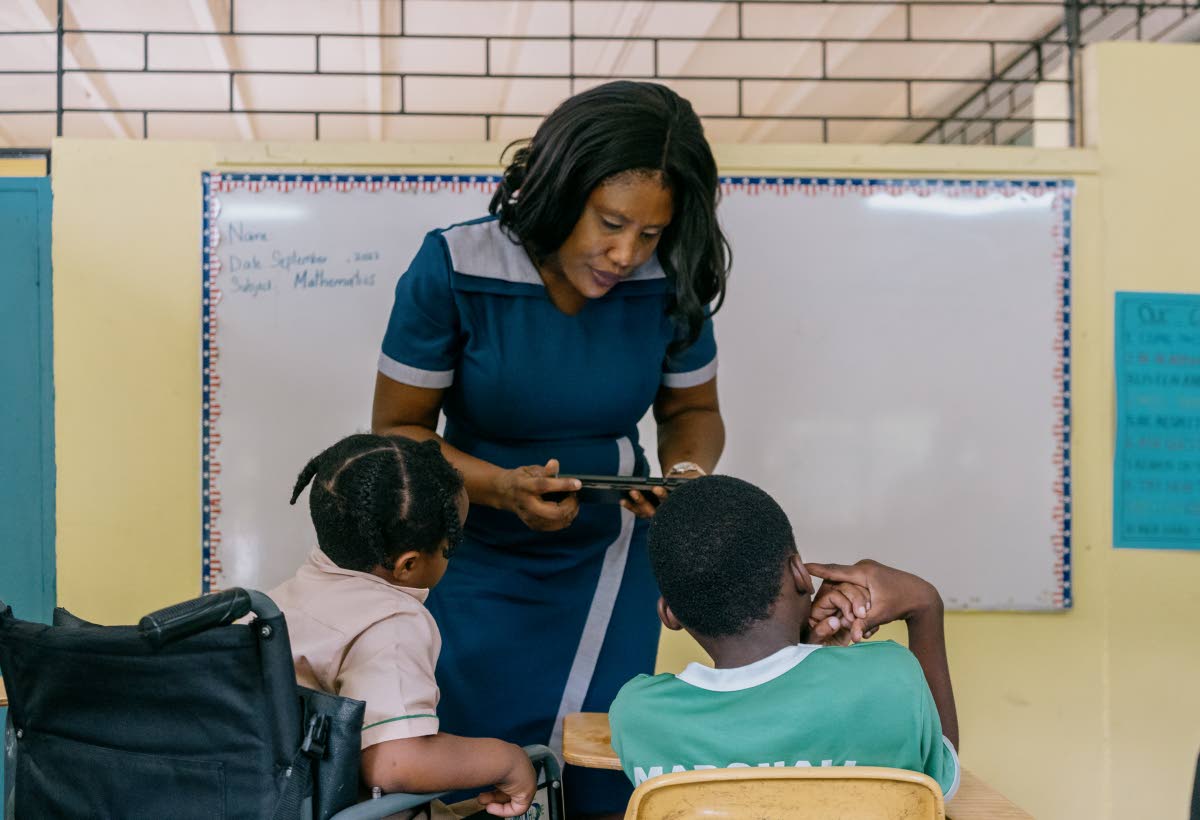 Representational image of a teacher in a classroom.
-
 Dennis Minott
There are moments when a newspaper column arrives with such extraordinary timing that one is tempted to ask whether the writer has somehow been reading one’s mind.
Reverend Ronald Thwaites’ “What if ... ?” is one of those moments.
His deceptively simple question is: what if Jamaica were to make the successful reopening and functioning of its schools the national objective? It is a question that deserves considerably more than the customary nod of agreement.
Because, behind those damaged classrooms, disrupted timetables, rotating students and months of lost learning lies a question much more disturbing: What if the educational consequences of Hurricane Melissa are not merely an unfortunate by-product of disaster but are creating precisely the kind of human-resource environment from which somebody, somewhere, stands to benefit?
I am asking whether we have become so accustomed to institutional failure that we no longer ask the more uncomfortable question: Cui bono? Who benefits?
Thwaites’s August 31 comparison between the post-Hurricane Melissa performance of Sandals and the slow restoration of hundreds of schools is devastating precisely because it exposes a choice. Sandals reportedly achieved in nine and a half months what would normally have taken three years because it mobilised immediately, established timetables, operated as a unit, and treated performance as existential. Meanwhile, as Thwaites observes, Jamaica’s schools remain compromised 10 months after the hurricane.
The Government has, to be fair, made enormous efforts. More than 600 schools were damaged, approximately 200 severely, and the ministry has deployed temporary classrooms, learning kits, revised curricula and other interventions.
But “schools have reopened” is not synonymous with “children have recovered their education”.
That distinction is becoming morally and economically critical.
In January, 37 of Region Four’s 164 schools, covering Hanover, St James and Westmoreland, were operating on rotational schedules. By August, the ministry’s regional leadership was acknowledging that some schools would enter the new academic year still using rotation, staggered face-to-face classes, and temporary structures.
And Region Four is the heartland of Jamaica’s extraordinarily efficient tourism machine.
So here is my deliberately provocative “What if?”
What if Jamaica’s western educational disruption eventually produces a cohort that is intelligent enough to perform the increasingly sophisticated emotional, technical and service work required by the tourism industry, but insufficiently educated to possess the qualifications, bargaining power and wider economic options necessary to escape the lower-earning end of that labour market?
That would be a particularly ugly form of 21st-century neo-slavery.
I use the term deliberately but analytically, not as a claim that contemporary hotel workers are legally enslaved.
Chattel slavery extracted human energy, intelligence, adaptability and skills and converted them into wealth for others without just compensation. My present concern is different: whether a modern economy can systematically appropriate human capability while allowing the people supplying that capability to remain educationally and economically constrained.
Consider the irony.
Minister Edmund Bartlett has repeatedly and correctly emphasised that Jamaica’s tourism product depends upon human beings. He has called workers the “backbone” of tourism, and his ministry has made training and certification central to professionalising the sector. In 2026, Bartlett announced even more ambitious tourism targets: 10 million visitors and US$10 billion in earnings over 10 years.
Yet, in April, he also acknowledged that, despite professionalisation and training, tourism remuneration is unlikely to reach the highest levels found in other industries “because of the nature of our business”. There is the “nature paradox”.
We want increasingly skilled, intelligent, adaptable and certified Jamaicans to deliver increasingly sophisticated tourism experiences.
But, can we simultaneously tolerate an educational system that leaves sections of those same Jamaicans with diminished instructional time, interrupted learning and weakened academic foundations?
Who captures the value of the difference?
This is where Thwaites’ intervention becomes much bigger than school repairs.
He correctly identifies compromised schooling as a national-security crisis and warns that we are setting ourselves up for another cycle of criminal behaviour and low productivity.
But perhaps we should add another category to the indictment: economic extraction.
A child does not merely lose a few schooldays when learning is interrupted. The child loses accumulated intellectual capital. Mathematics builds upon mathematics. Reading builds upon reading. Scientific reasoning, language, confidence, curiosity and disciplined problem-solving compound over time.
Learning is cumulative. So is learning loss.
And the poorest children are least able to purchase substitutes for what the State fails to provide. Thwaites’ example of the mother contemplating a 49 per cent loan simply to meet the cost of returning her son to school makes the point brutally. The affluent child gets private tutoring; the poorer child gets rotation.
One child emerges with more human capital, the other emerges with less. And then both enter the same labour market. This is a mechanism for reproducing inequality.
Western Jamaica’s extraordinary post-Melissa educational response also proves something important. Region Four educators have been sufficiently concerned about learning loss to create a six-day-a-week online enhancement programme, with volunteer teachers and education officers teaching mathematics, Spanish, English, science, information technology and social studies.
So the capacity cum compassion exists. The commitment exists. The intelligence exists. What appears to be missing is national urgency commensurate with the value of what is being lost.
Which returns me to Reverend Thwaites. Sir, you may indeed be reading my mind. Your “What if?” has prompted my own: What if we stopped asking merely how quickly we can reopen Jamaica’s schools and began asking how much Jamaican human intelligence we are permitting to be wasted?
What if we followed the energy, the intelligence, the money and, finally, what if we followed the beneficiaries?
Because, if Jamaica permits a substantial cohort of its children, especially in the western tourism belt, to emerge highly intelligent, adaptable and willing to work, but educationally spotty, economically vulnerable and weakly credentialled, we should not be surprised if an industry hungry for precisely those human qualities finds an abundant labour supply. That need not be anybody’s grand strategy.
But, if the outcome persistently serves the same interests, the distinction between deliberate design and institutional indifference becomes increasingly uncomfortable.
And that is the question: Are we repairing schools merely to reopen buildings, or are we rebuilding the intellectual power of the Jamaican people? Because the latter is our sovereign productive resource.
And, if we fail to develop it, somebody else will eagerly learn how to extract its value. Reverend Thwaites, keep reading our minds. But let us also start following the consequences.
Dennis Minott, PhD, is the CEO of A-QuEST-FAIR. Send feedback to: a_quest57@yahoo.com or columns@gleanerjm.com.