Jalil Dabdoub | Inebriated with words, practising hypocrisy
Loading article...
-
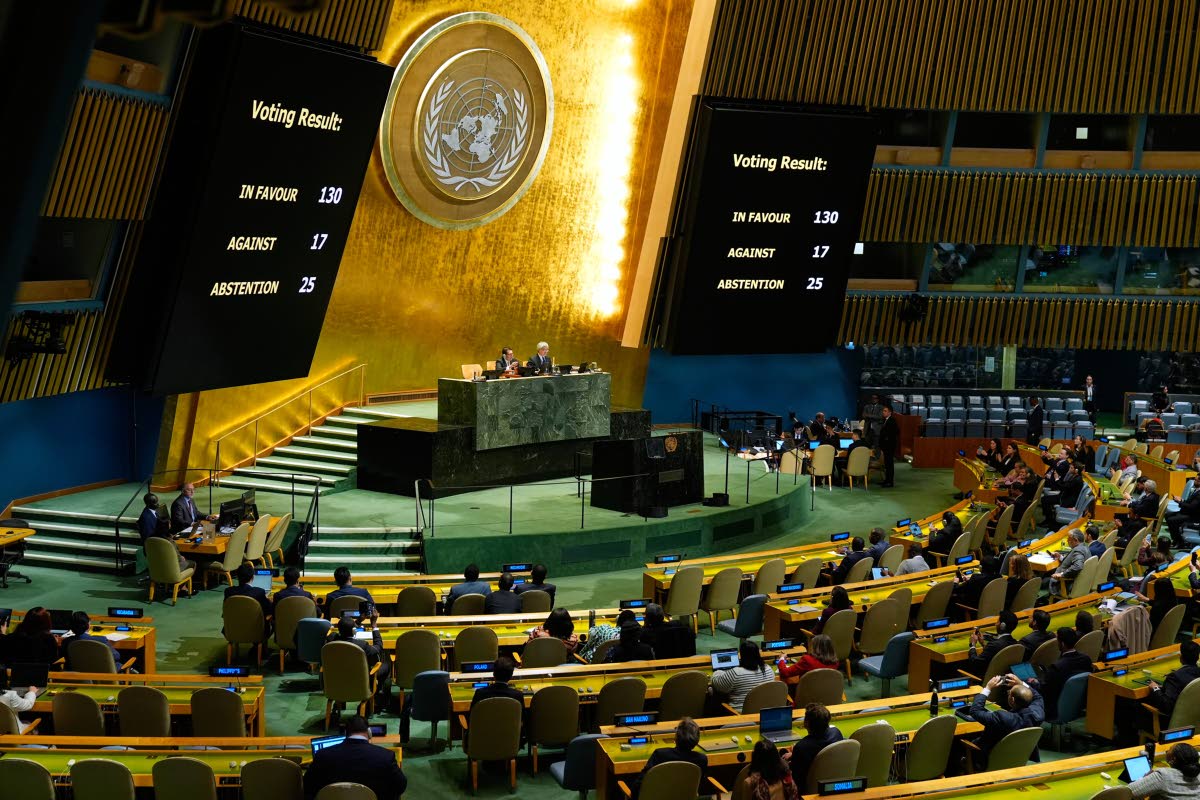 The results of a vote on ending the United States’ blockade of Cuba are displayed at United Nations headquarters. Photo - AP
-
The results of a vote on ending the United States’ blockade of Cuba are displayed at United Nations headquarters. Photo - AP
-
 Jalil Dabdoub. Photo - Contributed
There was much in Jamaica’s recent statement to the United Nations General Assembly (UNGA) with which no reasonable Jamaican could quarrel.
Foreign Affairs Minister Kamina Johnson Smith spoke eloquently of the UN Charter, international law, civilian protection, the rules-based international order and respect for decisions of the International Court of Justice (ICJ). At times, she appeared almost inebriated with her own recital of international law.
As an attorney-at-law, the minister knows that law is not applied in a vacuum. Facts must be identified, the applicable law established, and the law applied to those facts. Her speech was long on principle but short on application of those principles to the facts.
She declared: “Wherever conflict occurs, our principles must remain consistent.” Wherever means wherever. It does not mean wherever it is diplomatically convenient.
Yet, Palestine and Sudan received no substantive examination of the conduct, humanitarian suffering and international legal obligations involved. In Palestine, the ICJ has declared Israel’s continued presence in the occupied Palestinian territory unlawful and, in separate genocide proceedings, ordered provisional measures to protect the rights of Palestinians under the Genocide Convention.
The minister was quick to praise international law, but less willing to apply it. Jamaica cannot defend it in principle but abandon it over Palestine, Sudan, Cuba or any other instance where the Government feels it politically expedient to do so.
In Sudan, mass displacement, hunger and attacks on civilians have produced a devastating humanitarian catastrophe. The facts and the law were clear. What was missing was a demonstration of principle.
Cuba received particular attention. The minister expressed concern for its people’s suffering and called for greater economic integration and an end to their isolation under the embargo. Yet, after more than three decades of opposing that embargo, Jamaica abstained from the UN vote calling for its removal.
Former Prime Minister P.J. Patterson responded forcefully, describing the decision as an “abominable betrayal” of Jamaica’s foreign policy tradition.
Rather than simply defend the decision, the minister, in the November 1 Gleaner article, tellingly titled ‘Jamaica’s foreign policy: principle must guide, not political rhetoric’ took aim at Patterson, dismissed his conclusions as emotionally driven, and insisted that Jamaica had neither abandoned its opposition to the embargo nor betrayed its foreign policy tradition.
She argued that:
– An abstention was not the same as voting against the resolution;
– the annual vote had failed for more than 30 years;
– the Government was entitled to consider a broader and more constructive approach.
She then said that “principle should guide policy, not prevent us from examining its effectiveness”.
That argument raises the very questions the minister shies away from answering. What precisely is this broader approach? What initiatives have been advanced, negotiations undertaken or tangible benefits realised?
The minister acknowledges that Jamaica could have supported the resolution while expressing reservations. Why, then, did we abstain? If the Government still opposes the embargo and accepts that it contributes to Cuban suffering, what compelling national interest justified withholding our support?
The distinction between voting against a resolution and abstaining may be technically correct, but it does not make an answer. The minister speaks of pragmatism, constructive engagement and effectiveness, yet offers no evidence of results. Attractive language is not a foreign policy strategy, and calling a decision pragmatic does not make it so.
The Government has the authority to determine foreign policy, but it still owes Jamaicans an explanation for decisions taken in their name.
What has this Government’s “pragmatism” actually delivered?
The discontinuation of our longstanding Cuban medical cooperation arrangement, depriving an already overstretched public health system of much-needed doctors and specialists. A TCN arrangement with the United States, the full terms and operational details of which have not been made public.
Pragmatism should protect national interests, not accommodate the preferences of other countries in the hope that something might eventually benefit us. Are we protecting Jamaica’s interests, or betraying our principles to accommodate the interests of others?
If Jamaica is serious about its commitment to international law, should it not seriously consider severing diplomatic relations with Israel and suspending trade relations, as it did in opposing apartheid South Africa? The principle of refusing to normalise relations with a state whose conduct fundamentally violates international law deserves serious consideration.
Why are we prepared to challenge some violations of international law but retreat when doing so may displease other countries?
If this is pragmatism, the Government must explain what Jamaica has gained. Or is it that Jamaica does not gain, but the current administration does? Could political considerations, including the pursuit of continued or promised political support, be influencing decisions that ought to be determined by the national interest? Jamaicans are entitled to ask. The Government is obliged to answer.
The foreign minister now lectures Jamaicans on the importance of principle while defending a decision that departs from a principle Jamaica has consistently upheld for decades. More rhetoric about principle, but precious little practice.
The foreign minister, so taken with her own words, has lost sight of the distinction between principle and hypocrisy. Principle is not what you profess, but what you uphold when it is politically inconvenient. Preaching international law is easy; applying it consistently is the real test.
Congratulations, Prime Minister and Foreign Minister! Your approach to foreign policy may yet become legendary, not for the principles Jamaica defended or the benefits it secured, not for its independence, courage or willingness to stand on principle, but for the bare-faced hypocrisy of proclaiming principles that its own actions so often call into question. What a tragic legacy for a country whose international standing was built precisely on its willingness to speak and act on principle.
The foreign minister owes Jamaicans an explanation for why clear principles become negotiable when politically inconvenient. The prime minister must explain what national interest this policy shift serves.
The danger of becoming inebriated with our own words is that we eventually mistake the recital of principle for the practice of principle.
Jalil Dabdoub is an attorney-at-law. Send feedback to columns@gleanerjm.com