Gov’t wins as court throws out lawsuit by anti-COVID-19 vaccine protesters
Loading article...
-
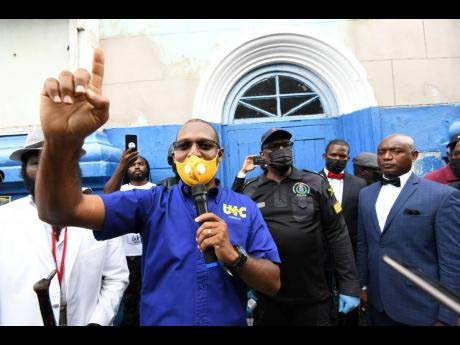 Organiser Joseph Patterson, head of the United Independent Congress, addresses protesters during a march against COVID-19 vaccines in Kingston on September 22, 2021, moments before he was arrested and charged. (Rudolph Brown photo)
-
Organiser Joseph Patterson, head of the United Independent Congress, addresses protesters during a march against COVID-19 vaccines in Kingston on September 22, 2021, moments before he was arrested and charged. (Rudolph Brown photo)
-
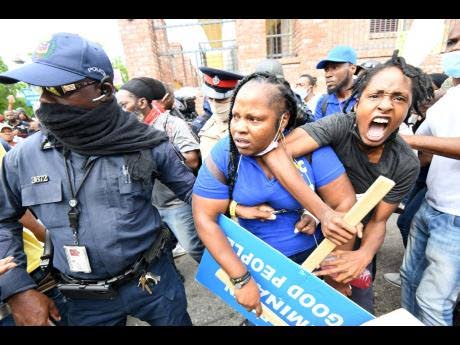 Police detain a protester during an unauthorised march in downtown Kingston on September 22, 2021. (Rudolph Brown photo)
-
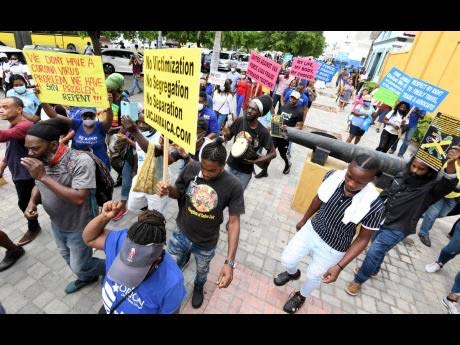 Protesters proceed on their march from North Parade in downtown Kingston towards Gordon House in defiance of instructions from the police not to proceed with the unauthorised event on September 22, 2021. (Rudolph Brown photo)
The Constitutional Court has rejected a sweeping challenge brought by four protesters who claimed the Government violated their fundamental rights when police broke up their protest against COVID-19 vaccines in 2021.
"It is accepted that the right to assemble and the right to freedom of movement should not be arbitrarily limited, but given the worldwide pandemic and the resulting deaths, we find that the restrictions were justified in a free and democratic society," said the panel comprising Justices Lorna Shelly Williams, Tricia Hutchinson Shelly, and Tania Mott Tulloch-Reid.
In a 42-page judgment handed last Thursday, the court found that restrictions imposed under the Disaster Risk Management Act (DRMA) during the COVID-19 pandemic were proportionate, lawful, and did not breach the Constitution.
They heard arguments in 2024.
The case was brought against the Government in 2021 by Joseph Patterson, leader the United Independents Congress (UIC), a registered political party, along with co-claimants David Thompson, Abbey-Gayle Thompson, and Kevaughn Harris.
They four sought 20 declarations and orders to strike out sections of the Disaster Risk Management Act and Public Order Act, arguing the laws unconstitutionally restricted freedom of movement, expression, and assembly.
Patterson, dissatisfied with the Government's pandemic response and the vaccination drive, organised a public march in Mandeville on September 11, 2021, and a second march in Kingston on September 22 of that year. They complained about the potential for mandatory vaccination.
The Kingston march was from the Ward Theatre in the heart of downtown to Gordon House, the seat of the country's Parliament.
What unfolded on September 22, forms the heart of the claimants' grievances.
Patterson alleged that police assaulted several marchers at the Ward Theatre, erected barricades to prevent the group from reaching Gordon House, assaulted Harris on the return journey, and arrested Abbey-Gayle Thompson.
Patterson himself said he was "assaulted and put into a police vehicle," sustaining a sprained finger and twisted foot. He was subsequently charged with violating both the DRMA and the Public Order Act, as well as resisting arrest.
However, the the police told a different story.
Senior Superintendent Steve McGregor testified that he informed Patterson the gathering was unlawful because no permission had been granted, and that Patterson, in defiance of instructions, "addressed the crowd" and directed marchers toward Gordon House before being arrested. Members of the police team also denied any assault.
The claimants launched a wide constitutional attack, led by their attorneys Hugh Wildman and Duke Foote. Taniesha Rowe-Coke instructed by the Director of State Proceedings appeared for the Attorney General, the defendant.
They argued that section 26(2) of the DRMA, which gave the Prime Minister broad powers to respond to disasters, was unconstitutional because it bypassed the section 20 mechanism in the Charter of Fundamental Rights, which requires a formal State of Public Emergency proclaimed by the Governor General.
They further argued the DRMA breached the separation of powers doctrine, and that sections 6, 11(b), and 12 of the Public Order Act, which require permits for public marches, conflicted with the constitutionally guaranteed right to freedom of movement.
Those arguments did not find favour with the Constitutional Court, which applied a proportionality test to determine whether the DRMA measures were constitutional.
On the question of whether the pandemic restrictions unjustifiably curtailed rights to assembly and movement, the court relied heavily on the affidavit of Jamaica's Chief Medical Officer, Dr Jacquiline Bisasor-McKenzie, who outlined the science underpinning the restrictions.
She described the "Three C's" - Crowded places, close-contact settings, and confined spaces with poor ventilation — as the principal drivers of COVID-19 transmission, and explained why limiting gatherings was a necessary public health intervention.
The court accepted that .the health ministry's "actions were intended to limit the spread of COVID-19 and ensure the welfare and health of all citizens". "These measures allowed for distancing to curtail or slow the spread of the pandemic," the judgment said.
"The pandemic had the potential to affect all persons in Jamaica. Unfortunately, the greater the risk, the greater the interference with individual rights. Given the circumstances, we do not find the limits imposed on individuals disproportionate..."
On the DRMA's constitutionality, the court found the act and the Constitution's emergency provisions were not in conflict.
The judges noted that when the DRMA regulations were first promulgated, the number of COVID-19 cases in Jamaica was still relatively small, placing the situation in the category of a "threat of disaster" rather than an actual disaster, which fell squarely within the DRMA's mandate rather than requiring a formal State of Emergency.
On the Public Order Act's permit requirement for marches, the court acknowledged that the right to freedom of movement was "curtailed to some extent," but held the requirement demonstrably justified.
Permits, the court reasoned, minimise disruption to road users, allow for security planning, and prevent multiple simultaneous marches from generating public disorder.
All declarations sought by the claimants were refused.
No damages were awarded and the court made no order as to costs so the parties will have to bear their own legal costs.
Follow The Gleaner on X, formerly Twitter, and Instagram @JamaicaGleaner and on Facebook @GleanerJamaica. Send us a message on WhatsApp at 1-876-499-0169 or email us at onlinefeedback@gleanerjm.com or editors@gleanerjm.com.