Critical condition – UHWI review committee lists finances, governance structure among slew of woes crippling hospital
Loading article...
-
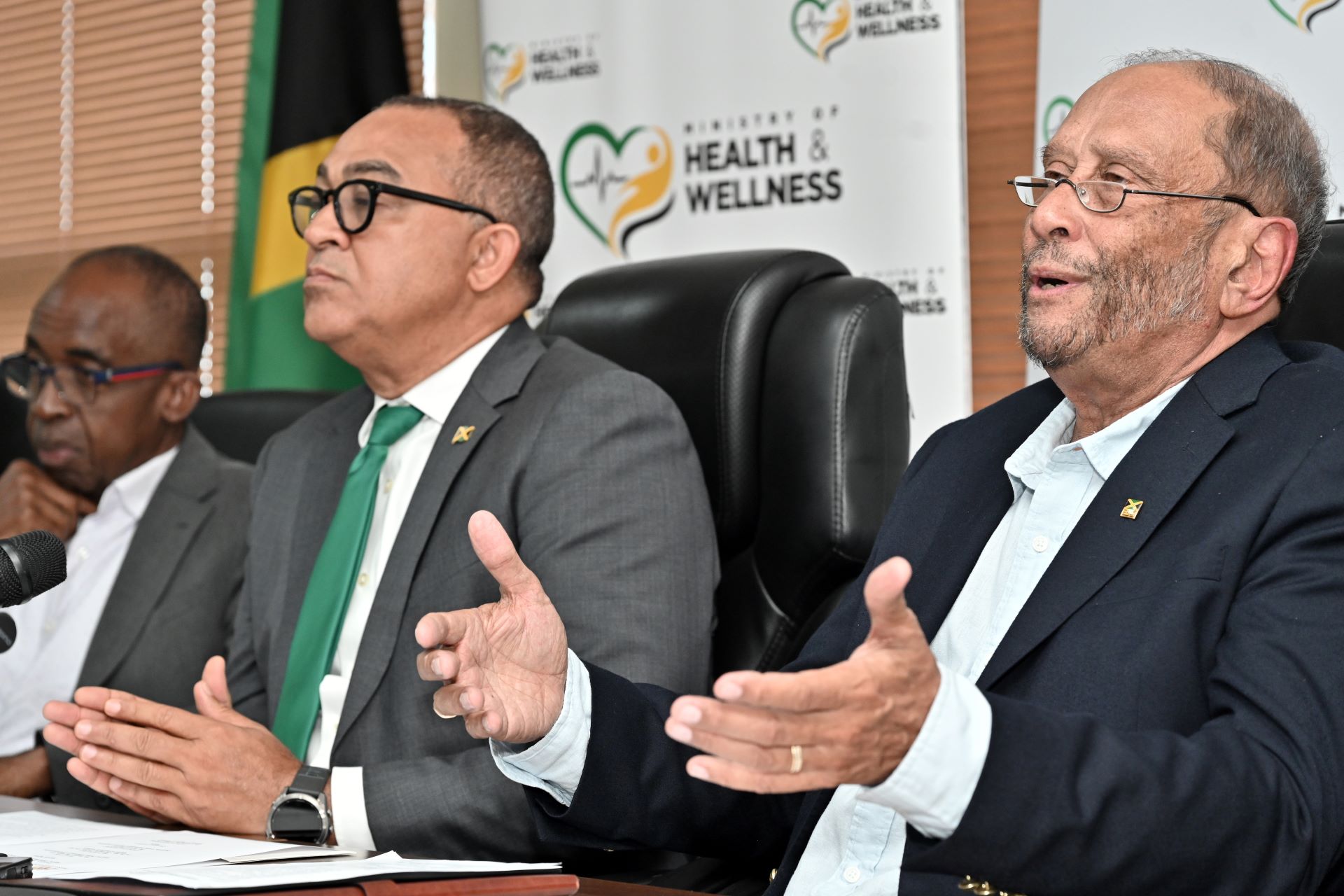
From left are Patrick Hylton, Chairman of Mona School of Business and Management; Dr. Christopher Tufton, Minister of Health and Wellness; and Howard Mitchell, Chairman of UHWI Institutional Review Committee at a press conference at the HECO, IBM Building in New Kingston on Tuesday, May 5, 2026. - Rudolph Brown photo
-
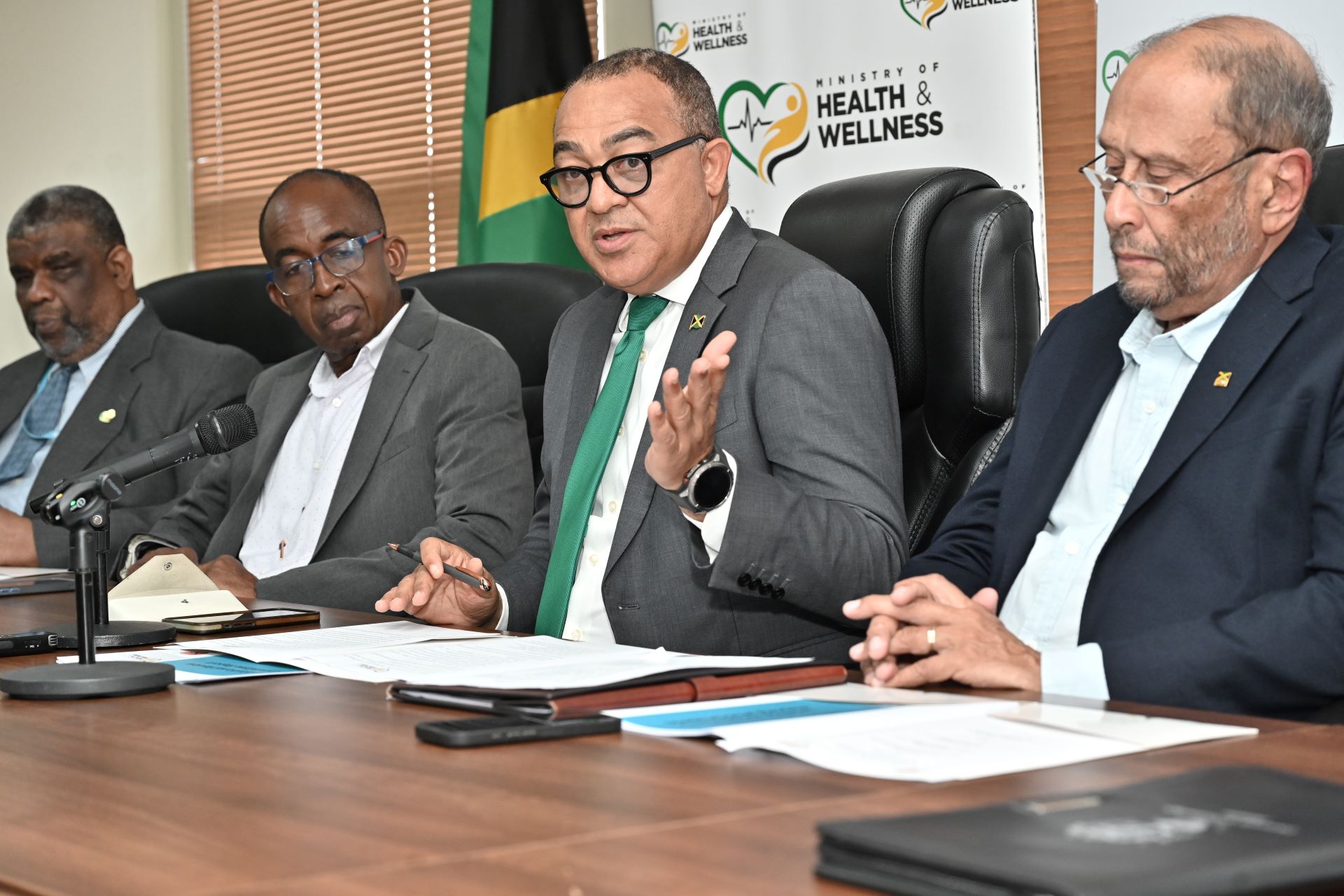
From left are Errol Greene, Permanent Secretary in the Ministry of Health & Wellness; Patrick Hylton, Chairman of Mona School of Business and Management; Dr. Christopher Tufton, Minister of Health and Wellness; and Howard Mitchell, Chairman of UHWI Institutional Review Committee, at the presentation of the UHWI Institutional Review Committee report at the HECO, IBM Building in New Kingston on Tuesday, May 5, 2026. - Rudolph Brown photo
Prolonged governance failures at the University Hospital of the West Indies (UHWI) have left the type A teaching institution in an “intensive care unit” state, the Institutional Review Committee tasked to assess its decades-long operations has concluded.
Chairman of the Dr Christopher Tufton-appointed review committee Howard Mitchell on Tuesday outlined a slew of challenges crippling the hospital, several of which concerned its finances and its governance structure.
“Financial governance issues because procurement systems, reporting systems, recording systems over the years have not been followed,” Mitchell told journalists at a press conference, where he presented a report on the findings of the review committee.
He said financial challenges have arisen because the operating and business structure of the hospital has not changed positively over the last 78 years.
Further, he said there was a lack of continuity and transmission of proper government practices. Strategic planning challenges were also identified by the committee.
The assessment follows the findings of an Auditor General special audit report which revealed that the UHWI awarded $521 million in contracts despite failing to provide essential procurement documentation.
That report further highlighted systemic breaches of government guidelines, including unapproved contract variations and missing records.
The audit also exposed after-the-fact bidding and the misuse of tax exemptions for private entities.
Yesterday, Mitchell described the hospital as an “institutional orphan” caught between the Jamaican Government and The University of the West Indies (UWI).
The Government funds 70 per cent of UHWI’s budget and contributing regional governments nine per cent, while the rest is self-funded.
He said there has been confusion over whether UHWI is a public body.
“It’s clearly a public body and it has been defined as such. Legal opinion has been arrived at to that effect but there is still a culture of saying ‘because we’re not in the public health system, we’re not a public body…’,” said Mitchell at the press conference held at the IDB Building in New Kingston.
“In addition to that and this is part of the duality of controls. When you have two masters you tend to playoff one against the other and not follow a straight track,” he added.
He pointed to the need for reform of the University Hospital Act of 1948.
It was one of five recommendations made in the report by the review committee which called for the elimination of an arrangement in which the chairman of UHWI’s medical committee sits on the institution’s board, while the CEO does not.
That structural inversion is a key recommendation in the report that identified “chronic and egregious” governance failures at the Caribbean’s oldest teaching hospital and called for sweeping legislative, financial and institutional reform.
The current CEO is Fitzgerald Mitchell, while the chairman of the medical committee is Dr Carl Bruce, also the medical chief of staff.
“There is no provision in the 1948 UHWI Act for the CEO to be a board member. The consequence of this anachronism is that while the chair of the Hospital Medical Committee is expected to report to the CEO under the PBMA (Public Bodies Management and Accountability Act), the (UHWI) Act requires the CEO to report to the chair as part of the CEO’s general reporting relationship to the board,” the report stated.
It added: “The anomaly must be eliminated and the scope of responsibility for both positions needs to be clearly articulated.”
Mitchell said the report is not about prosecuting anyone but how to improve the transparency, accountability and service delivery of the hospital.
“This is an opportunity to turn the page on what has happened over ... many decades. And take it back to the standard of performance, and the reputation that the University Hospital of the West Indies had when people older than everybody, [used to] refer to it as UC.”
For his part, Tufton said the report was presented to Cabinet on Monday.
“I think it's a good report. I support the recommendations of the report,” he said, adding that the discussion to follow should focus on how to make the recommendations work.
The report called for the strengthening of financial management, improving oversight by both the Government and UWI, and engaging an independent international body to support board operations.
It said the 1948 UHWI Act, amended once in 1962, served the hospital and Jamaica “reasonably well” but “needs to be revised.”
It also said the 18-member board is “too large and its composition is not well aligned to the institution’s financing reality”.
Mitchell noted that while some boards have performed effectively, most stakeholder representatives have failed to provide the active and robust oversight required.
His review committee raised further concerns about the overlapping roles of the CEO and the chairman of the Hospital Medical Committee. It said the “chairman of the medical committee should not hold a seat on the board,” and recommended that the law be amended to ensure the CEO is a board member.
It noted that “Since the CEO does not serve on the board .... a reporting relationship from the person occupying a board position to the CEO creates obvious potential for conflict” and is “a highly unusual organisational scenario for an upward management reporting relationship to exist between a non-board member and a board member.”
It said the lack of clarity has allowed the chairman to assume responsibilities typically reserved for the CEO, including “driving the institution’s strategic vision, procuring equipment and hiring staff”.
The committee warned that this blurring of roles undermines accountability frameworks under the Public Bodies Management and Accountability Act, which it said requires that public bodies have a CEO to whom all staff report directly or indirectly.
Meanwhile, the committee concluded that the UHWI had been operating “as if it is an institutional orphan,” saying it has “resisted the governance framework emanating from its public sector lineage, while not absorbing governance practices from its university heritage.”
“It’s seeming orphan status has been facilitated by the actions and omissions of each of its parent entities, the GOJ (Government of Jamaica) and The University of the West Indies,” the report said.
The committee found that both the Government and the UWI had faithfully appointed board representatives over the years but had “not engaged in active and robust oversight,” suggesting each may have assumed the other bore primary responsibility.
It also flagged UHWI’s tax debt to the Tax Administration of Jamaica of more than $40 billion, comprising unpaid statutory deductions inclusive of penalties and interest. The hospital has also been running monthly deficits of up to $300 million.
The report noted that the UHWI, unable to qualify for a Tax Compliance Certificate (TCC), had been using the TCC of its related private arm, the Tony Thwaites Wing, to clear imports, a practice discontinued only after the Auditor General’s findings.
It further identified serial delays in filing financial statements as a major issue obscuring the hospital’s financial position, noting that as recently as 2015, a health minister tabled 11 years of overdue annual reports.
“The mindset of both the board and staff will have to be receptive to the recommended changes,” the committee concluded, adding that only a deliberate cultural shift will ensure the recommendations are effective.
Kimone.francis@gleanerjm.com