‘I am going to prove him wrong’ - How sickle cell disease shaped Dr Jebby Campbell’s journey
Loading article...
-
 Campbell. Photo - Contributed
-
Campbell. Photo - Contributed
-
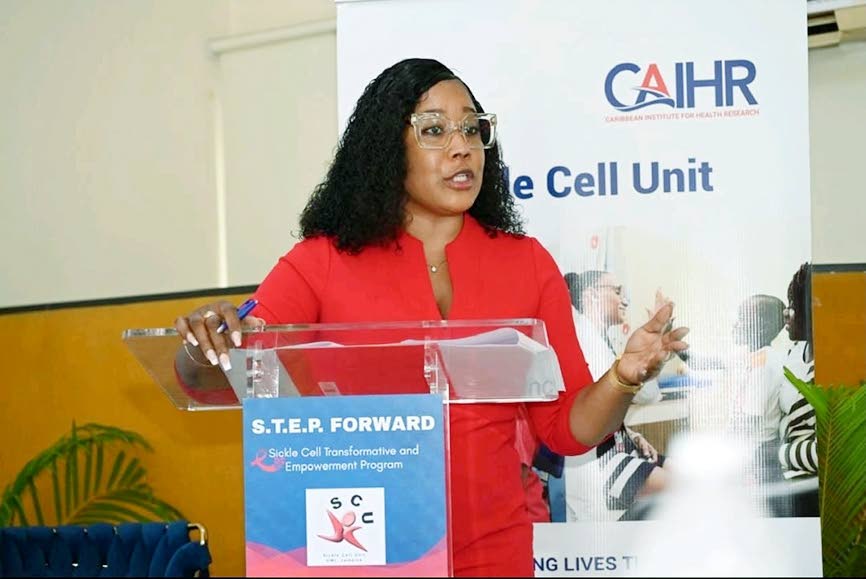 Dr Jebby Campbell addressing a forum hosted by Caribbean Institute of Health Research. Photo - Contributed
For most of her life, Dr Jebby Campbell has lived with a disease that medical experts say continues to shorten lives.
Yet, instead of allowing sickle cell disease to define her future, she transformed it into the force that propelled her to academic excellence, public service, and a distinguished legal career.
Diagnosed with sickle cell disease at the age of two, Campbell has spent more than four decades defying expectations, becoming a senior attorney, an academic, and a respected advocate whose life embodies resilience, determination, and nation-building.
Born into a nuclear family with three sisters who do not have the disease, Campbell credits the unwavering support of her parents and siblings with laying the foundation that enabled her to pursue her ambitions despite repeated health crises.
Her support network expanded throughout her life as she progressed academically, earning a Bachelor of Arts in English and international relations, a law degree, a Master’s in international and commercial law, and ultimately, a doctorate in business administration.
“I was age two when my parents discovered that I have the disease. Growing up, I was highly protected, with my sisters understanding the role they had to play when I had a crisis,” Campbell told The Gleaner.
She successfully passed the Common Entrance Examination and attended Holy Childhood High School for Girls, where she completed sixth form.
School life, however, was frequently interrupted by painful sickle cell crises, particularly during the cooler December months. Yet every setback was met with encouragement from those around her.
“If I was absent from school, the work would be collected, and if I can focus long enough to read, there would be someone available to read to me, and I would write the answers,” she recalled.
“I had that level of motivation and that level of support while I was going through my pain. The fact of the matter is I never felt alone growing up,” Campbell continued, adding that there was always someone – either one of her siblings or her mother – by her bedside to comfort her.
‘LIVE TO FINISH’
Rather than viewing sickle cell disease as an obstacle, Campbell says it became the catalyst for her determination.
She describes the illness as a badge of honour because it awakened a fighting spirit within her.
“By this I mean that because of the disease I pushed harder. I have to dig deep in order to keep afloat. You can’t afford to fall back, especially while preparing for major exams,” she said.
That resolve was tested repeatedly throughout her academic journey, but perhaps never more painfully than while pursuing her doctorate.
Campbell recalled experiencing severe pain during her doctoral studies and seeking treatment from a physician who was not her regular doctor.
“I remember when I went. The gentleman looked at me and said to me:’You are so ambitious. Why would you take on such a challenge, with your illness? Do you think you will live to finish?’”
His remarks stunned her.
Campbell said she sat in the chair, looked at him and asked him to tell her why not. All he said was that her body could not take that level of pressure.
Instead of accepting his prognosis, she turned it into motivation.
“I thought about what he said, and I prayed about it and said to myself that I am going to prove him wrong. I ended up with a doctoral GPA of 3.98.”
MAJOR SETBACK
The road to that achievement was anything but easy.
Near the completion of her doctoral programme, Campbell suffered one of the most devastating health setbacks of her life.
“Just about when I was preparing to submit my thesis, I became very ill and was out for seven months. Couldn’t do anything, couldn’t do my reviews, couldn’t read, I could not do nothing,” Campbell said, describing it as the darkest and most painful period of her life.
The illness coincided with the death of her father, compounding both her grief and physical suffering.
Still, she never abandoned her dream of completing her doctorate.
Today, Campbell serves in the Jamaican Government as a senior attorney, practising primarily in estate planning and conveyancing.
She has become a passionate advocate for property ownership as a pathway to generational wealth and sustainable economic development through secure land tenure.
She also believes that estate planning is essential to protecting loved ones after death.
“I would encourage every Jamaican to prepare wills and organise their affairs to preserve family wealth and avoid unnecessary disputes.
“Property ownership provides stability, builds equity, and strengthens communities,” she said, adding that estate planning is an act of love, responsibility, and stewardship.
A devoted Christian, Campbell credits God’s grace with sustaining her through every challenge.
Her commitment to service extends well beyond the courtroom. She serves as president of her citizens’ association and is a board member of both the Sports Foundation and the Gender Advisory Council.
She believes community involvement strengthens social cohesion, accountability, and nation-building.
Campbell has also become a passionate advocate for people living with sickle cell disease.
“I believe many persons with sickle cell disease continue to suffer in silence and should be recognised for their potential rather than their diagnosis,” she stated, stressing the importance of building strong support systems for those affected by the illness.
Her advice to others living with sickle cell disease reflects the principles that have guided her own life.
Her message to people living with the disease is to develop a strong support base, accept their limitations, challenge themselves, and do the things that will extend their longevity.
LIFE EXPECTANCY
Jamaica continues to have one of the highest rates of sickle cell disease globally. Approximately one in every 150 babies is born with the disease, and an estimated 19,000 Jamaicans are living with the condition. Around 10 per cent of the population carries the sickle cell trait, and roughly 15 per cent carries an abnormal haemoglobin gene that can contribute to sickle cell disorders.
Although there is no single national death rate for people living with sickle cell disease, earlier Jamaican research estimated the median life expectancy for people with haemoglobin SS (HbSS), the most severe form of the disease, at about 53 years for men and 58.5 years for women.
More recent guidance from the Ministry of Health and Wellness suggests that people with severe sickle cell disease now live about 10 years less than the general population, with an average lifespan of around 55 years. Many are also living significantly longer because of improvements in newborn screening, vaccinations, hydroxyurea therapy, and advances in the management of pain crises and infections.
For Campbell, however, statistics have never determined destiny.
Her life stands as a testament to the idea that while sickle cell disease presents enormous physical challenges, resilience, faith, family support, and an unwavering determination to succeed can empower individuals not merely to survive – but to excel.
ruddy.mathison@gleanerjm.com