Attorney explores justice, power in new book
Loading article...
-
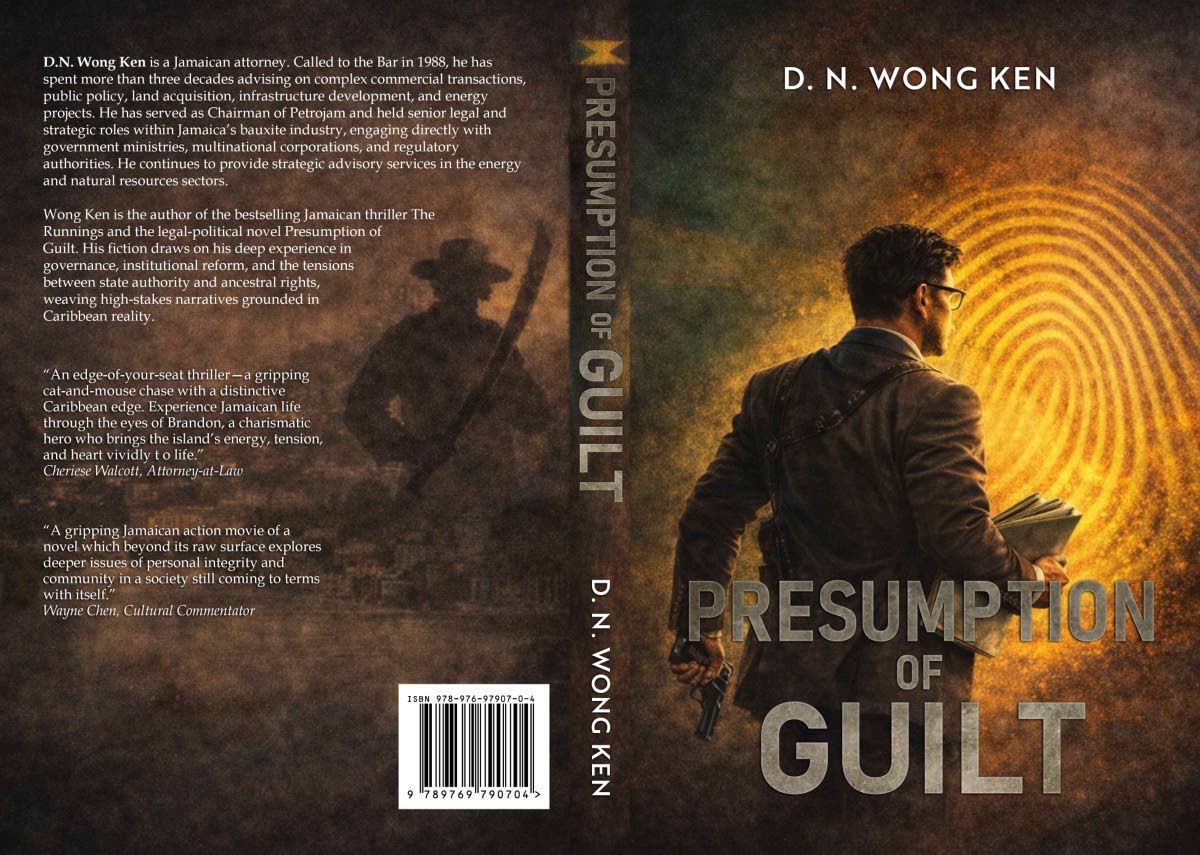 Cover of ‘Presumption of Guilt’ authored by attorney-at-law David Wong Ken.
-
 Wong Ken
Attorney, entrepreneur and author David Wong Ken is inviting readers into a world where justice, power and history collide in his latest legal thriller, Presumption of Guilt.
Rich in courtroom drama, political intrigue and suspense, the novel explores questions of guilt, accountability and conscience through a distinctly Jamaican lens. Drawing on the island’s legal traditions, Maroon heritage and democratic institutions, it challenges readers to look beyond assumptions and consider whether true justice can exist when power shapes the narrative.
Although only recently released, the book’s origins stretch back more than two decades.
“ Presumption of Guilt actually began more than 20 years ago,” Wong Ken said. “Around 2005, I found myself with three stories I felt compelled to tell. The Runnings was the first. Presumption of Guilt followed soon afterwards, and even then the central storyline was already there, a young man’s desperate struggle for survival converging with the eastern Maroons’ enduring quest for sovereignty,” he said.
Life, however, interrupted the creative process. The demands of legal practice, business ventures and personal challenges meant the manuscript remained unfinished for years.
“It wasn’t until those matters had largely been resolved that I found the mental space to return to the novel. Ironically, I believe the delay made it a better book. The story’s heart never changed, but I did. Time replaced anger with perspective, and the novel evolved from being a story about injustice into a more thoughtful exploration of justice, power and conscience,” he said.
The title immediately attracts attention, deliberately challenging one of the justice system’s most fundamental principles.
“In law, we speak of the presumption of innocence as one of the cornerstones of a fair society. Yet history repeatedly reminds us that individuals, communities and even nations are sometimes judged before they are heard,” he said.
The title reflects one of the novel’s central themes: assumptions replacing evidence, often with profound consequences. Wong Ken said several characters find themselves condemned long before the truth is fully understood, giving the title resonance on both legal and humanistic levels.
ROOTED IN JAMAICA
Unlike many legal thrillers that could unfold anywhere in the world, Presumption of Guilt is firmly rooted in Jamaica.
“Jamaica is not simply the setting, it is one of the principal characters,” Wong Ken said.
The novel draws heavily on the island’s legal traditions, democratic institutions, Maroon heritage and political history. While its themes of justice, state power and individual rights are universal, Wong Ken believes a Jamaican perspective offers readers something distinctive.
“I hope readers here recognise their own country, while readers overseas discover a Jamaica that extends well beyond the familiar stereotypes,” he said.
At the centre of the story is Junior, a young man whose life changes forever after he kills a police officer while protecting the mother of his child. Forced to flee, his struggle for survival becomes entwined with a much larger national conflict.
Readers are reunited with attorney Brandon Chong, first introduced in The Runnings, as he navigates legal, constitutional and political questions where traditional courtroom arguments alone cannot resolve competing claims of justice and history.
As Junior’s personal struggle converges with the eastern Maroons’ quest to preserve their sovereignty, the government faces constitutional and international dilemmas in which every decision carries consequences.
Wong Ken’s legal career lends authenticity to the novel’s courtroom scenes and legal arguments.
“Much of the legal framework comes from my own professional experience after more than three decades in practice,” he said, following his book launch last month.
The constitutional and historical dimensions required extensive research into Jamaican constitutional law, the history of the Maroons and international governance. Yet Wong Ken is quick to note that compelling fiction demands more than factual accuracy.
“The challenge is weaving those facts into a story where readers become invested in the characters rather than the legal arguments,” he said.
His professional experience also informed the novel’s blend of legal drama, political intrigue and suspense.
“As an attorney, I have seen that legal disputes are rarely confined to the courtroom. They often involve politics, economics, history and deeply personal human relationships. Rather than treating those elements separately, I wanted to reflect the reality that they are often inseparable,” he said.
One of the novel’s defining strengths is its morally complex characters.
“It was essential. Real life is rarely divided into heroes and villains,” he said.
His years in law have shown him that people often make poor decisions for understandable reasons, while institutions acting with good intentions can still produce unjust outcomes.
ISSUES OF JUSTICE
That moral ambiguity extends to the broader questions explored throughout the book. Rather than offering simple answers, Wong Ken invites readers to grapple with issues of justice, accountability and power.
Among them are whether justice can always be achieved through the law, how governments should balance national security with individual rights, and when the pursuit of justice itself becomes an abuse of power.
“If readers finish the novel still debating those questions. I will feel I have succeeded,” he said.
Surprisingly, Wong Ken said one of the greatest challenges was allowing the story to develop naturally. As the characters evolved, they led him in unexpected directions, raising new questions and deepening the narrative beyond his original vision.
He also sees Presumption of Guilt as part of a broader effort to strengthen Caribbean storytelling, particularly within the thriller and crime-fiction genres.
“The Caribbean has produced extraordinary literature, but comparatively few recurring thriller protagonists,” he said.
His ambition is for Brandon Chong to become one of those enduring Caribbean literary figures whom readers revisit again and again.
Through StoryMasters Limited, Wong Ken is also expanding his stories beyond traditional publishing. Plans are already under way for a radio adaptation of The Runnings, scheduled for broadcast later this year, while Presumption of Guilt will soon be available as an audiobook. Future ambitions include film and television adaptations.
“I’ve never set out simply to write legal thrillers. What interests me is how ordinary people respond when confronted by extraordinary power. The law provides the framework, but people provide the drama,” he said.
If Presumption of Guilt eventually reaches the screen, Wong Ken hopes audiences will experience more than Jamaica’s scenery.
“I would want audiences to experience Jamaica in all its complexity, not merely its scenery, but its history, institutions, humour, resilience and remarkable diversity,” he said.
Ultimately, however, his aim remains simple. Beyond the suspense, courtroom battles and political intrigue, he hopes readers leave with a deeper appreciation that justice is rarely straightforward, that power must always be held accountable and that compassion is often as important as the law itself.
keisha.hill@gleanerjm.com