One-year scorecard for Government - Political analyst, commentator note strong crime gains, persistent concerns over roads, accountability and execution
Loading article...
-
 Damion Gordon, political analyst
-
-
Political analyst Damion Gordon, and veteran journalist and political commentator Lloyd B. Smith have delivered mixed assessments of the Dr Andrew Holness-led administration’s first year in its unprecedented third consecutive term.
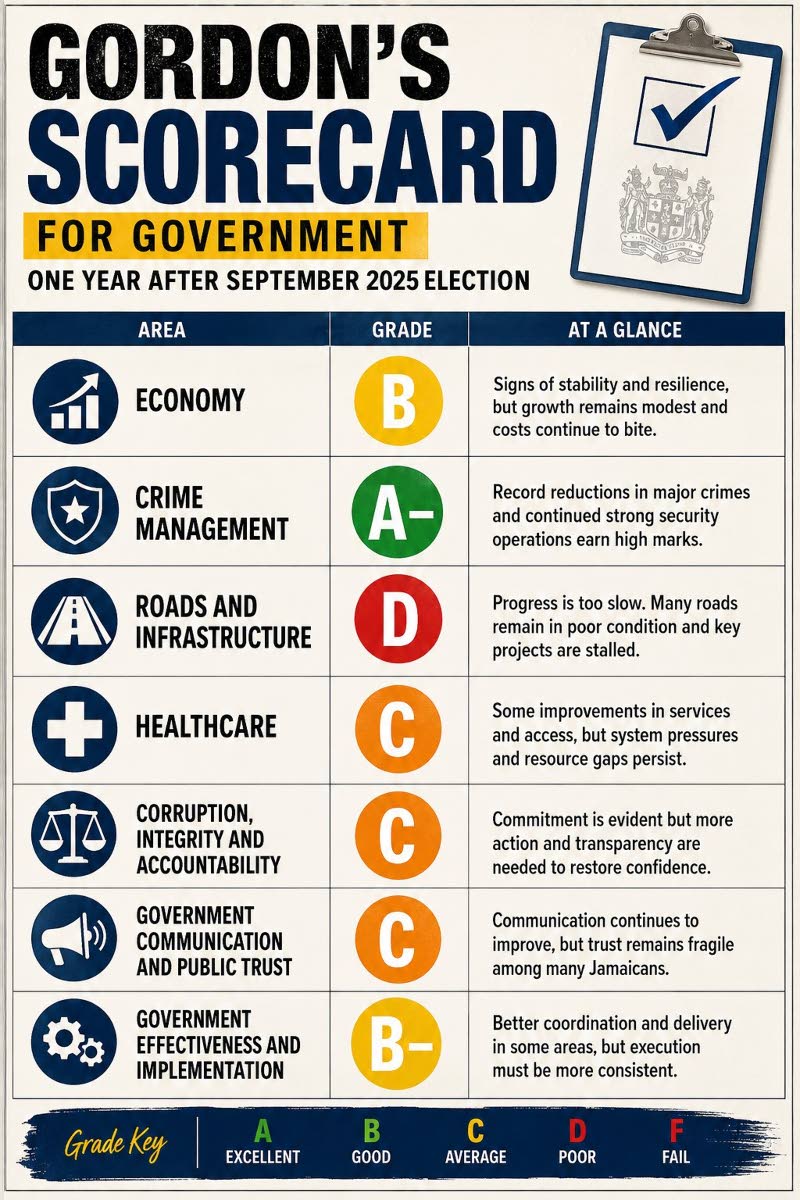
Gordon has given the Government high marks for its management of violent crime and relative fiscal stability, but faulted it for the deteriorating state of the nation’s roads, weaknesses in accountability and public communication, and the sluggish implementation of some major programmes.
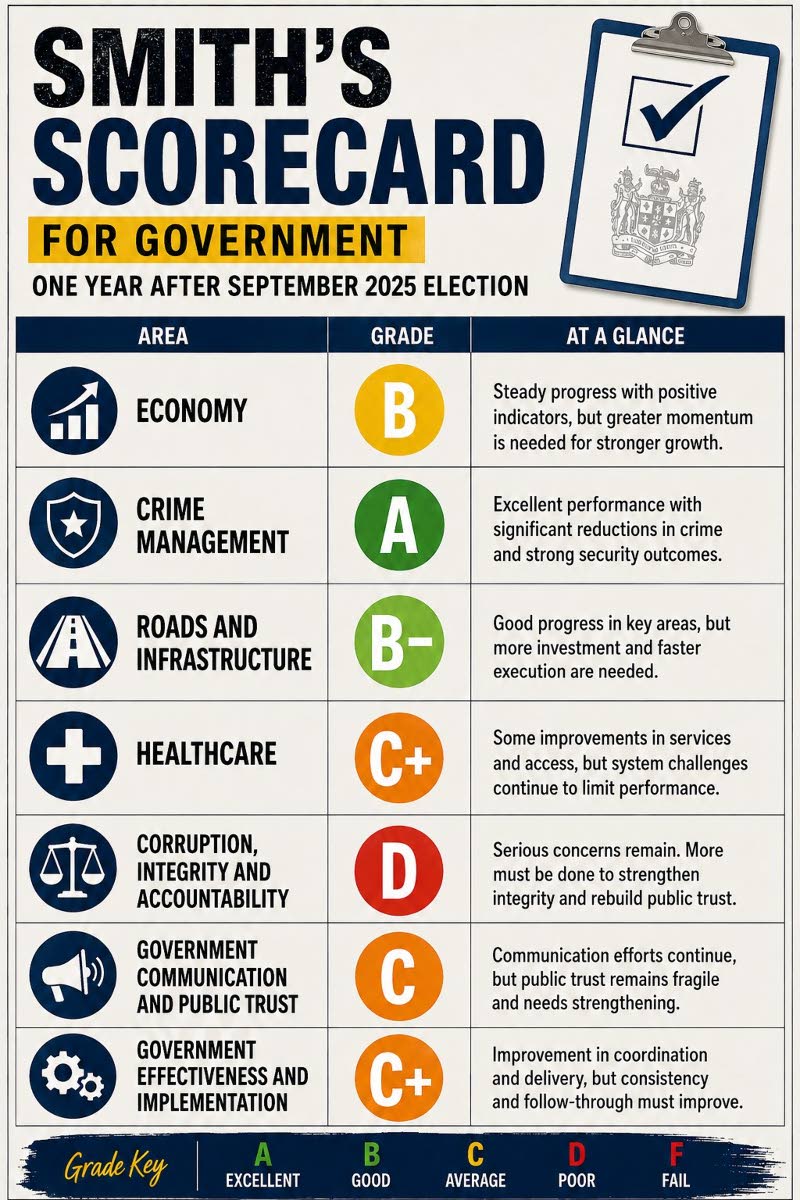
Smith, meanwhile, gave the administration an overall ‘B-’, crediting it for the continuing decline in murders, a relatively stable macro-economic environment, and a more responsive approach to public-sector issues and major pain points, while raising concerns about its handling of Hurricane Melissa, governance and the pace of reform.
the assessment
Gordon, who lectures government studies at The University of the West Indies, Mona, made the assessment as the administration marked one year since the September 3, 2025 general election, which returned the Jamaica Labour Party (JLP) to office and extended Holness’ tenure as prime minister.
His scorecard presents an administration that, while demonstrating considerable capacity to mobilise resources and respond to national challenges, continues to struggle to translate policy commitments into timely and tangible outcomes for citizens.
Gordon’s strongest assessment was reserved for crime management, which he graded ‘A-’.
“Crime management has been one of the Government’s strongest areas over the past year,” he said, pointing to the continued decline in murders to levels Jamaica has not experienced in decades.
He said the reduction in violent crime had also fostered a growing perception among Jamaicans that they were safer in their communities and daily lives.
However, Gordon cautioned that declining crime statistics, while significant, could not constitute the sole measure of success in the Government’s crime-fighting strategy.
He drew particular attention to an increase in fatal police shootings and several incidents that have prompted questions about the use of force, due process, and the treatment of citizens.
“We are a constitutional democracy, so the success of our crime strategy cannot be measured by crime figures alone,” he said.
more dismissive than reassuring
Gordon argued that the police must simultaneously demonstrate effectiveness, preserve public confidence, and operate within the constitutional safeguards governing citizens’ rights. He said the Government’s responses to concerns about police conduct had, at times, appeared “more dismissive than reassuring”.
Smith also credited the administration for the continuing decline in murders, which formed part of the basis for his overall ‘B-’ assessment.
On the economy, Gordon awarded a ‘B’, crediting the administration for maintaining a measure of fiscal stability despite the enormous disruption caused by Hurricane Melissa early in its new term.
He said the disaster inevitably redirected Government attention and resources towards relief, recovery and economic stabilisation, while constraining the fiscal space available for other programmes and projects.
He said, though, that the pace of recovery had fallen short of what many affected Jamaicans would have expected.
Of particular concern, Gordon said, was the auditor general’s finding that only 1.8 per cent of the $1.44 billion in cash donations received following Hurricane Melissa had been spent by February 23.
While acknowledging the Government’s explanation that much of the immediate assistance had been provided through in-kind donations, and that cash resources were being preserved largely for longer-term reconstruction, Gordon said the finding nevertheless raised legitimate questions about the speed with which available resources were being deployed while families remained displaced and communities struggled to recover.
Smith similarly said the administration’s first year was “hobbled by the ravages of Hurricane Melissa”, arguing that its response mechanisms had fallen short in many areas, and that the Government was now playing catch-up.
He was particularly critical of the National Reconstruction and Resilience Agency (NaRRA), which he said “at the outset has been primarily a PR stunt”, adding: “Where is the beef?”
Roads and infrastructure represented the administration’s weakest showing, earning a ‘D’.
Gordon said the condition of the country’s roads had evolved beyond an infrastructure concern into a serious quality-of-life issue, with consequences for motorists, businesses, farmers, pedestrians and the broader movement of people and goods.
execution remained inadequate
He acknowledged the substantial investment being made through the Social and Economic Recovery and Access to Infrastructure Programme (SPARK) and other road initiatives, but said the pace of execution remained inadequate.
“The concern, therefore, is not necessarily that the Government has failed to recognise the problem or allocate resources to it. It is that the improvements have not come quickly enough to match the scale and urgency of the deterioration that people are experiencing,” Gordon said.
Smith identified traffic management as another concern, while also pointing to the administration’s “continuing pussyfooting” on constitutional reform and the fight against corruption. He also cited land settlement, beach access and what he described as a seeming unwillingness to empower local government.
Healthcare received a ‘C’.
While Gordon recognised the Government’s investments in healthcare infrastructure, equipment and facilities, he argued that expenditure alone should not be the principal yardstick by which the sector is judged.
Instead, he said, greater weight must be placed on patients’ experiences, including waiting times, access to diagnostic services and medication, staffing levels, the condition of public facilities and the quality of care.
He pointed to the prolonged rehabilitation of Cornwall Regional Hospital as emblematic of the delays that have tempered his assessment.
On corruption, integrity and accountability, Gordon also awarded a ‘C’, citing Jamaica’s unchanged score of 44 out of 100 on the Corruption Perceptions Index and persistent public concerns surrounding nepotism, cronyism, political connections, appointments and the awarding of public contracts.
He also expressed concern about the tenor of some criticism directed at the Integrity Commission, arguing that independent oversight institutions should be strengthened rather than weakened when their findings prove uncomfortable for those in power.
Smith echoed concerns about governance, citing the fight against corruption among areas requiring greater attention.
Government communication and public trust likewise earned a ‘C’.
Gordon said the administration had, at times, been slow to respond to controversial matters, and that its eventual responses were not always sufficiently clear or consistent.
He was also critical of what he described as a tendency among some government representatives to respond defensively to legitimate scrutiny or to characterise criticism as politically motivated.
body-worn cameras
He cited the education minister’s controversial “school is not a runway” comment, as well as the national security minister’s responses to calls for greater use of body-worn cameras by police personnel and questions surrounding the proposed third-country national arrangement.
Smith said the Government must become “more proactive in dealing with governance”, arguing that there was “an underlying arrogance emanating from Jamaica House”, particularly in how it deals with civil society groups.
He said this was coupled with what he viewed as growing complacency, which he attributed primarily to a weak Opposition and a beleaguered media.
On overall Government effectiveness and implementation, Gordon awarded a ‘B-’.
He said the administration had demonstrated the capacity to formulate policy, mobilise resources and confront major national challenges, but maintained that implementation remained a persistent weakness.
“The weakness continues to be the pace at which some policies and projects are translated into results,” he said.
And, given the administration’s longevity, Gordon said it could no longer rely comfortably on the argument that longstanding weaknesses in the public sector were simply the result of actions taken before it came to office.
“At this stage, longstanding weaknesses in the public sector cannot always be treated as inherited problems,” he said.
Smith, meanwhile, pointed to the broader media and political environment as part of the challenge facing governance, saying the media was having to cope with “the onslaught of social media and a dwindling base which has seen a decline in fearless and assertive journalism”.
“Nowadays it is all about PR and bloggers,” he said.
Gordon’s assessment depicts an administration that has demonstrated resilience and capacity, particularly in managing crime and maintaining macroeconomic stability, but whose record is increasingly being measured against the speed and quality of delivery.
With more than a decade in office, the burden of proof, his scorecard suggests, has shifted. The question is no longer simply whether the Government is doing enough, but whether it is delivering results with the urgency, transparency and responsiveness Jamaicans have come to expect.
olivia.brown@gleanerjm.com