Demand outpacing recovery in tourism bounceback
Loading article...
-
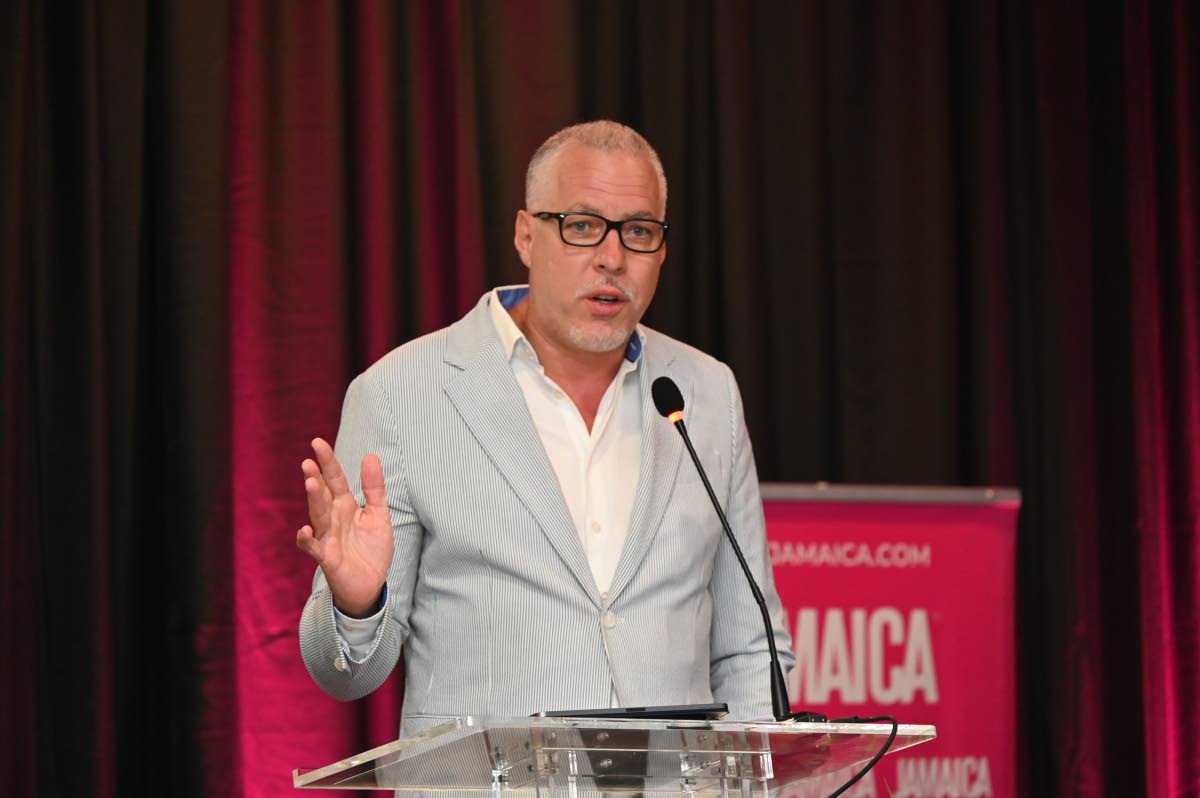 Deputy Director of Tourism for the Americas, Phillip Rose addressing delegates at the opening forum of the Jamaica Product Exchange in Ocho Rios, St Ann, on Monday.
-
 O’Brian Herron, president of the Jamaica Hotel & Tourist Associatio, speaking at the event.
WESTERN BUREAU:
Jamaica’s tourism industry is facing an unusual post-hurricane challenge: demand for the destination is running ahead of the country’s ability to accommodate it.
Eight months into the year, flights to the island are operating at an average 85 per cent load factor even though available airline seats have fallen 22 per cent year-on-year, yet approximately 30 per cent of the hotel room stock affected by Hurricane Melissa is still to return to service.
Still, tourism officials say the recovery is accelerating, with more than 11,000 rooms expected to return between 2026 and 2027.
The figures, revealed by Deputy Director of Tourism for the Americas Phillip Rose at Monday’s opening of the Jamaica Product Exchange (JAPEX) at Moon Palace Jamaica in Ocho Rios, paint a picture of an industry still constrained by the fallout from Melissa, but apparently not by waning appetite for the destination.
“Jamaica is in vogue. Jamaica is in demand. Jamaica is sexy, and the flights are full coming in,” Rose told tourism stakeholders, international buyers and media.
FULL FLIGHTS
Between January and August, Jamaica welcomed approximately 2.3 million visitors and generated US$2.5 billion in tourism revenue.
Passenger arrivals were down just under 20 per cent year-on-year, while available airline seats declined by 22 per cent. However, Rose said load factors increased 3.8 per cent to 85 per cent.
“The number that I want you to focus on is that load factor at 85 per cent,” he said. “That means that essentially the flights are full. You might be able to get a seat on a Tuesday or a Wednesday, but all the prime days are full.”
On the accommodation side, approximately 70 per cent of the hotel room stock affected by Melissa has returned to service, with thousands more rooms scheduled to come back during the final quarter of this year and early 2027.
Sandals South Coast is expected to reopen in November with 392 rooms, while more than 1,900 rooms are scheduled to return across several properties in December.
Another just under 3,500 rooms are expected during the first quarter of 2027, including several of western Jamaica’s major resorts.
“Overall, we have over 11,000 more rooms coming back on stream between 2026 and 2027,” Rose said. “That is a remarkable feat.”
WHAT COMES NEXT
But Jamaica Hotel and Tourist Association (JHTA) President O’Brian Heron said the industry’s response to Melissa must extend beyond restoring the tourism plant damaged by the hurricane.
“Resilience is not simply about recovering. It is truly about what comes next,” Heron told JAPEX delegates.
He said tourism businesses had rebuilt and reinvested while supporting employees, families and communities affected by the hurricane.
Heron argued that Jamaica is rebuilding at a time when tourism itself is undergoing rapid transformation.
“Tourism is changing, travellers are changing, technology is changing, and the way people discover, choose and experience destinations is also changing,” he said.
“The question for Jamaica is not whether change is coming. The question is how will we respond to it?”
Heron said Jamaica must remain competitive and embrace innovation while protecting the authenticity that distinguishes the destination, arguing that its people remain its greatest advantage.
Jamaica is already planning beyond the restoration of its existing tourism plant.
Rose disclosed that another 15,000 to 20,000 rooms are slated for construction over the next five to 10 years, alongside further development of the Rose Hall and North Coast tourism corridors.
The expansion is being contemplated as policymakers place increasing emphasis on tourism earnings rather than visitor numbers alone.
“We no longer celebrate just heads and beds. We no longer celebrate bums in seats,” Rose said. “We celebrate the revenue that’s generated.”
Heron said the benefits of tourism must also extend beyond hotels and attractions to the farmers, manufacturers, entertainers, transportation providers, entrepreneurs and thousands of Jamaican families who depend on the sector.
“When tourism succeeds, the benefits extend well beyond our hotels and well beyond our attractions,” he said.
For Jamaica, however, the immediate task is ensuring that the return of hotel rooms and airline capacity can keep pace with the demand tourism officials say is already there.
JAPEX is being staged by the JHTA in partnership with the Jamaica Tourist Board.
janet.silvera@gleanerjm.com