Jamaica positions itself for the future of clean shipping
Loading article...
-
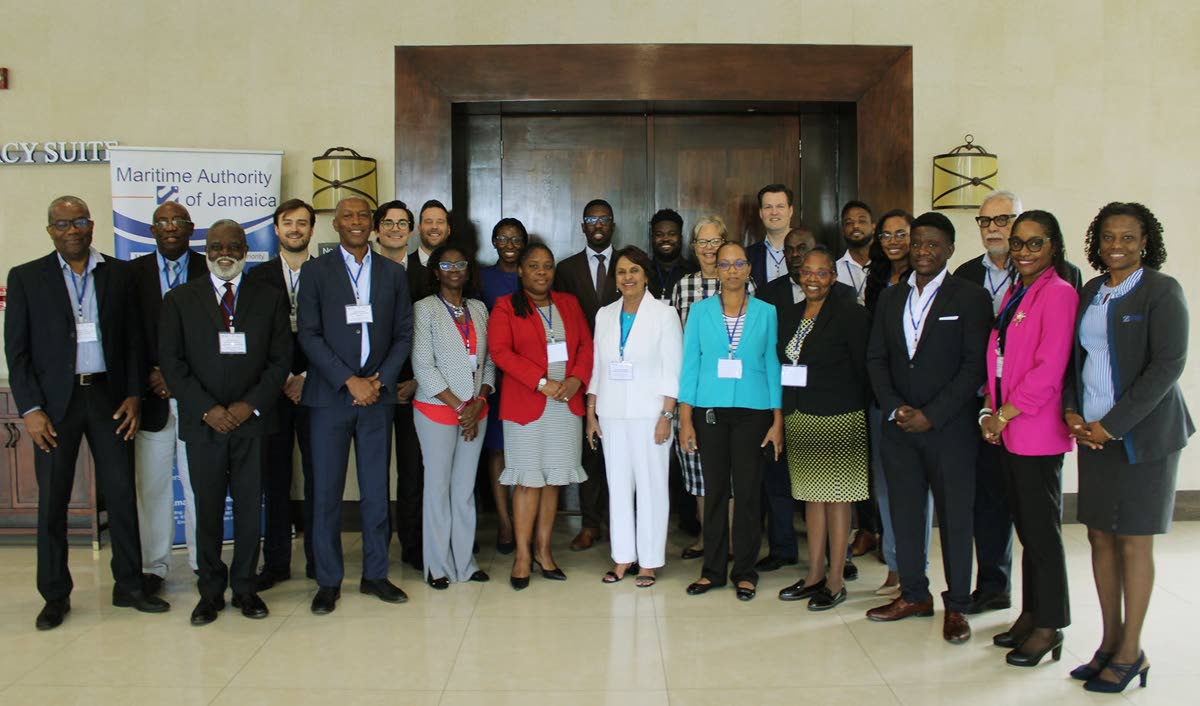 Participants at the National Stakeholder workshop.
-
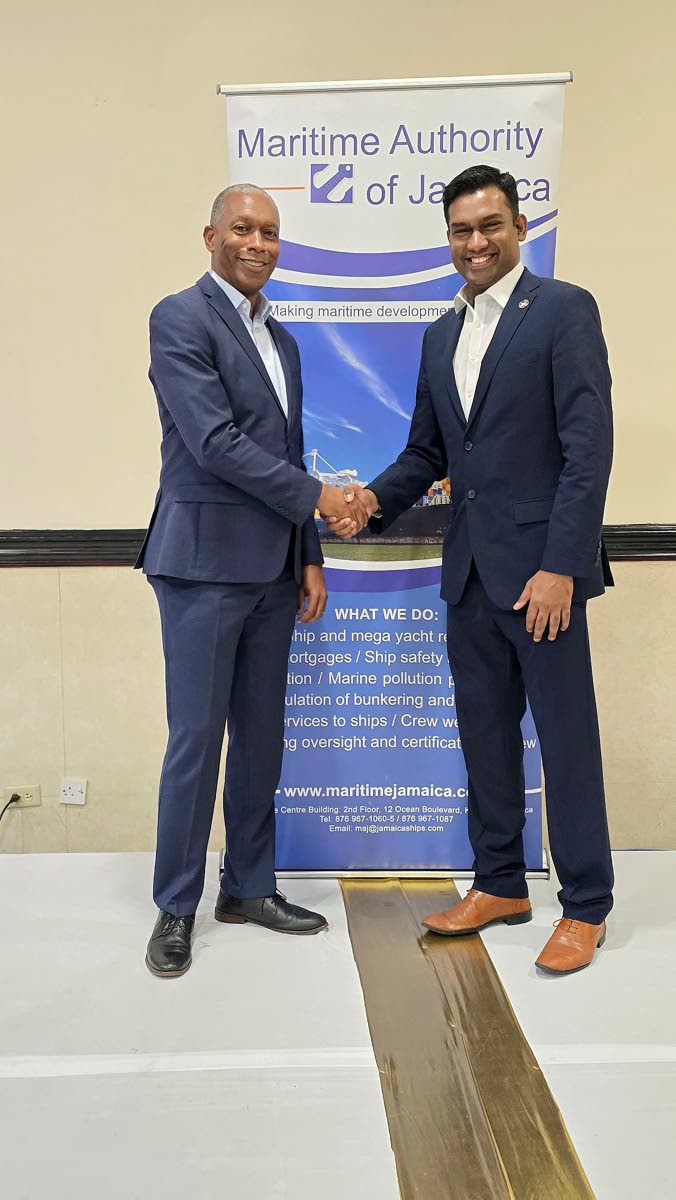 Bertrand Smith, director general, Maritime Authority of Jamaica (left) with Subaskar Sitsabeshan, project officer of the Green Voyage 2025 initiative of the International Maritime Organization’s Technical Cooperation and Implementation Division.
-
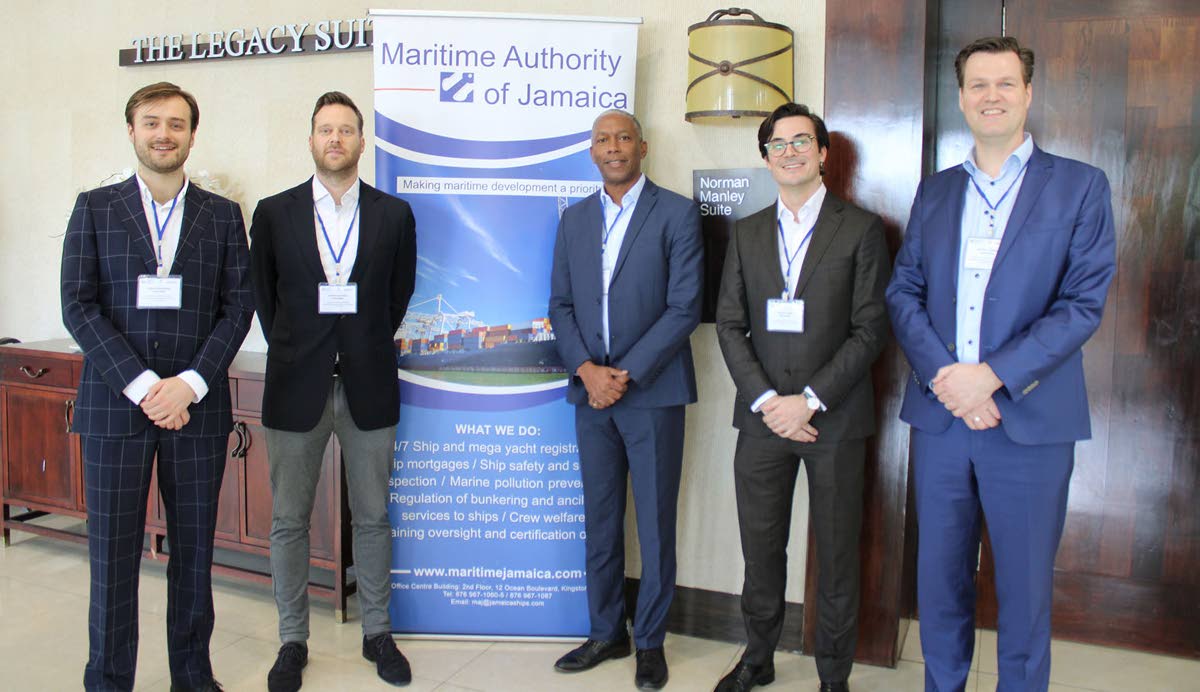 Bertrand Smith, director general, Maritime Authority of Jamaica (centre) with consultants from Haskoning (left to right) Michiel Nijboer, Patrick Walison, Reinout Perik and Jonas Hendriksen.
Global shipping is undergoing one of the most significant transformations in its history. As the industry moves steadily toward low- and zero-carbon energy, countries that depend on maritime trade face a critical question: Will they adapt quickly enough to remain competitive?
For Jamaica, the answer appears to be a deliberate and strategic yes.
The Maritime Authority of Jamaica (MAJ), in collaboration with the International Maritime Organization (IMO), recently convened a National Stakeholder Workshop to examine Jamaica’s potential role in the emerging market for alternative marine fuels. The session formed part of an IMO GreenVoyage2050-supported study exploring both the supply and demand dynamics of cleaner fuels as global shipping transitions away from traditional fossil fuels
The discussions were not theoretical. They were focused, technical and forward-looking — addressing infrastructure readiness, regulatory reform, investment priorities and market demand. In essence, the workshop asked a simple but critical question: How can Jamaica turn the global decarbonisation push into a national economic opportunity?
Director General of the Maritime Authority of Jamaica, Bertrand Smith, framed the moment as both practical and strategic. While international negotiations on the IMO Net Zero Framework have experienced pauses and adjustments, he noted that the broader shift toward decarbonisation is inevitable
Shipping lines are already investing in new vessel designs and alternative fuel technologies. Liquefied natural gas (LNG) has emerged as a transition fuel, while hydrogen-derived e-fuels, ammonia and methanol are moving rapidly from pilot concepts to commercial orders
The message is clear: the ships are changing, and ports must change with them.
Jamaica’s strategic advantages were central to the conversation. Situated along major east-west shipping lanes and supported by the depth and accessibility of Kingston Harbour, the island already plays a critical role in regional transshipment and bunkering activity. The objective now is to ensure that this geographic advantage translates into leadership in clean marine energy.
The country’s bunkering sector is already evolving. Five operators are active, including Shell LNG, and LNG bunkering volumes at Kingston and the outer anchorage continue to grow. Ship-to-ship bunkering activity at Portland Bight has also increased, reflecting steady market expansion.
This growth provides a foundation upon which alternative fuel capacity could be built. However, infrastructure alone will not secure Jamaica’s position. Policy and regulatory reform are equally critical. According to the Maritime Authority, work is advancing on a modern legal framework designed to support a sustainable and secure maritime transport system, including standards for safe and competitive bunkering
Legislation to strengthen this framework is expected to be passed this year, signalling that Jamaica intends to match ambition with governance.
The workshop itself reflected a whole-of-industry approach. Participants included representatives from the Ministry of Energy, Transport and Telecommunications, the Port Authority of Jamaica, Petrojam Limited, West Indies Petroleum, Kingston Freeport Terminal Limited, Caribbean Maritime University, Scott Bunkering Jamaica Limited, Environmental Solutions Limited and other regulators and stakeholders
International consultancy Haskoning facilitated plenary sessions and interactive discussions, supporting both the IMO and MAJ in delivering the study. The Alternative Marine Fuel Study is assessing Jamaica’s potential to produce and bunker biofuels, methanol, ammonia and hydrogen, with the aim of developing evidence-based recommendations and a practical implementation roadmap aligned with the IMO Greenhouse Gas Strategy. Beyond domestic implications, findings will contribute to a regional roundtable in Trinidad and Tobago, reinforcing the importance of coordinated Caribbean action.
For Jamaica, the stakes extend beyond environmental responsibility. Maritime services are a cornerstone of the national economy. As shipping lines adjust their fuel choices, ports that cannot accommodate new energy requirements risk losing traffic and investment. Conversely, those that move early could strengthen their competitive edge.
The global energy transition is often framed as a challenge. For Jamaica’s maritime sector, it may well prove to be an opportunity — one that builds on existing strengths in logistics, geography and maritime expertise.
The question is no longer whether shipping will decarbonise. It is whether Jamaica will be ready when the new generation of vessels arrives at its shores. Judging by the momentum now under way, the country intends to be more than ready.