Elizabeth Morgan | War – what is it good for?
Loading article...
-
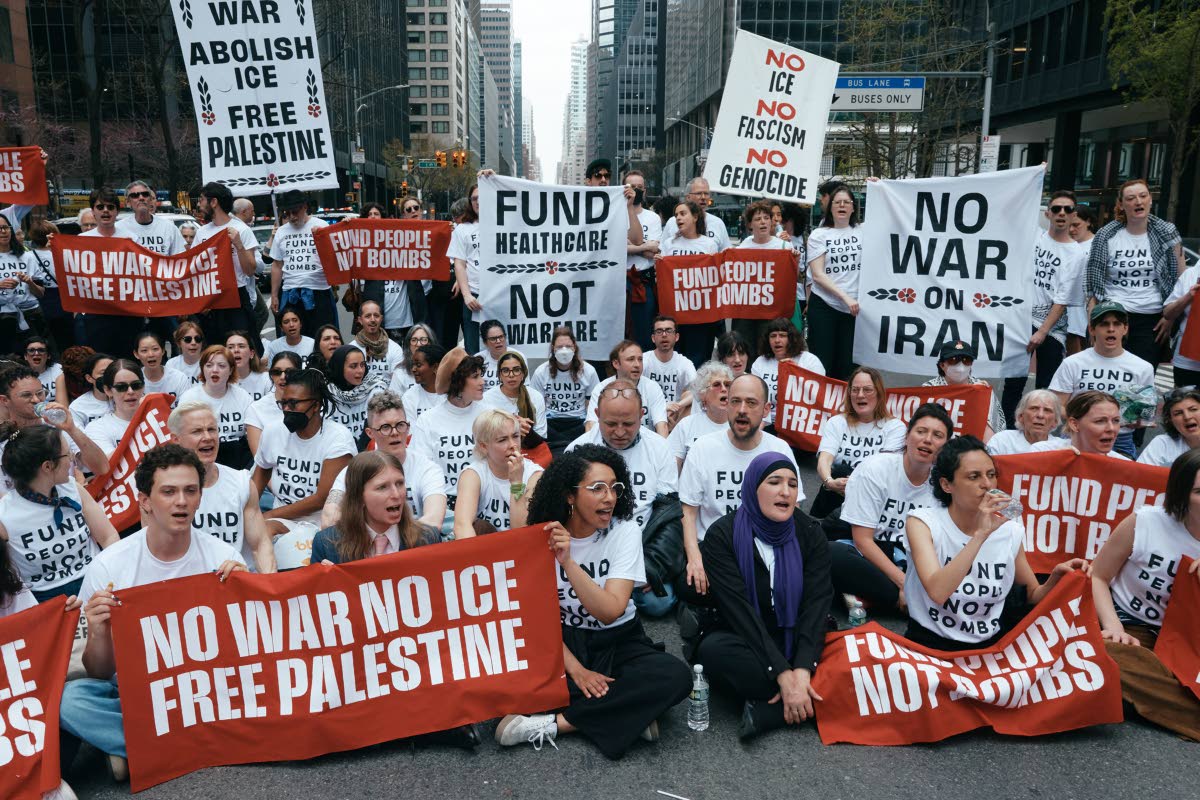 Chelsea Manning, bottom second left, and protesters with Jewish Voice for Peace block traffic during a demonstration outside the New York office of US Senator Chuck Schumer, calling for an end to the US-Israel war with Iran and opposing US weapons support, on Monday, April 13, 2026, in New York.
-
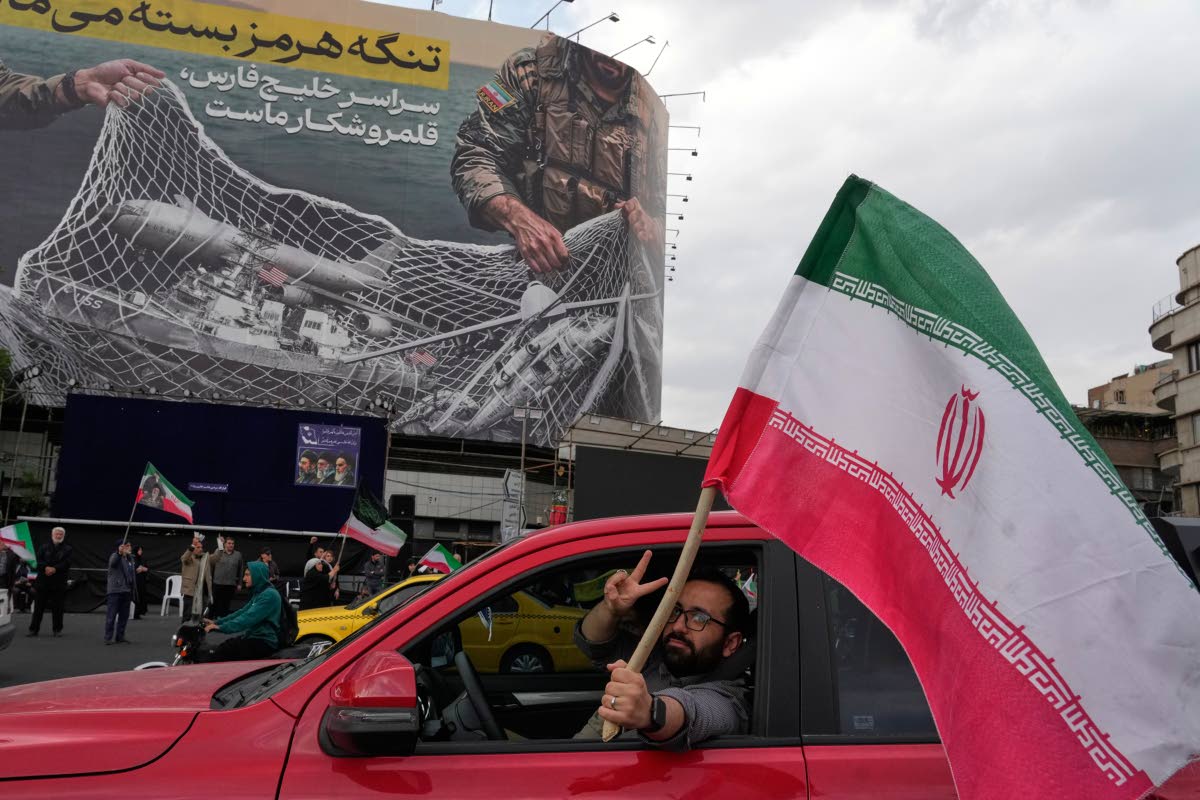 A man flashes a victory sign as he carries an Iranian flag in front of an anti-US billboard depicting the American aircrafts into the Iranian armed forces fishing net with signs that read in Farsi: “The Strait of Hormuz will remain closed. The entire Persian Gulf is our hunting ground,” at the Eqelab-e-Eslami, or Islamic Revolution Square in down town Tehran, Iran, on Monday, April 13, 2026.
Since January, it seems that the news has been full of war, military action, more than usual. We have had military activities continuing in Gaza, the West Bank, Lebanon, Syria, the Caribbean, Venezuela, and in Iran. While all this is happening, the Russia/Ukraine war is continuing as well as the brutal civil war in Sudan and the conflict in the Democratic Republic of Congo. There was a confrontation between Pakistan and Afghanistan. Threats of annexation and regime change seem to still be on the agenda. There are other long standing conflicts simmering in Africa, Asia, and Europe. Latin America has a couple of ongoing border conflicts, Venezuela/Guyana and Guatemala/Belize.
The Western Hemisphere has been relatively peaceful in terms of cross border, inter-state active military conflicts. What has impacted Latin America and the Caribbean has been criminal activity, gang wars, and political violence. Criminal activities have been scary enough and have seriously impacted the development of communities and countries. The worst case scenario in the Caribbean is Haiti. We have been fortunate not to experience the full blown wars.
In 80 years, we can say, although there have been regional wars, a global war and a nuclear war have been avoided, so far. An article in this column, in March, looked at the lucrative trade in arms and ammunition, especially the new weapons being unveiled.
CONTROVERSY
Recently, controversy has been sparked as Pope Leo XIV, head of the global Roman Catholic Church, has called for dialogue to achieve peace and end wars. He has pointed to the devastating impact of wars on civilians, particularly the most vulnerable, women, children, the elderly, and the sick. This is the role of a Christian religious leader, who is following the teachings of Jesus Christ, the Prince of Peace. Jesus was not a messiah who came to lead armies into wars of liberation or conquest. He sought to disarm through peace and love.
We are still today talking about armies of conquest from hundreds of years ago which subjugated peoples and committed genocide, eliminating or diminishing civilizations in the Western Hemisphere.
THE COST OF WAR
Thinking about wars led to a review of some of the many wars fought in history and some of the poems written about them. Robert Southey, in “ After Blenheim”, was recalling the 1704 Battle of Blenheim in Europe and noting the thousands of men, usually young men, who were killed, stating sarcastically that though everybody said ‘t’was a famous victory’, nobody was really very clear about ‘ ... what they fought each other for’.
In the US Civil War, 1861-1865, though it later became clear that the objective was to end slavery, the death toll and destruction were immense. As many as 850,000 men, fighting for both sides, died in this long and bloody conflict. The civilian death toll is unknown. Recall that President Abraham Lincoln was assassinated in 1865 and, thus, was a casualty of this war. Its legacy is still felt in the US today. For the Southern whites, it remains their mythical “lost cause”.
World War 1, 1914-1918, was a complicated world war. It took time to unravel why they actually fought each other. This war claimed the lives of 15-22 million people, soldiers and civilians, and resulted in millions of displaced people. Recall that many men from the British West Indies served and died in this war. Eight million horses, donkeys and mules were killed. Infrastructure damage was immense. The cost of WWI was estimated at well over US$ 180 billion. The British poet, a war veteran, Wilfred Owen, in “ Dulce et decorum est”, recalls the horrors of that war and states that it is an old lie that “It is sweet and glorious to die for one’s country”.
World War II, 1939-1945, is described as the deadliest conflict in human history. Over 85 million people were killed worldwide and over 60 million were displaced. The total financial cost exceeded US$4 trillion. Continental Europe was in ruins. The environment suffered. Remember too that the first atomic bombs were used by the USA in Japan with devastating effect. This war might possibly be assessed as a ‘just war’ from the point of view of the allied forces.
The title of this article is taken from a popular song during the Vietnam War, 1965-1975. It is estimated that over 58,000 Americans, two million Vietnamese civilians, over one million North Vietnamese soldiers, and upwards of 200,000 South Vietnamese soldiers were killed in this war. It cost the USA about $176 billion. This was a war that the USA did not win. Edwin Starr’s “ War” was an anti- Vietnam protest song. It poses the question, ‘War, what is it good for?’ and gives the answer, “absolutely nothin’”. That was the feeling of many American soldiers drafted to fight there. Recall that Donald Trump was not one of them.
In the Afghanistan War, 2001-2021, over 241,000 people died, including 3,500 NATO soldiers. It cost the USA $2.3 trillion. This war is also not assessed as a success for the US and NATO allies, as the Taliban is back in power there.
For this current Iran war, the death toll, so far, is given by human rights agencies as about 3,600 and it is estimated that the USA is spending about $1 billion per day. The US national debt is $39 trillion, increasing by $1 trillion each quarter. The US debt could be 137 per cent of its GDP, a significant portion held by foreign investors. How does the US afford this war?
Recall too that the data for these wars do not include those who were injured, maimed and suffered mental disorders. War comes with a very heavy price tag on all fronts, for all countries, even when it is deemed that problems were resolved. Some never are.
SEEKING PEACE
Therefore, this column supports Pope Leo XIV’s call to seek peace through dialogue, to look for other non-violent options to resolve conflicts. War should always be a last resort. The United Nations was established for this purpose, if allowed to work. This is particularly important for small states. Some of those who support wars, especially unjustified wars, are distant spectators, or usually are not the ones sending their children and grandchildren to fight in them.
Elizabeth Morgan is a specialist in international trade policy and international politics. Send feedback to columns@gleanerjm.com.