Adekeye Adebajo | Who will save Cuba from Trump?
Loading article...
-
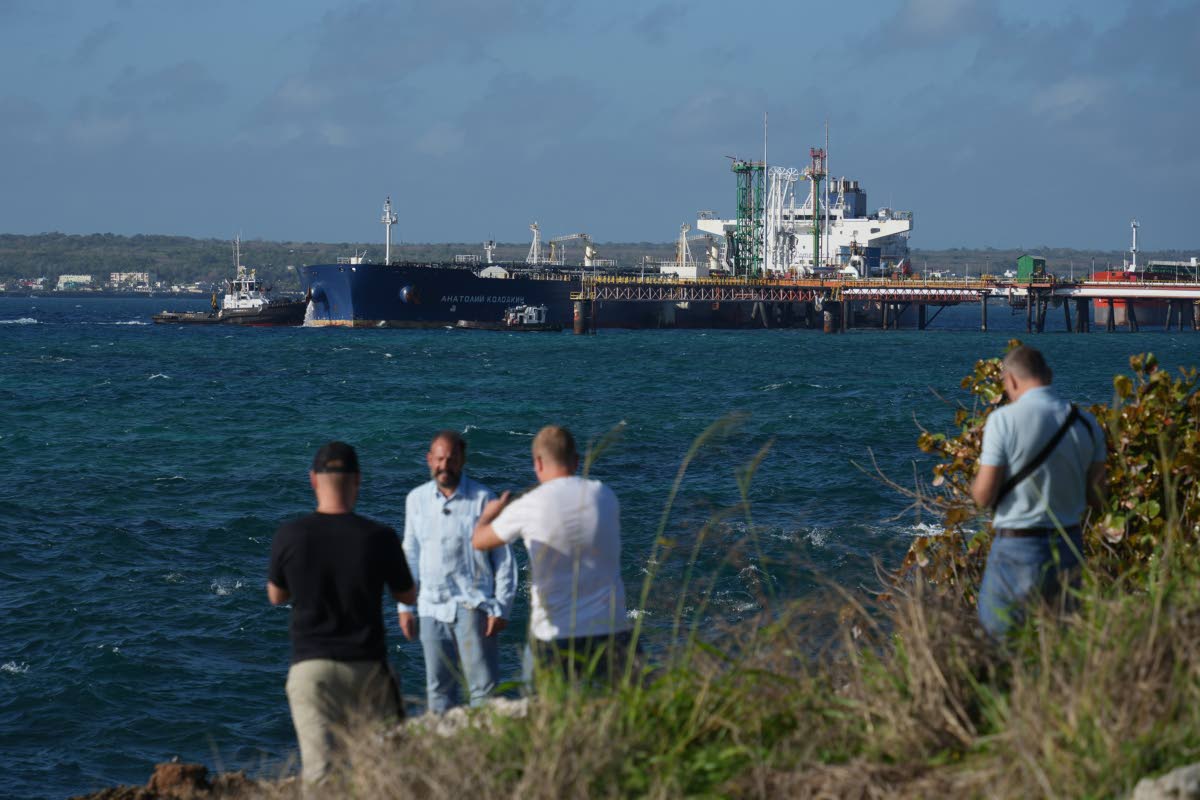 Journalists do a standup in front of the Russian-flagged oil tanker Anatoly Kolodkin docked in Matanzas, Cuba.
-
 Adekeye Adebajo
Cuba is currently under an oil blockade imposed by a Donald Trump administration bent on “regime change”. This follows a US blockade enforced since 1959 against the former Communist enclave, following the charismatic Fidel Castro’s popular revolution.
The Soviet Union helped Havana to survive economically until its own disintegration in 1991. Given Cuba’s formidable contributions to Southern Africa’s liberation, as well as to strengthening healthcare across the Caribbean through its export of equipment and able doctors, it is tragic that no one is coming to Havana’s rescue in its moment of need.
Apartheid’s leaders sought to reduce Southern Africa to a region of “broken-back” states through devastating military attacks. In 1988, Cuban troops in Angola shattered the myth of white military invincibility by forcing the apartheid army into retreat at the famous battle of Cuito Cuanavale, helping to hasten the withdrawal of foreign troops from Angola, the independence of Namibia, and the end of apartheid in South Africa.
CUBA’S COLLAPSE
The fall of the Soviet Union caused Cuba’s Gross Domestic Product (GDP) to fall 35 per cent in three years, and this slide has continued in this island nation of 10 million inhabitants, with a 3 million-strong diaspora in Florida, Spain, and Mexico. America’s kidnapping of Venezuelan president, Nicolás Maduro, in January, on trumped up drug charges to face trial in New York, cut off Cuba’s main source of oil.
Trump’s subsequent oil blockade of Cuba – continuing his acts of international piracy in illegally blowing up boats in the Caribbean Sea to pressure the Maduro regime – and threats of tariffs against countries supplying oil to Havana, resulted in Mexico also halting oil flows to Cuba, and only a Russian tanker has recently been allowed through the American blockade.
Though the Cuban government of Miguel Díaz-Canel has loosened restrictions on private ownership of businesses and allowed Cuban exiles and others to invest in the economy, agriculture, mining, manufacturing, sugar exports, infrastructure, and the island’s power grid have all collapsed. This has resulted in agriculture falling from 52 per cent of Cuba’s exports in 2000 to 15 per cent in 2025 and 18-hour rolling blackouts. Public transport has been massively reduced, universities and schools closed, and this collapse has triggered an exodus of an estimated 20pre cent of the population (over one million people), among whom are the island’s most productive people.
By 2025, infant mortality had doubled in seven years. The fall of Cuba’s currency - the peso - means an average monthly salary can now only buy a dozen eggs. Tourism - mainly from the US, Canada, and Mexico - which was traditionally the main source of revenues, has dried up due to a lack of fuel for flights, as well as frequent power cuts, and political uncertainty. The country defaulted on its external debt in 2019, while Cuba’s fiscal deficit rose from 3.1 per cent of GDP between 2010 and 2015 to reach 17.7 per cent by 2020, before coming down to 11.5 per cent in 2023.
As the government in Havana started printing money, hyperinflation predictably set in. Once world-class health facilities have crumbled, with medical workers struggling to reach hospitals, and many critical surgeries having to be shelved. Even amid a trickle of foreign investment, production has been suspended by Sherritt, the Canadian nickel exporter. Further exacerbating matters, the shadowy military-industrial oligarchy, Grupo de Administración Empresarial S. A. (GAESA), which dominates the economy (controlling banks, hotels, and stores), has created much resentment among Cuba’s struggling population.
The island has 20,000 doctors working across the globe, from which the government earns valuable hard currency. Under US pressure, these doctors have been expelled from Venezuela, with Washington pressuring 15 other countries to throw out Cuban doctors. Italy and Qatar have resisted, while Jamaica, Guatemala, and Honduras have caved in.
US POLICY: FROM TRUMP TO OBAMA
After an inhumane 67-year American blockade of Cuba, US president, Barack Obama’s opening to the country in 2014-2016 sensibly promoted re-establishing diplomatic ties, attracting foreign investment, boosting tourism, and loosening economic and political restrictions. He thus sought to advance gradualist popular reforms that could eventually result in a functioning rules-based democracy. Obama also lifted some trade restrictions, but his efforts to remove America’s punishing 55-year blockade of the island was thwarted by the Republican-controlled US Congress.
President Trump and his opportunistic Cuban-American Secretary of State, Marco Rubio (who has led negotiations with Havana) have – as in Venezuela – remained largely silent about restoring democracy to Cuba though Rubio has called for new leadership. As Trump noted in March: “I do believe I will be having the honour of taking Cuba.” If protests erupt on the island as a result of political repression and economic hardships, an American military intervention is likely if Havana violently clamps down on dissent. Any mass exodus of Cubans would head towards the US and Mexico.
The current US president may also have his own self-serving interest in advocating “regime change” in Cuba. The Trump Organization registered a trademark in Havana in 2008 for hotels, casinos, and golf courses, and dispatched its officials to identify possible locations in 2013. The powerful Cuban-American voting bloc will also be critical for Republicans in mid-term elections in November, in which Trump’s party is in danger of losing both the House and the Senate. Two US Democratic lawmakers – Pramila Jayapal and Jonathan Jackson – who visited Havana this month, condemned the “cruel collective punishment” to which the Trump administration has subjected Cuba’s population. The UN and the global South have also condemned this brutal blockade.
While there is no doubt that Cuba needs economic reforms and a democratic transition (over 1,000 political prisoners remain in jail), a Trump-led regime change will likely mainly benefit American corporations and some of the military-dominated domestic firms centred around the Castro family. State workers, pensioners, and most households in Cuba will continue to struggle to eke out a living. Who will save Cuba – which has shed so much blood for Southern Africa’s liberation – from Trump’s belligerence?
Professor Adekeye Adebajo is a senior research fellow at the University of Pretoria’s Centre for the Advancement of Scholarship in South Africa. Send feedback to columns@gleanerjm.com.